
 Account
Categories

0 "Shadows in the Ivy: The Unsolved Mystery of Suzanne Jovin's Murder"
A Promising Life Cut ShortSuzanne Jovin, a 21-year-old Yale University senior, was a vibrant and accomplished student known for her academic excellence and community involvement. Born in Göttingen, West Germany, to scientists at the Max Planck Institute, she was fluent in multiple languages and had a passion for international studies. At Yale, she majored in political science and international studies, co-founded the German Club, sang in the Bach Society Orchestra, and volunteered with the Best Buddies program, which pairs students with individuals with intellectual and developmental disabilities. Her senior thesis focused on the emerging threat of Osama bin Laden, demonstrating her keen interest in global security issues. The Night of the MurderOn December 4, 1998, Suzanne spent the evening organizing a pizza party for Best Buddies at Trinity Lutheran Church. After the event, she returned a borrowed Yale station wagon around 8:45 p.m. and walked to her apartment. At 9:02 p.m., she emailed a friend, mentioning plans to retrieve GRE study materials from an unnamed person. Around 9:25 p.m., she was seen by a fellow student, Peter Stein, who noted she appeared tired and was looking forward to sleep. Approximately 30 minutes later, her body was discovered nearly two miles away, near the corner of Edgehill and East Rock Roads. She had been stabbed 17 times in the back of the head and neck, and her throat was slit. Despite the brutality, her personal belongings were untouched, suggesting the motive was not robbery. The Investigation BeginsThe initial investigation focused on James Van de Velde, Suzanne's thesis advisor, due to their academic relationship and his presence on campus that evening. Despite no physical evidence linking him to the crime, he was publicly named a suspect, leading to significant personal and professional repercussions. Van de Velde was eventually cleared, and in 2013, he settled a defamation lawsuit against Yale and the city of New Haven. Key Evidence and LeadsSeveral pieces of evidence were collected: A broken knife tip was found lodged in Suzanne's skull. DNA was recovered from under her fingernails, but initial testing was delayed, and later results indicated contamination from a lab technician. A Fresca bottle with Suzanne's fingerprints and an unknown partial palm print was found near the crime scene. Witnesses reported: Hearing a woman scream, "I can't believe you're doing this!" around the time of the murder. Seeing a man in a green jacket running from the area. Observing a tan or brown van parked near the crime scene. The Unidentified "Someone"In her final email, Suzanne mentioned retrieving GRE materials from "someone" who had borrowed them. This individual has never been identified, and it's unclear if she met with them that night. Investigators have considered this person a potential lead, but no further information has surfaced. The Cold Case Unit's EffortsIn 2006, the case was assigned to Connecticut's Cold Case Unit, comprising retired state police detectives. They reviewed existing evidence and sought new leads, including re-examining witness statements and forensic evidence. Despite these efforts, the case remains unsolved. Community Involvement and Ongoing HopeThe New Haven community and Yale alumni have continued to seek justice for Suzanne. Memorials and tributes have been held, and a combined reward of $150,000 is offered for information leading to an arrest and conviction. Authorities encourage anyone with information, no matter how trivial it may seem, to come forward. Conclusion Over two decades have passed since Suzanne Jovin's tragic death, yet her case remains a poignant reminder of a life full of promise cut short. The persistent efforts of investigators, combined with community support, keep hope alive that one day, justice will be served.

0 The Long Road Home: The Grateful Doe, Jason Callahan, and the Power of Collective Memory
The Mysterious Crash in EmporiaOn June 26, 1995, a fatal car accident occurred on U.S. Route 58 near Emporia, Virginia. A Volkswagen Vanagon veered off the road and crashed into trees, killing both occupants. The driver was identified as 21-year-old Michael Hager, a University of South Carolina student. The passenger, however, had no identification, and his identity remained unknown for two decades. Clues at the SceneThe unidentified passenger was found with two Grateful Dead concert ticket stubs dated June 24 and 25, 1995, a dollar in quarters, a yellow Bic lighter, and a note addressed to "Jason" signed by "Caroline T. & Caroline O." The note included a phone number without an area code and a small drawing, possibly of Jerry Garcia. These items led investigators to nickname the unknown man "Grateful Doe." Physical Description and Initial InvestigationsThe young man was estimated to be between 15 and 21 years old, with long curly brown or dark blond hair dyed reddish, brown eyes, and a tattoo of a star on his upper-left arm. He wore a red tie-dyed Grateful Dead T-shirt, Levi's jeans, white socks, and black Fila running shoes. Despite efforts, including fingerprint analysis and facial reconstructions, authorities could not identify him. The Role of Internet SleuthsIn 2012, a Facebook page dedicated to identifying "Grateful Doe" was created, and by 2015, it had garnered significant attention. Reddit users also became involved, sharing information and theories. In early 2015, photographs of a young man named Jason, a known Grateful Dead fan who had been missing since 1995, surfaced. These images bore a strong resemblance to the facial reconstructions of "Grateful Doe." Identification of Jason CallahanIn January 2015, Margaretta Evans reported her son, Jason Patrick Callahan, missing. He had left home in Myrtle Beach, South Carolina, in June 1995 to follow the Grateful Dead and had not been heard from since. DNA testing confirmed that "Grateful Doe" was indeed Jason Callahan. Reflections on a Tragic JourneyJason's story highlights the challenges faced by families of missing persons, especially those who lead nomadic lifestyles. His mother had attempted to report him missing earlier but was uncertain about the appropriate jurisdiction. The case also underscores the impact of community efforts in solving cold cases, demonstrating how collective memory and determination can bring closure to long-standing mysteries. Legacy and Lessons The identification of Jason Callahan serves as a poignant reminder of the importance of reporting missing persons, regardless of their lifestyle choices. It also showcases the power of internet communities in aiding investigations and the enduring human desire to seek answers and honor the memories of those lost.
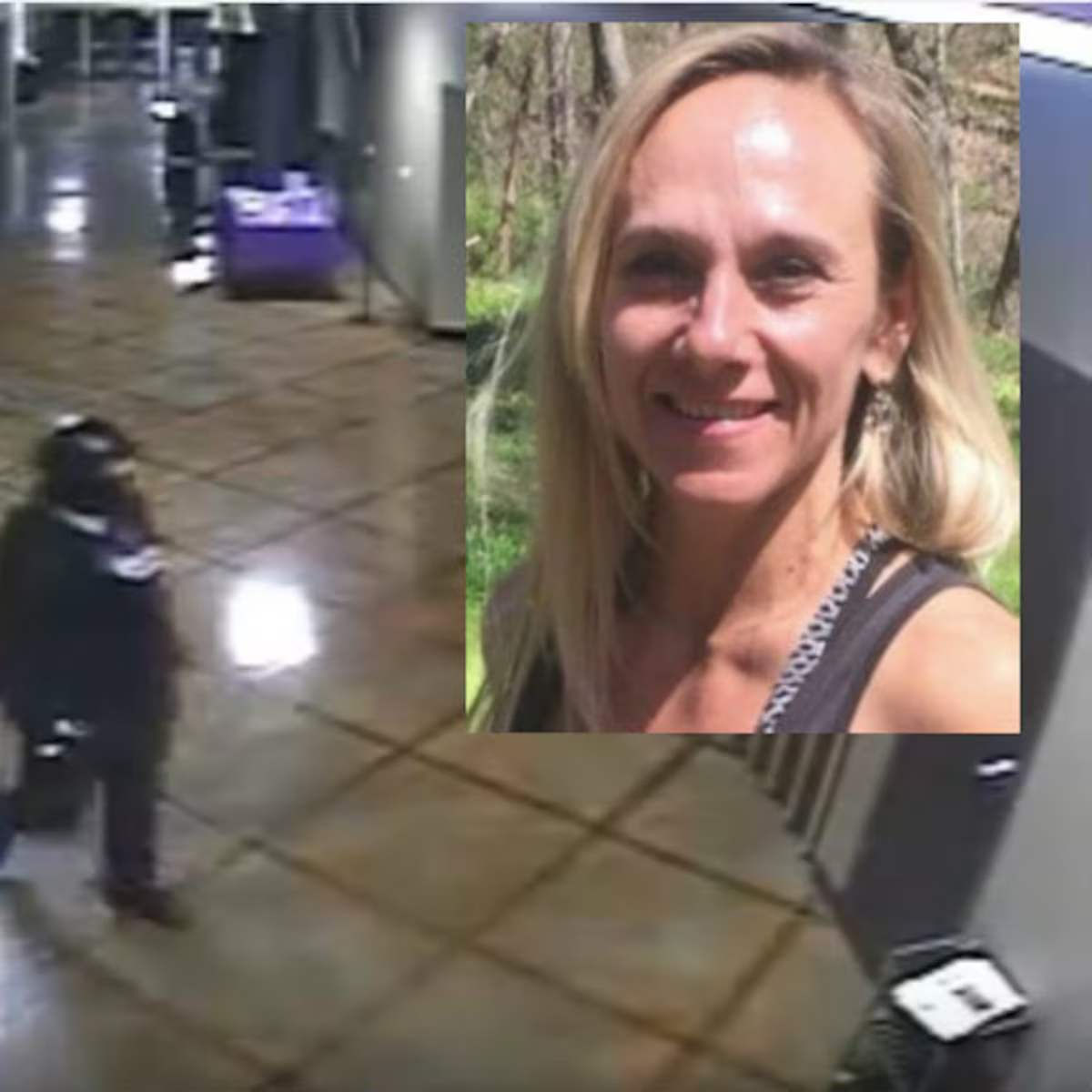
0 Shadows in the Sanctuary: The Unsolved Murder of Missy Bevers
The Morning That Changed EverythingOn April 18, 2016, Terri Leann “Missy” Bevers, a 45-year-old fitness instructor and mother of three, arrived at Creekside Church of Christ in Midlothian, Texas, to prepare for her early morning Camp Gladiator boot camp class. Due to inclement weather, she had moved the class indoors. Shortly after 5 a.m., her students discovered her lifeless body inside the church. She had suffered multiple puncture wounds to her head and chest, injuries consistent with tools carried by the assailant. The Chilling Surveillance FootageInvestigators quickly turned to the church's internal surveillance system. The footage revealed a figure clad in SWAT-like tactical gear, including a helmet, gloves, and a vest labeled "POLICE," roaming the church hallways with a hammer. The suspect's gait was distinctive, characterized by a limp or abnormal stride, leading to speculation about their physical condition or possible disguise. Initial Theories and Shifting MotivesAt first, authorities considered the possibility of a burglary gone wrong, as the suspect appeared to be vandalizing the church. However, nothing was stolen, and Bevers' personal belongings were left untouched. This led investigators to believe that the attack was targeted and premeditated, with the suspect possibly attempting to stage the scene to mislead law enforcement. Digital Clues and Online InteractionsSearch warrants revealed that Bevers had received "creepy and strange" messages from an unknown male on LinkedIn in the months leading up to her death. One individual admitted to engaging in flirtatious conversations with her but was not deemed a suspect. Investigators also explored the possibility that the suspect had been monitoring Bevers' schedule through her online postings, as she frequently shared class details on social media. Family Members Under ScrutinyBevers' husband, Brandon, and father-in-law, Randy, were both investigated. Brandon was on a fishing trip in Mississippi at the time of the murder, and Randy was traveling in California. Suspicion arose when Randy brought a blood-stained shirt to a dry cleaner four days after the murder. He claimed the blood was from a dog fight, and forensic analysis confirmed the blood was canine, not human. The Mysterious VehicleSurveillance footage from a nearby business captured a 2010-2012 Nissan Altima or Infiniti G37 driving around the area in the early hours before the murder. The vehicle's driver exhibited unusual behavior, such as turning headlights on and off and parking briefly before leaving. Despite public appeals, the driver has never been identified, and their connection to the case remains uncertain. Community Efforts and Ongoing InvestigationThe Midlothian Police Department has received over 3,000 tips since the murder, with a dedicated detective and a part-time investigator focusing solely on the case. Community members, including friends of Bevers, have launched the "True Crime Broads" podcast to keep the case in the public eye and encourage new leads. Annual vigils are held in her memory, reinforcing the community's commitment to finding justice. The Lingering MysteryDespite extensive investigation, the identity of Missy Bevers' killer remains unknown. The case continues to haunt the Midlothian community, with many hoping that advances in technology or a crucial tip will eventually lead to a breakthrough. The haunting image of the suspect in tactical gear serves as a grim reminder of the unresolved tragedy.Conclusion The murder of Missy Bevers stands as one of the most perplexing unsolved cases in recent history. With a wealth of evidence yet no definitive answers, the pursuit of justice continues. The dedication of law enforcement and the community alike keeps hope alive that one day, the truth will emerge, and Missy's family will find the closure they deserve.

0 Unraveling the Tragedy: The Unsolved Mystery of Faith Hedgepeth's Murder
A Promising Life Cut ShortFaith Danielle Hedgepeth, a 19-year-old sophomore at the University of North Carolina at Chapel Hill, was a beacon of hope and ambition. As a member of the Haliwa-Saponi Native American tribe, she aspired to become a pediatrician and return to serve her community. Her academic excellence earned her a Gates Millennium Scholarship, and she was actively involved in campus life, including pursuing membership in the Alpha Pi Omega sorority. The Night of the TragedyOn the evening of September 6, 2012, Faith attended a sorority event before heading to the Davis Library with her roommate, Karena Rosario, to study. Later that night, they visited The Thrill, a local nightclub, leaving around 2:06 a.m. By 3 a.m., they returned to their apartment. Rosario left the apartment at 4:25 a.m., believing Faith was asleep. When Rosario returned later that morning with a friend, they discovered Faith's lifeless body in her bedroom. The Crime Scene and Initial InvestigationFaith was found partially nude, wrapped in a quilt, and had suffered blunt force trauma to the head. An empty rum bottle, believed to be the murder weapon, was found at the scene. A note scrawled on a fast-food bag read, "I'm not stupid bitch jealous." DNA evidence, including semen, was collected, but initial suspects, including Rosario's ex-boyfriend, were ruled out. Years of UncertaintyDespite the evidence, the case remained unsolved for nearly a decade. Investigators released a composite image based on DNA phenotyping, suggesting the suspect was of mixed Native American and European ancestry. A voicemail, possibly accidentally recorded by Faith, captured a conversation with unidentified individuals, but its relevance was debated. A Break in the CaseIn September 2021, Miguel Enrique Salguero-Olivares was arrested and charged with first-degree murder after his DNA matched evidence from the crime scene. He had not been a suspect initially but was identified through DNA samples after a separate arrest. Court documents revealed that his palm print matched one found on the murder weapon. Ongoing Legal ProceedingsAs of early 2025, Salguero-Olivares faces additional charges, including first-degree burglary, rape, and sexual offense. Both prosecution and defense have indicated readiness to proceed to trial, but a date has yet to be scheduled. The prolonged legal process has been a source of frustration for Faith's family and the community. Remembering Faith Faith Hedgepeth's legacy endures through the memories of those who knew her and the continued pursuit of justice. Her story has raised awareness about violence against Native American women and the challenges in solving such crimes. Her family remains hopeful that the truth will fully emerge, bringing closure to a painful chapter.

0 The Hollywood Ripper: Unmasking Michael Gargiulo’s Trail of Terror
Origins of a Killer: The Glenview YearsMichael Thomas Gargiulo was born on February 15, 1976, in Glenview, Illinois, a suburban enclave northwest of Chicago. Growing up, he was one of seven children and reportedly endured physical abuse at the hands of his father and siblings, though these claims remain uncorroborated. Neighbors and acquaintances described him as a bully with a volatile temper, capable of sudden and intense outbursts. This early environment may have laid the groundwork for the violent tendencies that would later define his life. The First Murder: Tricia PacaccioOn August 14, 1993, the body of 18-year-old Tricia Pacaccio was discovered on the front steps of her family's home in Glenview. She had been stabbed 12 times, and her arm was broken. Tricia was a neighbor and the sister of one of Gargiulo's friends. Despite being questioned by police, Gargiulo was not charged at the time, and the case went cold. Relocation and New Crimes in CaliforniaIn 1998, Gargiulo moved to Los Angeles, California, ostensibly to escape scrutiny from Illinois authorities. There, he worked as an air-conditioning repairman and bouncer, jobs that allowed him access to various neighborhoods and potential victims. Between 2001 and 2008, he committed two murders and one attempted murder in Southern California. The Murder of Ashley EllerinOn February 21, 2001, 22-year-old Ashley Ellerin was found dead in her Hollywood home, having been stabbed 47 times. Ellerin was a fashion student and had plans that evening to attend a Grammy Awards party with actor Ashton Kutcher. When Kutcher arrived at her home and received no answer, he looked through a window and saw what he thought was spilled wine on the floor, later realizing it was blood. Gargiulo had befriended Ellerin under the guise of helping with her car and had been seen exhibiting stalker-like behavior prior to her murder. Maria Bruno's Tragic EndOn December 1, 2005, 32-year-old Maria Bruno was murdered in her El Monte, California, apartment. She was stabbed 17 times while she slept. Bruno was a mother of four and had recently moved into the complex where Gargiulo also resided. The brutality of the attack shocked the community and added to the growing list of Gargiulo's suspected crimes. Michelle Murphy's Survival and BreakthroughOn April 28, 2008, Michelle Murphy was attacked in her Santa Monica home. Despite being stabbed multiple times, she fought off her assailant, causing him to flee. Blood found at the scene matched Gargiulo's DNA, providing the crucial evidence needed to arrest him. This attempted murder linked him definitively to the previous killings and marked the beginning of his legal reckoning. Legal Proceedings and ConvictionsGargiulo was arrested on June 6, 2008, by the Santa Monica Police Department. His trial began on May 2, 2019, in Los Angeles. Prosecutors described him as a "serial, psychosexual, thrill killer" who meticulously planned his attacks. On August 15, 2019, he was convicted of two counts of first-degree murder and one count of attempted murder. The jury recommended the death penalty, and he was formally sentenced to death on July 16, 2021. Extradition to Illinois for Tricia Pacaccio's MurderIn September 2024, Gargiulo was extradited to Cook County, Illinois, to face charges for the 1993 murder of Tricia Pacaccio. This move came after years of legal battles and was seen as a step toward justice for Pacaccio's family. He appeared in court in Skokie, Illinois, marking a significant moment in the decades-long pursuit of accountability for his crimes. Current Status and Ongoing InvestigationsAs of April 2023, Gargiulo was incarcerated at the California Health Care Facility. Investigators continue to explore the possibility that he may be connected to additional unsolved murders, given the pattern and nature of his known crimes. The full extent of his actions may never be known, but efforts persist to uncover any further victims and provide closure to affected families. Legacy and ImpactMichael Gargiulo's case has left an indelible mark on the communities affected by his crimes. The brutality and calculated nature of his attacks have been the subject of extensive media coverage and public fascination. His moniker, "The Hollywood Ripper," underscores the chilling intersection of his crimes with the glitz of Los Angeles, serving as a stark reminder of the darkness that can lurk beneath the surface.

0 Whispers in the Cradle: The Chilling Tale of Christine Falling, Florida’s Killer Babysitter
Early Life and Troubled BeginningsChristine Laverne Falling, born Christine Slaughter on March 12, 1963, in Perry, Florida, entered the world under challenging circumstances. Her father was 65, and her mother was just 16 at the time of her birth. The family lived in poverty, and Christine faced numerous health issues, including epilepsy and developmental delays. Her early years were marked by instability, including time spent in foster care and orphanages. As a child, she exhibited disturbing behavior, such as dropping cats from heights to test their "nine lives" .Early Signs of ViolenceChristine's adolescence was tumultuous. At 14, she was forced into a marriage with a 20-year-old man, which ended after six weeks due to domestic violence. Following the divorce, she experienced numerous hospitalizations for various ailments, many of which were psychosomatic. She suffered from hallucinations and claimed to see "red dots" before her eyes .The Babysitter Murders BeginIn 1980, Christine began working as a babysitter. On February 25, she was caring for 2-year-old Cassidy Johnson, who later died from blunt force trauma to the skull. Christine claimed the child had fallen from her crib, but a physician suspected foul play and recommended an investigation. Unfortunately, the note was lost, and no action was taken .A Pattern of Suspicious DeathsChristine moved to Lakeland, Florida, where two more children died under her care: 4-year-old Jeffrey Davis and his 2-year-old cousin, Joseph Spring. Both deaths were attributed to natural causes at the time. In 1981, she returned to Perry and began working as a nursing assistant. On her first day, 77-year-old William Swindle died suddenly. Later that year, her 8-month-old niece, Jennifer Daniels, died while in her care, initially ruled as Sudden Infant Death Syndrome .The Final Victim and ConfessionOn July 2, 1982, 10-week-old Travis Coleman died while Christine was babysitting. An autopsy revealed internal injuries consistent with suffocation. When questioned, Christine confessed to killing three children, stating she heard voices telling her to "Kill the baby." She described using pillows and blankets to smother the children, a method she had seen on television .Legal Proceedings and SentencingIn December 1982, Christine Falling pleaded guilty to three counts of first-degree murder. In exchange for her confession, prosecutors did not pursue the death penalty. She was sentenced to life imprisonment with the possibility of parole after 25 years .Parole Denied and Current StatusChristine became eligible for parole in 2007. Her application was denied in 2017, with the parole board citing the severity of her crimes. No one appeared on her behalf during the hearing. She remains incarcerated at the Lowell Correctional Institution in Ocala, Florida, with her next parole hearing scheduled for 2024 .Psychological Profile and MotivesChristine's actions have been analyzed by psychologists, some suggesting she suffered from mental illness, including hallucinations and possible Munchausen syndrome by proxy. Despite her mental health issues, she was deemed legally sane at the time of her trial .Impact and Legacy The case of Christine Falling shocked the nation and led to increased scrutiny of childcare providers. Her story serves as a grim reminder of the potential dangers lurking behind seemingly innocent facades. The tragic loss of young lives under her care remains a haunting chapter in criminal history.

0 Unmasking the Lady of the Dunes: The Life and Tragic Death of Ruth Marie Terry
Early Life in TennesseeRuth Marie Terry was born on September 8, 1936, in the rural town of Whitwell, Tennessee. Her early years were marked by hardship; her mother, Eva Terry, passed away when Ruth was just a year old. Despite these challenges, Ruth sought to build a better life for herself. In 1957, she moved to Livonia, Michigan, where she secured employment at the Fisher Body automotive plant. The following year, she gave birth to a son, Richard. Due to financial constraints, she made the difficult decision to allow her workplace superintendent, Richard Hanchett Sr., to adopt her son in exchange for settling her debts. After the adoption, Ruth relocated to California, seeking a fresh start .Marriage to Guy Rockwell MuldavinIn early 1974, Ruth married Guy Rockwell Muldavin, an antiques dealer with a shadowy past. The couple traveled together, visiting Ruth's family in Tennessee. Family members noted that Ruth seemed different around Guy, describing his behavior as possessive and controlling. They mentioned plans to travel across the United States in search of antiques, with Massachusetts being one of their intended destinations .The Discovery in ProvincetownOn July 26, 1974, a 12-year-old girl discovered the decomposing body of a woman in the Race Point Dunes near Provincetown, Massachusetts. The victim was found lying face-down on a beach blanket, her hands missing, and her head nearly severed. She had suffered a fatal blow to the head, and there were indications of postmortem sexual assault. Despite extensive investigations, the victim remained unidentified for decades, earning the moniker "Lady of the Dunes" .Decades of Mystery and InvestigationOver the years, multiple efforts were made to identify the Lady of the Dunes. Her body was exhumed in 1980, 2000, and 2013 for various forensic analyses, including DNA testing and facial reconstructions. Despite these efforts, her identity remained a mystery. In 2022, advancements in genetic genealogy led to a breakthrough. The FBI announced that the victim had been identified as Ruth Marie Terry .Revelation of the KillerFurther investigations revealed that Ruth's husband, Guy Rockwell Muldavin, was responsible for her death. Muldavin had a history of suspicious behavior and was previously linked to the disappearances of his second wife and her daughter in 1960. Despite being a prime suspect, he was never charged in those cases. Muldavin died in 2002, and in August 2023, authorities officially named him as Ruth's killer .Family's Response and ClosureThe identification of Ruth Marie Terry brought a mix of emotions to her surviving family members. While it provided answers to a long-standing mystery, it also reopened old wounds. Family members expressed relief at finally knowing what happened to Ruth but also sorrow over the tragic circumstances of her death .Legacy and ImpactThe case of the Lady of the Dunes highlights the advancements in forensic science and the importance of persistence in solving cold cases. Ruth Marie Terry's story serves as a reminder of the countless unidentified victims whose stories remain untold. Her case has inspired renewed efforts to apply modern technology to other unsolved cases, offering hope for justice and closure to many families.Conclusion The identification of Ruth Marie Terry and the revelation of her killer after nearly five decades underscore the enduring nature of justice. Through the dedication of investigators and the advancements in forensic science, a woman once known only as the Lady of the Dunes now has her name restored, and her story told. Her legacy will continue to influence the pursuit of truth in cold cases for years to come.

0 The Haunted Elegance of 1140 Royal Street: Unmasking the Horrors of the LaLaurie Mansion
Origins of a Socialite: The Life of Delphine LaLaurieMarie Delphine Macarty, born on March 19, 1787, in New Orleans, was a prominent figure in Creole society. She hailed from a wealthy family with deep roots in the region. Delphine married three times, with her third husband being Dr. Leonard Louis Nicolas LaLaurie. In 1831, the couple acquired a property at 1140 Royal Street, where they constructed a grand mansion that became a hub for social gatherings among New Orleans' elite. The Fire That Unveiled AtrocitiesOn April 10, 1834, a fire broke out in the LaLaurie Mansion. Responders discovered a 70-year-old enslaved woman chained in the kitchen, who confessed to starting the fire to escape the horrors within. Upon further investigation, authorities found enslaved individuals in the attic who had been subjected to severe torture and mutilation. Public Outrage and the AftermathThe revelations sparked outrage among the citizens of New Orleans. A mob descended upon the mansion, destroying much of its contents. Delphine LaLaurie fled the city, eventually settling in Paris, where she died in 1849. The Mansion's Evolution Through TimeAfter the fire and subsequent damage, the mansion was rebuilt in the late 1830s. Over the years, it served various purposes, including a public school, a music conservatory, and apartments. In 2007, actor Nicolas Cage purchased the property, though he later lost it to foreclosure. Legends and HauntingsThe LaLaurie Mansion has garnered a reputation as one of the most haunted locations in New Orleans. Visitors and residents have reported paranormal activities, attributing them to the tortured souls of those who suffered within its walls. Reflections on a Dark Legacy The story of the LaLaurie Mansion serves as a grim reminder of the atrocities committed during the era of slavery. It underscores the importance of confronting and acknowledging the darker chapters of history to ensure they are neither forgotten nor repeated.

0 The Killer Clown Case: A Tale of Murder, Mystery, and Justice Delayed
The Shocking Crime That Shook FloridaOn the morning of May 26, 1990, Marlene Warren, a 40-year-old mother of two, was at her home in Wellington, Florida, with her 21-year-old son, Joe Ahrens, and his friends. Their peaceful morning was disrupted when a person dressed as a clown, carrying balloons and flowers, approached their front door. Marlene, who had a fondness for clowns, opened the door and remarked, "How pretty!" In a horrifying turn, the clown pulled out a gun and shot her in the face before calmly walking back to a white Chrysler LeBaron and driving away. Initial Investigation and SuspicionsThe investigation initially focused on Marlene's husband, Michael Warren, who ran a used car dealership. Witnesses reported that Michael was having an affair with Sheila Keen, an employee who repossessed cars for his dealership. Despite suspicions, there was insufficient evidence to charge either of them at the time. A Cold Case ReopenedIn 2014, the Palm Beach County Sheriff's Office reopened the case, utilizing advanced DNA technology. Investigators re-examined evidence from the abandoned getaway car, including orange fibers resembling a clown wig and brown human hairs. DNA analysis linked the hair to Sheila Keen, providing the breakthrough needed to move forward with the case. Arrest and Legal ProceedingsSheila Keen was arrested in 2017 in Virginia, where she had been living with Michael Warren, whom she married in 2002. Initially pleading not guilty, she later accepted a plea deal in 2023, pleading guilty to second-degree murder and receiving a 12-year sentence. Due to time served and good behavior credits, she was released in November 2024 after serving 18 months. Impact on the Victim's FamilyJoe Ahrens, who witnessed his mother's murder, expressed dissatisfaction with the outcome, stating that the sentence did not provide full closure. He continues to grapple with the trauma and loss resulting from the crime. Conclusion The murder of Marlene Warren remained unsolved for nearly three decades, highlighting the challenges of cold cases and the importance of advancements in forensic technology. While justice was eventually served, the case underscores the enduring impact of violent crimes on victims' families and the complexities of the legal system.

0 Unraveling the Mystery of Denise Beaudin: The Orange County Jane Doe
IntroductionDenise Beaudin's disappearance in 1981 remains one of New Hampshire's most perplexing mysteries. At 23, she vanished alongside her infant daughter, Dawn, and her boyfriend, Robert "Bob" Evans. Decades later, advancements in DNA technology and relentless investigative efforts have shed light on her fate, linking her disappearance to a series of tragic events spanning multiple states.Denise Beaudin's Last Known MomentsOn November 26, 1981, Denise was last seen attending Thanksgiving dinner with her family in Goffstown, New Hampshire. She was accompanied by her nearly six-month-old daughter and her boyfriend, Bob Evans. Shortly after this gathering, Denise, her daughter, and Evans left their Manchester apartment unexpectedly. Her family later discovered they had departed, believing it was to start anew, possibly due to financial strains. Consequently, Denise was not reported missing at that time. The Enigmatic Bob EvansBob Evans was an alias used by Terry Peder Rasmussen, a man with a history of using multiple identities. Rasmussen's true identity remained elusive for years, complicating investigations into Denise's disappearance. His ability to assume different personas hindered authorities' efforts to track his movements and understand his connections. Discovery of the Bear Brook MurdersIn 1985, a hunter discovered a barrel in Bear Brook State Park, Allenstown, New Hampshire, containing the remains of an adult woman and a child. Fifteen years later, another barrel was found nearby, holding the remains of two young girls. These victims remained unidentified for decades, with their identities and the circumstances of their deaths shrouded in mystery. Connecting the Dots: DNA Evidence and Genealogical ResearchThe breakthrough in the Bear Brook case came through extensive DNA analysis and genealogical research. Investigators discovered that one of the victims was Rasmussen's biological daughter. This revelation prompted a deeper examination of Rasmussen's past relationships and movements, leading to the identification of Denise Beaudin as another of his victims. Denise Beaudin's Daughter: The Key to Unraveling the MysteryDenise's daughter, initially known as Lisa, was abandoned by Rasmussen in 1986 at a California RV park. She was later identified through DNA testing as Dawn Beaudin. Her survival and subsequent identification were pivotal in connecting Rasmussen to multiple disappearances and murders across the country. The Unidentified "Middle Child" and Ongoing InvestigationsAmong the Bear Brook victims, one child, referred to as the "middle child," remains unidentified. DNA analysis indicates she was Rasmussen's biological daughter, though her name and full identity remain a mystery. Ongoing efforts, including those by the DNA Doe Project, continue to seek her identification and uncover the full extent of Rasmussen's crimes. Rasmussen's Convictions and DeathIn 2003, Rasmussen was convicted of the murder of his girlfriend, Eunsoon Jun, in California. He was sentenced to 15 years to life in prison but died in 2010 before he could be tried for other suspected murders, including those of Denise Beaudin and the Bear Brook victims. Impact on Forensic InvestigationsThe cases associated with Terry Rasmussen, particularly the Bear Brook murders, have significantly influenced forensic science. They highlighted the potential of DNA analysis and genealogical research in solving cold cases, leading to advancements in forensic methodologies and collaborative efforts across state lines. Conclusion The story of Denise Beaudin is a poignant reminder of the complexities involved in criminal investigations, especially when perpetrators manipulate identities and evade detection. Through relentless pursuit of truth and the application of advanced forensic techniques, investigators continue to unravel the mysteries surrounding her disappearance and the broader scope of Terry Rasmussen's criminal activities. While some questions remain unanswered, the ongoing efforts provide hope for closure and justice for all victims affected by Rasmussen's actions.