

Where to Find Active Missing Persons Cases Right Now

If you need current information on active missing persons cases, three sources matter most: the FBI’s National Crime Information Center (NCIC), which law enforcement checks on your behalf; the National Missing and Unidentified Persons System (NamUs), which anyone can search directly; and your state police or state DOJ missing-person page, which usually has the freshest local listings. If someone is in immediate danger, call 911 first. Otherwise, contact the local police department handling the case or the number listed on the case entry itself.
Before you call, gather what investigators will actually ask for:
- Full name, aliases, date of birth, and physical description
- A recent, clear photo
- Last known location, date, and circumstances
- Phone numbers for the person and close contacts
- Case number, if one has already been assigned
As of December 2025, NCIC held 88,093 active missing-person records, with nearly half a million new entries and just over half a million purges that same year. That churn is a good reminder: these lists move fast, and last week’s status can already be outdated.
Key Takeaways
Active missing persons cases are tracked across separate systems, NCIC for law enforcement, NamUs for public search, and state or local pages for the freshest local activity, so checking just one source will always leave gaps.
| Point | Details |
|---|---|
| Check multiple sources | NCIC, NamUs, and state or local police pages each hold different slices of active cases. |
| Know the current scale | NCIC listed 88,093 active records in December 2025; NamUs tracked 26,416 active cases in April 2026. |
| Report urgent cases fast | Call 911 for immediate danger; otherwise contact local police with photos, last-known location, and identifiers. |
| Search with variants | Try name spellings, wider age ranges, and neighboring counties or states before assuming no match exists. |
| Coordinate, don’t freelance | Route tips through official channels; consider Crimesolverscentral for organized case files and volunteer coordination. |
Table of Contents
- Where Official Active Missing-Person Listings Live
- How Do You Search Official Missing-Person Databases?
- What “Active” Really Means, and What the Numbers Show
- How to Report a Missing Person and What to Have Ready
- What the Public Can Do to Help Responsibly
- How Crime Solvers Central Fits Alongside Official Channels
- Get Full Case Access and Coordinate Support Through Crimesolverscentral
- Sources
- FAQ
Where Official Active Missing-Person Listings Live
No single database holds every case in the country, which is exactly why families end up checking three or four sources instead of one.
NCIC is the backbone. The FBI maintains it, but it’s restricted to law enforcement, so you won’t get a login and browse it yourself. Police departments enter cases here, and this is the system officers query during traffic stops, welfare checks, and coroner intakes. If you want to know whether a case is logged in NCIC, you ask the agency handling it, not the FBI directly.
NamUs works differently. It’s public-facing, and the April 2026 monthly report listed 26,416 active missing persons cases, alongside 65,626 resolved cases logged over the system’s history. Families, coroners, medical examiners, and agencies can submit entries voluntarily, which explains part of the gap between NamUs and NCIC’s much larger count. NamUs was built for exactly the kind of search this article covers: open access, searchable fields, photos, and case narratives the public can review without going through a records request.
Then there are state and local pages. California’s DOJ Missing Person Search lets you look up cases by name or case number and includes hotline instructions. Washington State Patrol runs a similar page with an email tip line. Local police departments often post the most current activity of all, sometimes hours after a report comes in, through dedicated news feeds like Chicago Police’s missing-persons category.

Check all three tiers. A case might be fresh on a city police blog before it ever reaches NamUs.
How Do You Search Official Missing-Person Databases?
Searching NamUs and state portals takes a bit of technique if you want real matches instead of a wall of “no results.”
- Start on NamUs with the person’s legal name, then repeat the search with common nicknames or spelling variants.
- Widen the age range by two or three years in either direction. Reported ages are sometimes estimates, especially for older or unidentified cases.
- Enter the last known location as a county or region rather than a single address, since many databases index by broader geography.
- Cross-check any promising match against nearby state portals and local police news feeds, not just the state where the person went missing.
- Look for distinguishing details in the case narrative, tattoos, scars, or clothing, since these often separate two people with the same common name.
Pro Tip: Run the search on your state’s own portal and the neighboring state’s portal, even if you’re sure the person never left home. People turn up across state lines more often than families expect, and jurisdiction boundaries mean one agency may not automatically flag a match another agency already logged.
State tools like California’s search page mainly show name, case number, and county fields, while local police feeds show narrative posts. Expect different formats between the two, and don’t assume a “no results” on one system means the case doesn’t exist elsewhere.
What “Active” Really Means, and What the Numbers Show
An “active” listing means the case remains open and unresolved, not that visible search efforts are happening every day. NCIC’s 88,093 active records as of the end of 2025 reflect law-enforcement entries that meet mandatory reporting criteria, while NamUs’ 26,416 active cases as of April 2026 reflect cases voluntarily submitted to a public system by families or agencies.
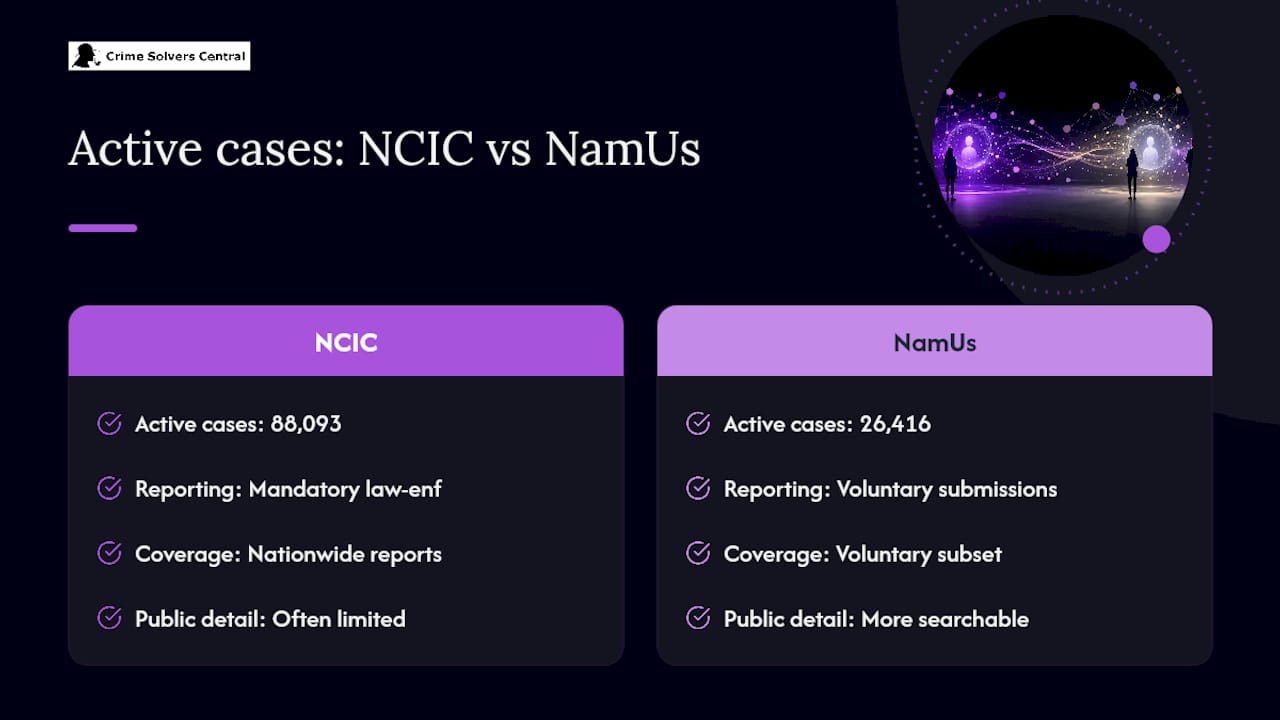
The gap between those two figures comes down to access and entry rules, not a disagreement about who’s actually missing. NCIC captures nearly every law-enforcement report nationwide. NamUs depends on someone choosing to submit a case, so it tracks a smaller slice, though a more publicly searchable one.
That distinction matters when you’re searching. A case marked active in NCIC might carry almost no public detail, since officers, not families, control what’s visible. Investigators sometimes work a case quietly through bank records or digital footprints rather than public appeals, so a listing can look dormant while real work continues behind it.
How to Report a Missing Person and What to Have Ready
Call 911 immediately if there’s any sign of danger, a violent situation, a young child, or a person with a medical condition that makes time critical. For cases without an immediate threat, contact the local police department where the person was last seen, or the agency number listed on an existing case entry.
When you call, have this ready:
- Legal name, date of birth, and physical description
- The most recent photo you have, ideally within the last year
- Last known location, time, and who they were with
- Any medical conditions, mental-health concerns, or medication needs
- Vehicle description and license plate, if applicable
- An existing case number, if the person has already been reported once
Police will typically ask follow-up questions over the next few days as they assess risk level and decide on public alerts. Families can also request a NamUs entry directly, often working through a medical examiner’s office or a participating agency, which adds the case to the public system alongside the police report. Our guide to building a missing-person case file walks through organizing these details before you make that first call.
What the Public Can Do to Help Responsibly
Community involvement helps most when it stays coordinated instead of freelance. Share only information confirmed by police or an official case listing, and never post personal theories about a suspect or motive; that kind of speculation can taint witness statements and give a defense attorney grounds to challenge evidence later.
A few guidelines worth following:
- Volunteer for searches only when organized through police or a recognized search-and-rescue group.
- Distribute flyers using the exact wording and photo approved by the family or agency, not your own edited version.
- Report tips through the official hotline or tip line listed on the case, never through a public comment thread.
- Avoid sharing addresses, workplaces, or family details that could put someone at risk, this applies to the missing person and to any named witnesses.
Pro Tip: If you spot conflicting details between a NamUs entry and a local news post, don’t try to resolve it yourself online. Call the listed agency and let them reconcile the record.
Uncoordinated social-media campaigns tend to generate noise that investigators then have to sort through, which slows things down rather than speeding them up. Our breakdown of common search mistakes covers this in more detail.
How Crime Solvers Central Fits Alongside Official Channels
Crimesolverscentral runs a searchable national database covering cold cases, missing persons, and unsolved homicides, organized by state and case type. Members get access to fuller case files, digital evidence boards, a flyer builder, and volunteer coordination tools that make it easier to organize community support around a specific case.
None of that replaces filing a report with police or checking NCIC and NamUs first. Think of it as the layer that helps families and volunteers stay organized once the official report is filed, aggregating tips, building shareable materials, and connecting people working the same case from different angles.
Get Full Case Access and Coordinate Support Through Crimesolverscentral
Official databases tell you a case is open. They rarely give you the tools to organize a sustained effort around it, and that’s the gap Crimesolverscentral fills. Where NCIC stays law-enforcement-only and NamUs offers a static public listing, a Crimesolverscentral membership gives families and volunteers a working space: full case details, a digital evidence board, a flyer builder for consistent outreach materials, and direct coordination with other members tracking the same case.
For families feeling isolated after filing a police report, or for community members who want to help but don’t know where to start, that structure matters. It won’t file your police report or replace a detective’s work, but it gives you somewhere to organize while that investigation moves forward. If a friend or relative is grieving through this process, grief-support guidance can help you support them alongside the practical search work.
Browse the national cold case database by state to see if an existing case profile already covers your situation, or start a membership to unlock full case access and volunteer coordination tools.
Sources
- 2025 NCIC missing and unidentified person statistics (FBI)
- NamUs monthly case report — April 2026
- Missing Person Search — California Department of Justice
- News category: Missing Persons — Chicago Police
FAQ
How many missing persons cases are there right now?
NCIC reported 88,093 active missing-person records as of December 2025, while NamUs listed 26,416 active cases as of April 2026. The gap reflects NCIC’s mandatory law-enforcement reporting versus NamUs’s voluntary public submissions.
Who is the longest missing person found alive?
Long-term recoveries after decades are rare, and they typically result from renewed cold-case reviews, DNA or ancestry testing, and private tips rather than a single dramatic breakthrough. No single record holder is consistently verified across sources, so treat viral claims about “the longest case ever solved” with caution.
Have Lilly and Jack Sullivan been found?
This article’s sources don’t cover the current status of that specific case. Check the investigating agency’s official page or a NamUs search directly for the latest update.
What is the most popular missing person case?
Public attention tends to concentrate on cases with heavy media or social-media coverage rather than the cases most likely to be resolved. Checking NamUs and your state’s missing-person page will surface active cases in your own area that rarely make national headlines.