

Cold Case Search Engine Playbook for Researchers With 264,913 Cases

Start with NamUs and Crime Solvers Central’s national catalog, then branch out. Run a search on the NamUs public database first, save or export what you find, and open a matching case summary on Crime Solvers Central to compare details. Public NamUs searches show most fields for free; full case files, forensic notes, and professional tools require registration or a paid membership elsewhere.
TL;DR:
- Most cases in NamUs are cold cases that have been unresolved for over a year or remains unidentified for that length of time.
- Crime Solvers Central expands case access with over 264,913 records organized by state and offers community tools for collaboration.
- Official federal systems like NamUs, ViCAP, and the Civil Rights portal each serve different investigative scopes and should be searched sequentially based on case details.
- Local police, sheriff, and medical examiner websites often hold unique case information, including photos and detailed narratives not available in national databases.
- Cross-referencing case details across multiple sources and keeping detailed logs improves the chances of matching or solving cases, especially when coverage gaps exist.
Table of Contents
- What Do the National Cold Case Databases Actually Cover?
- Finding State and Local Cold-Case Databases
- How to Run a Serious Cold Case Search
- How to Submit a Tip or Request a Case Review
- Why Some Cases Are Missing and What to Do About It
- How Crime Solvers Central Fills the Gaps Between Official Systems
- The Perspective Missing From Most Cold Case Advice
- Search the Full Cold Case Catalog on Crime Solvers Central
- Sources
- FAQ
What Do the National Cold Case Databases Actually Cover?
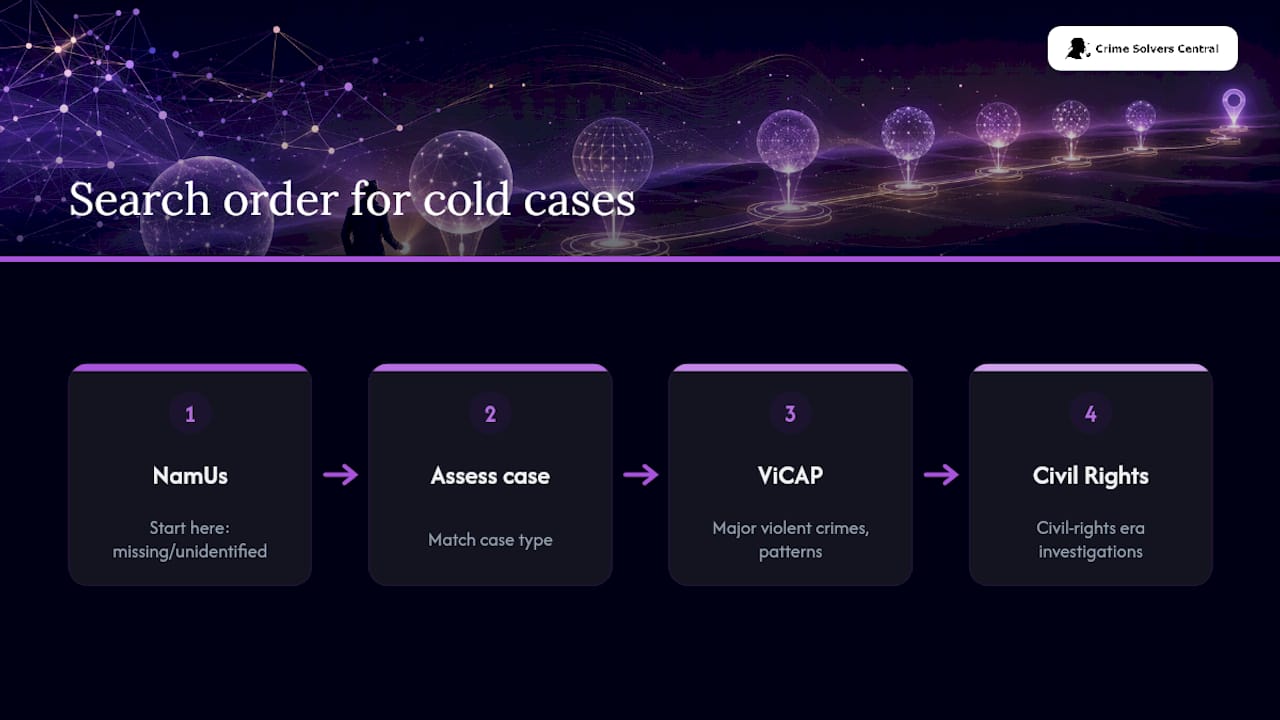
Three federal systems anchor most serious research, and each one does a different job.
NamUs is the biggest public entry point. It’s a centralized repository for missing, unidentified, and unclaimed person cases, and roughly 95% of its published cases meet the standard definition of a cold case: missing for over a year, or remains unidentified for more than a year. Anyone can browse public entries. Registered users get more, including access to free forensic services and support from a Cold Case Advisory Team that runs multidisciplinary reviews on qualifying cases.
FBI ViCAP works differently. It’s an investigative repository built for major violent crimes, homicides, sexual assaults, missing persons tied to foul play, and unidentified remains, used mainly by law enforcement analysts hunting for cross-jurisdictional patterns. A civilian can browse the public-facing case pages, but ViCAP isn’t built as a general research tool the way NamUs is.
Civil Rights Cold Case Records, hosted through the National Archives, is narrower still. The Civil Rights Cold Case Records portal catalogs civil-rights era cases and related federal archival records, filterable by incident date, location, and victim name. It won’t help with a 2019 disappearance, but it’s the right place for historical civil-rights investigations.
The practical order: search NamUs first for anything involving a missing person or unidentified remains, then check ViCAP or the civil-rights portal if the case type matches their narrower scope.
Finding State and Local Cold-Case Databases
National systems miss a lot of local detail. State police, departments of public safety, county sheriffs, and medical examiner offices often run their own cold-case pages with information you won’t find anywhere else.
What state and county pages typically include:
- Case lists organized by county or region, often with photos
- Direct contact information for the assigned detective or tip line
- Case narratives with more local color than a national database entry
- Occasionally, digitized case files or evidence photos not shared federally
A few search tactics speed this up. Use a site: search limited to a state’s .gov domain plus “cold case” or “unsolved homicide” to surface pages that don’t show up in a general search. State police websites usually have a public affairs or investigations directory that links out to unsolved case rosters. And don’t skip anniversary coverage. Local newsrooms often republish case details every five or ten years, and those articles sometimes include quotes from investigators or family members that never made it into an official database.
How to Run a Serious Cold Case Search
Casual searching gets casual results. If you’re actually trying to help solve something, treat it like research, not browsing.
- Register on NamUs if you plan to search repeatedly. Registered users unlock advanced search fields and Boolean operators, which public visitors don’t get.
- Filter aggressively. Narrow by case status, physical descriptors (height, weight, distinguishing marks), estimated date range, and jurisdiction before you start reading individual entries.
- Export to CSV when the system allows it. A spreadsheet of forty potential matches is far easier to work through than forty open browser tabs.
- Log every search. Write down the exact query parameters you used, save the result URLs, and screenshot anything that looks promising with a timestamp attached.
- Cross-check descriptors. Compare dental records, scars, tattoos, and estimated age ranges across multiple entries. A name might not match, but the physical profile sometimes does.
- Triangulate with outside sources. Newspaper archives and genealogy sites like those indexed through public library systems often confirm or rule out a match that the database alone can’t settle.
Pro Tip: Keep a single running document for each case you’re researching. List every database you checked, every filter combination you tried, and every dead end. Six months later, when a new detail surfaces, you’ll thank yourself for not having to redo the same searches from scratch.
The NamUs advanced searching guide walks through registration and search mechanics in more depth if you want a step-by-step reference.
How to Submit a Tip or Request a Case Review
If your research turns up something real, the way you report it matters as much as what you found.
For public tips, NamUs has a structured submission process built into each case entry, and most state and local agencies list a tip line or email directly on their case pages. When you’re contributing information, include:
- Exact dates, times, and locations, as precise as you can make them
- Names of any witnesses, even if you only have a first name or description
- Photos or scanned documents, with the originals preserved and untouched
- How you found the information, since investigators often need to verify the chain
If your tip involves anything urgent, potential evidence, a location, a name, contact the investigating agency directly rather than posting publicly. Requesting a full Cold Case Advisory Team review typically has to go through the agency of record, not NamUs directly. Families and volunteers should also think about privacy before sharing details publicly, since oversharing case specifics can sometimes compromise an active investigation.
Why Some Cases Are Missing and What to Do About It
Database coverage is uneven, and that’s not a flaw so much as a structural reality. Only a minority of states legally require automatic entry of missing-person cases into NamUs, so participation varies significantly by state and agency. Some records, dental charts, full forensic reports, are restricted to professional or law enforcement users and never appear in public search results.
If you can’t find a case you know exists:
- Check the agency’s own website or call the department of record directly
- Request a NamUs vetting or ask whether the case has been submitted at all
- Search local newspaper archives, which sometimes predate any database entry
- Try Crime Solvers Central’s national database, which catalogs many cases independent of state reporting requirements
Also watch for common search mistakes: misspelled names, missed maiden names, aliases, or a victim who used a nickname that never made it into official paperwork.
How Crime Solvers Central Fills the Gaps Between Official Systems
Official databases are authoritative but narrow in scope. Crime Solvers Central’s catalog runs over 264,913 cases, organized by state and situation, which gives researchers a much wider net to work with alongside NamUs and ViCAP.
What that looks like in practice:
- Curated case summaries that pull together scattered agency details into one readable profile
- State-by-state categorization that mirrors how most researchers actually search
- Community forums and digital evidence boards for volunteers comparing notes
- A flyer builder and AI image tools for keeping a missing person’s case visible
Public visitors see case summaries and basic details for free. Full case files, additional source documents, forum access, and volunteer coordination tools require membership. That’s a deliberate line, not a paywall for its own sake, since deeper investigative material needs some structure around who’s accessing it and why.
Pro Tip: When a case appears on both NamUs and Crime Solvers Central, cross-reference the details rather than trusting one source alone. Discrepancies in dates or descriptions sometimes reveal which record is more current.
The Perspective Missing From Most Cold Case Advice
Most guides treat database searching like a scavenger hunt: find the right site, type in a name, done. That’s not how cold cases actually get solved. NamUs itself leans on public participation precisely because agencies are stretched thin and reporting gaps are real. The families and volunteers who actually move a case forward are the ones treating this like ongoing research, not a one-time lookup.
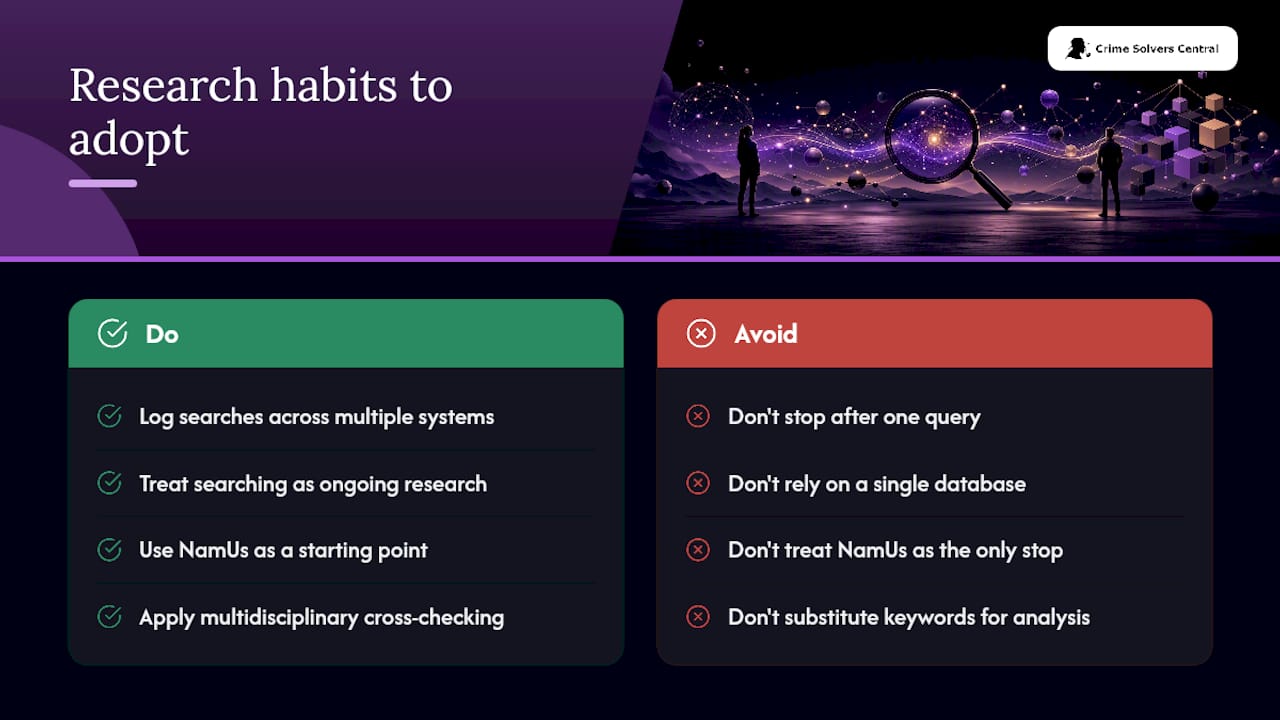
The conventional advice oversells the idea of a single “master database.” There isn’t one. NamUs is the strongest public starting point, but it was never designed to be the only stop, and treating it that way is how people miss cases that live only in a county sheriff’s PDF or a decade-old newspaper clipping. The multidisciplinary review process behind NamUs Cold Case Advisors exists because matching a missing-person record to unidentified remains often requires forensic science and analytical cross-checking, not just a keyword search.
What should come first: build the habit of logging searches across multiple systems, not just running one query and calling it done. Coverage gaps are the rule, not the exception, and the researchers who close cases are usually the ones who kept looking after the first database came up empty.
— Crime
Search the Full Cold Case Catalog on Crime Solvers Central
NamUs and FBI ViCAP give you the official record. Crime Solvers Central gives you the volume and the community tools to actually work a case: a catalog of over 264,913 files organized by state, digital evidence boards, a flyer builder, and forums where family members and volunteers compare notes on the same investigation. Public summaries are free to browse. A membership unlocks full case files, source documents, and the community features that turn a lone search into a coordinated effort. If you’ve just spent an afternoon combing through NamUs entries, the next move is simple: pull up the cold case database by state and see whether the case you’re researching already has a fuller profile waiting.
Sources
FAQ
Can Civilians Look at Cold Case Files?
Yes. NamUs, state police pages, and Crime Solvers Central all offer public case summaries, though full forensic reports and some restricted records are limited to registered professionals or investigating agencies.
What Are the Top Unsolved Cases People Search For?
The most-searched cases tend to be high-profile missing-person and unidentified-remains cases with active media coverage, but the more useful question is which cases near you have open leads. State cold-case pages and Crime Solvers Central’s state-by-state catalog are better starting points than a general “top unsolved cases” list.
Where Can I Find Free Cold Case Files to Research?
NamUs offers free public search access to most case fields, and Crime Solvers Central provides free case summaries across its catalog, with full files available to members.
Is There a Dedicated Cold Case Search Engine?
Yes. NamUs functions as the primary national one, backed by free forensic services and Cold Case Advisory Team support, and Crime Solvers Central complements it with a broader case catalog and community research tools.
How Do I Know if a Case Search Result Is Accurate?
Cross-check physical descriptors like height, dental records, and scars across multiple sources, and treat any single database entry as a starting point rather than a confirmed match. Descrepancies between records are common, so verifying against a second source before drawing conclusions matters.