

Cold Cases by City: How to Find and Report Unsolved Crimes
To find cold cases by city, start with three places: the local police department or district attorney’s cold-case page, a regional Crime Stoppers or P3 tip portal, and national databases such as NamUs and Crime Solvers Central. If you have information about a specific case, the single most useful thing you can do right now is write down the case number and contact details listed on that case’s page, then call the tip line rather than posting what you know on social media.
Most municipal police departments and county DA offices keep some form of public cold-case list, though the depth varies wildly. A small department might post a single PDF with ten names. A city like Virginia Beach maintains a dedicated cold-case unit page with case summaries and direct contacts. Others, like Fort Wayne, partner with third-party databases that display cases in a searchable interface rather than a static page.
Before you dig into search tactics, remember what matters most:
- Local PD and DA cold-case pages are your first stop for jurisdiction-specific listings.
- Crime Stoppers, P3 apps, and agency tip lines let you report anonymously.
- NamUs and Crime Solvers Central fill in gaps when a city’s own page is thin or outdated.
- Every listing should include a case number, incident date, and contact point. Record all three before you do anything else.
- Never touch, move, or attempt to test physical evidence yourself.
Key Takeaways
Finding cold cases by city requires checking local police and DA pages first, then escalating to state portals and national databases like NamUs and Crime Solvers Central when local listings fall short.
| Point | Details |
|---|---|
| Search in layers | Start with the city PD or DA page, then move to state portals and national databases if listings are thin. |
| Record before you report | Save the case number, incident date, and contact method before doing anything else. |
| Use official tip channels | Submit through agency tip lines or Crime Stoppers/P3 apps rather than social media. |
| Never handle evidence | Document location and appearance only; let law enforcement collect and preserve it. |
| Dedicated units are rare | Only about 18% of departments with 100+ officers run a dedicated cold-case unit, per the NIJ. |
Table of Contents
- How to Search for Cold Cases by City
- What a Cold Case Listing Actually Tells You
- How to Submit a Cold Case Tip That Actually Gets Used
- Why Some Cities Have Cold Case Units and Others Don’t
- National and State Resources Worth Checking Alongside City Pages
- Reading the Archive: Decades, Updates, and Solved Flags
- What Families and Citizen Investigators Should Do Next
- Why This Work Matters
- Sources
- FAQ
How to Search for Cold Cases by City
Finding the right page for a specific city takes a bit of search strategy, mostly because there’s no single national portal that indexes every department’s cold-case list. Search engines reward specific phrasing.
Try these searches in this order:
- “[City name] cold cases” — this usually surfaces the department’s own page if one exists.
- “[City name] police cold cases” — narrows results to the agency’s detective bureau or investigations division.
- “Unsolved crimes [city]” — catches Crime Stoppers affiliates and local news archives that a department-only search misses.
- “[City name] cold case unit” — useful for larger cities where a specific unit, rather than the general PD site, owns the case list.
- “[State] cold case portal” — jump here when the city itself has nothing, since many states now run a centralized cold-case index.
If a city page returns nothing or looks stale, go up a level. State police agencies increasingly run their own portals. The Virginia State Police cold case site covers homicides, missing persons, and unidentified remains across the state, and it deliberately randomizes which cases appear first so no single case gets buried by an alphabetical or chronological default. That’s a smart design choice worth knowing about: if you check a statewide portal once and don’t see a particular case on the front page, don’t assume it’s been removed. Search directly instead of browsing.
Once you land on the right page, use whatever filtering tools it offers. Many departments organize cases by:
- Decade or year (a “1990s” or “2000s” heading, sometimes with a further year breakdown).
- Case type (homicide, missing person, unidentified remains, sometimes separated into their own tabs).
- Geographic area, if the department covers a large or divided jurisdiction and includes a map or precinct filter.
Smaller cities without a dedicated cold-case page often fold unsolved cases into the department’s general “most wanted” or news release archive, so search the site directly using the department’s own search bar with terms like “unsolved” or “homicide” rather than relying on Google alone. County sheriff’s offices sometimes maintain separate lists from city police, especially for cases just outside municipal boundaries, so check both if the city and county have separate law enforcement agencies.
Pro Tip: Bookmark the exact case URL, not just the department’s homepage. Many agencies restructure their websites every few years, and a case that was on page one in 2023 might be three clicks deep by 2026. A direct link saved now, or a PDF export, protects you from a dead-end redesign later.
If you’re researching a case tied to a family member and the local page has almost nothing, don’t stop at the city level. Move to NamUs for missing persons and unidentified remains, or search Crime Solvers Central’s national index, which categorizes cases by state and situation, and often has more detail than a small department’s single-page listing.
What a Cold Case Listing Actually Tells You
A well-built case entry follows a fairly predictable format, whether it comes from a municipal PD, a state portal, or a national database. Knowing what to expect helps you spot gaps and know what you’re missing.
Most listings include some combination of:
- Case number — the primary reference detectives use internally; always record this first.
- Incident date and time — sometimes precise, sometimes approximate if the original report was delayed.
- Incident location — an address, intersection, or general area, especially for older cases where exact addresses have changed or been redeveloped.
- Victim information — name, age, and sometimes a photo, though many unidentified remains cases withhold identity by definition.
- Suspect description, when one exists and is safe to publish without compromising the investigation.
- A short narrative summary of what happened, often just two or three sentences.
- Evidence status or reward information, particularly on Crime Stoppers-affiliated pages.
- Contact instructions — a tip line number, an email, or a submission form.
Investigators consistently say the same thing about what makes a tip useful: specificity. A vague “I think I know something” gets logged and forgotten. A tip with a precise time window, a full name instead of a nickname, a vehicle make and color, or a witness who can corroborate your account gets prioritized. If you’re recalling something from years ago, write down what you remember before you contact anyone, since memory degrades and a documented account carries more weight than a phone call made from recollection alone.
Save everything as you go. Screenshot the listing, export it as a PDF if the site allows it, and note the date you accessed it. Case pages get updated, cases get marked solved, and departments occasionally take pages down during website migrations. Having your own dated record protects you if the online version changes or disappears.
How to Submit a Cold Case Tip That Actually Gets Used
Every case page should list a contact method, and which one you use matters less than making sure the information gets to an actual detective rather than a general inbox that nobody monitors.
The three most reliable channels are:
- The agency’s official tip line, listed directly on the case page. This routes straight to the department or the specific cold-case unit handling that file.
- Crime Stoppers or P3/TipSubmit apps, which allow anonymous submission and often include reward eligibility. Kansas City Metro Crime Stoppers, for example, lists unsolved cases alongside anonymous reporting numbers and reward amounts, a model many regional Crime Stoppers chapters follow.
- The specific contact listed on the case page itself, if it differs from the general tip line, since some cold-case units use a dedicated email or a named detective’s direct line.
When you submit a tip, include as much of the following as you safely can:
- The case number from the listing.
- Exact dates, times, and locations, or your best approximation if memory is imperfect.
- Full names, not nicknames, for anyone involved.
- How you know the information. Investigators weigh a firsthand account differently than something you heard secondhand.
- How they can reach you, even if you’re submitting anonymously through an app that lets you check back for follow-up questions.
Pro Tip: If you’re submitting through an anonymous app like P3, most systems generate a tip number and allow two-way anonymous messaging. Save that tip number. It’s the only way to follow up or answer a detective’s clarifying question without revealing your identity.
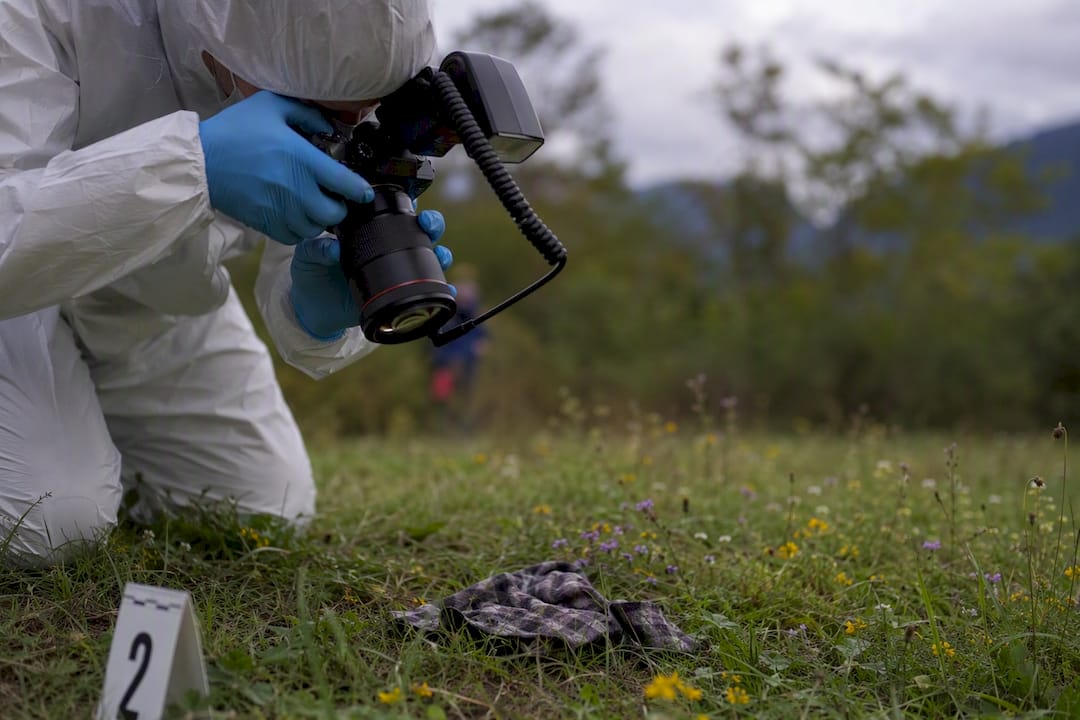
Two cautions matter more than anything else here. First, if you’ve found or think you’ve found physical evidence, do not touch, move, or attempt to preserve it yourself. Document exactly where it is with a photo and note the location, then report it and let law enforcement handle collection, since improper handling can compromise chain of custody. Second, avoid naming a suspect publicly on social media or community forums based on suspicion alone. Beyond the harm to an innocent person, tampering with an active investigation, including destroying or concealing evidence, is a federal crime under 18 U.S. Code § 1519, with penalties that can reach 20 years for serious violations. Report what you know through official channels and let the process work. Our guide on how to report information about a cold case walks through this in more detail.
Why Some Cities Have Cold Case Units and Others Don’t
Not every department that lists cold cases actually has a team working them, and that gap explains a lot about why some cities’ listings feel current while others look frozen in time.
There’s no single legal definition of “cold case.” The National Institute of Justice generally treats a case as cold once it has gone unsolved for roughly three years and has some realistic potential to be solved with new information or new forensic technology. Individual departments set their own thresholds, and you’ll see anywhere from one to five years depending on the agency.
Dedicated cold-case units are far less common than most people assume. Only about one in five law enforcement agencies nationally has formal protocols for initiating a cold-case investigation in the first place. That number drops to about 1% for smaller departments, according to the NIJ’s best-practices guide. That’s not a small gap. It means whether a case gets sustained attention often has more to do with department size and resources than with the strength of the evidence itself.
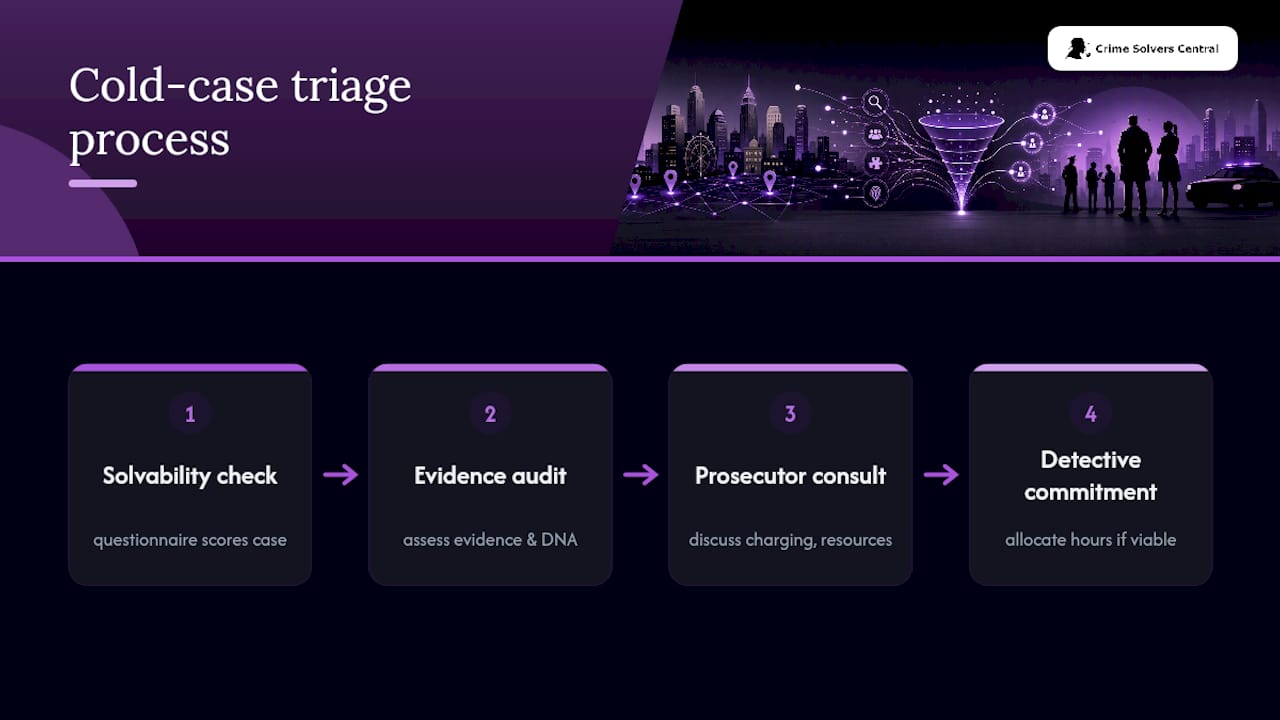
When a case does get picked up, agencies typically run it through some form of triage: a solvability questionnaire, an audit of what physical evidence still exists and whether it can be retested with current DNA technology, and often direct consultation with the prosecutor’s office before committing detective hours to it. The NIJ estimates roughly 242,000 unresolved homicides have accumulated since 1980, a backlog large enough that no department, however well funded, can work every file at once. That’s precisely why triage exists, and why the case list you’re looking at online represents a fraction of what a department is actually able to actively pursue. Our breakdown of why cold case units get established covers how that decision gets made in more detail.
National and State Resources Worth Checking Alongside City Pages
City pages are the starting point, but they’re rarely the whole picture, especially for smaller jurisdictions or cases that crossed county lines during the original investigation.
NamUs is the most useful national tool for missing persons and unidentified remains specifically. It lets you search by physical description, location, and date range, which matters when a city’s own page might not include a case at all if the person disappeared elsewhere and was later found in that city’s jurisdiction, or vice versa. Use NamUs when a case involves someone who might not appear in local records under the name or location you’d expect.
For understanding how investigations actually get prioritized and staffed, the NIJ’s cold-case best-practices materials explain the reasoning behind evidence audits, staffing models, and why forensic advances, particularly DNA and forensic genetic genealogy, have turned cases that were considered permanently unsolvable into active leads again. That single shift in forensic capability is arguably the biggest reason cold-case work looks different today than it did fifteen years ago.
Crime Solvers Central functions as the practical bridge between all of this. The database indexes over 264,000 cases by state and situation, which is useful precisely because it doesn’t depend on any one city maintaining a good website. Members get access to full case files, digital evidence boards, a flyer builder for community distribution, and forums where citizen investigators and family members coordinate research. When a municipal page gives you three sentences and a phone number, Crime Solvers Central often has the fuller file, along with tools to organize what you find and share it responsibly. Our cold case database guide explains when to use it instead of, or alongside, a city or state portal.
The forensic tools available now, especially genetic genealogy, have reopened cases that departments had quietly written off as permanently unsolvable. That shift is the single biggest reason it’s worth rechecking a case every couple of years, even if nothing changed the last time you looked.
Reading the Archive: Decades, Updates, and Solved Flags
Most city cold-case pages group cases by decade, “1980s,” “1990s,” “2000s,” rather than a straight chronological list. That structure exists mostly for browsing ease, but it also tells you something: a case sorted deep into an older decade with no recent update is more likely sitting in the unworked backlog than actively being pursued.
A few things to watch for:
- Missing timestamps. If a page doesn’t show when it was last updated, treat the information as potentially outdated and verify independently.
- “Solved” or “closed” flags that appear suddenly. Cross-check these against a DA press release or local news coverage before assuming the update is accurate, since some pages lag behind an actual case closure by months.
- Gaps between decades. A page heavy on 1990s cases with almost nothing from 2010 onward may reflect a records migration issue rather than an actual drop in unsolved crime.
If a page has no update information at all, your best move is to call the listed contact directly and ask when the case was last reviewed, rather than assuming the online listing reflects the current status.
What Families and Citizen Investigators Should Do Next
Once you’ve found a listing and you’re ready to act, whether you’re a family member pushing for renewed attention or a community member helping investigate, a little organization goes a long way toward getting taken seriously by detectives.
- Collect your reference numbers first. Get the police report number, medical examiner case number if applicable, and the cold-case listing number.
- File a formal tip through official channels, not informal contact with an officer you happen to know.
- Register with victim services if you’re a family member. Advocates often help keep a case visible and maintain communication with the assigned detective over the long term.
- Ask about an evidence audit. It’s a fair question to ask whether existing evidence has been retested with current forensic methods, particularly DNA.
- Build a documentation packet: a timeline of events, a witness list with contact information, a log of every communication with law enforcement, and notes on where physical evidence was last known to be located.
- Track every follow-up. Note dates you contacted the department and who you spoke with, so nothing falls through the cracks over months or years.
Pro Tip: A simple shared document with four sections, timeline, witnesses, communications log, and evidence notes, is often more useful to a detective than a folder of loose paperwork. It shows you’ve organized your knowledge, and it makes it faster for them to see what’s actually new versus what’s already in the file.
Involve an attorney or victim advocate when a case has stalled for years despite your efforts, or when you’re unsure how to push for renewed attention without overstepping. Media attention, including local news and true-crime podcasts, can genuinely revive interest and surface new witnesses, but coordinate timing with the assigned detective first. Publicity that surprises investigators, or that names a suspect prematurely, can complicate rather than help the case. Our guide to crowdsourcing tips on unsolved homicide cases covers how to organize community involvement without stepping on an active investigation.
Why This Work Matters
Every case buried in a decade-old archive represents a family that’s still waiting. Crime Solvers Central exists because most of those cases never get the sustained attention a large department’s cold-case unit can offer, and community tips have moved more than one file from “inactive” to “reopened” without ever making headlines.

Check your local city and state pages first. Follow the reporting checklist here when you have information. And if the local trail runs out, register with Crime Solvers Central to search the fuller national record and connect with others doing the same work.
Sources
For missing persons and unidentified remains, search NamUs. For guidance on how departments structure cold-case work, review the NIJ’s best-practices guide. For evidence-tampering law, see 18 U.S. Code § 1519. For a national, state-indexed case database with member research tools, visit Crime Solvers Central.
- Expert Panel Issues New Best Practices Guide for Cold Case Investigations | National Institute of Justice
- 18 U.S. Code § 1519 — Destruction, alteration, or falsification of records in federal investigations and bankruptcy
- NamUs (National Missing and Unidentified Persons System)
- Implementing a Cold Case Homicide Unit: A Challenging Task | Office of Justice Programs / NIJ (PDF)
FAQ
What cities have the most cold cases?
Larger cities generally accumulate more cold cases simply due to population and historical crime volume, but exact rankings vary by how each department defines and reports “cold” status. Check state-level portals for the clearest city-by-city comparison, since municipal reporting standards differ widely.
What are the top 10 cities with the most murders?
Homicide totals shift year to year and depend on the reporting period, so there’s no single fixed list. The NIJ notes that roughly 242,000 homicides have gone unresolved nationally since 1980, and clearance rates have declined over that same period, meaning cities with historically high homicide counts also tend to carry the largest cold-case backlogs.
What is the most famous cold case in history?
Fame varies by region and era, and no single case holds a universal “most famous” title. Many of the best-known unsolved cases owe their visibility to sustained media coverage or podcasts that kept public attention alive long enough to generate new tips.
Which US state has the most cold cases?
No single authoritative national ranking breaks this down by state, largely because reporting standards and record-keeping differ across jurisdictions. Statewide cold-case portals, like Virginia’s, are a more reliable way to gauge a specific state’s backlog than any national comparison.