

How Cold Case Reviews Are Initiated: A Clear Guide

A cold case review is defined as the formal re-examination of an unresolved criminal investigation after active inquiry has stalled, typically triggered by new solvability factors that did not exist at the time of the original investigation. Understanding how cold case reviews are initiated matters deeply to families waiting for answers, legal researchers studying criminal justice gaps, and community advocates pushing for accountability. The process is more structured than most people realize. Legislation like Oklahoma’s Senate Bill 1636 has formalized timelines and procedures, and forensic advances in DNA analysis have expanded what counts as actionable new evidence. Crimesolverscentral tracks over 264,913 cases in its national database, making it one of the most accessible resources for families navigating this process.
How cold case reviews are initiated: triggers and solvability factors
Cold case reviews begin when investigators identify what criminologists call “solvability factors.” These are specific conditions that make a previously stalled case worth re-examining with fresh resources and attention.
Key triggers include new witness statements, deathbed confessions, the discovery of overlooked records, and advances in forensic technology such as DNA analysis. Each of these represents a concrete reason to believe the case outcome could now be different. Without at least one solvability factor, most agencies will not allocate the time or personnel needed for a full review.

Forensic technology is the most significant driver of cold case reopenings in the modern era. DNA advancements have allowed investigators to retest biological evidence collected decades ago, sometimes producing suspect profiles from samples that older technology could not process. Digital forensics, including the recovery of deleted files, cell tower records, and surveillance footage, has added another layer of solvability to cases that predate the smartphone era.
New witnesses emerge more often than people expect. A neighbor who stayed silent out of fear, a former associate who has since left a criminal network, or a family member of the suspect who finally decides to speak can all restart an investigation. Deathbed confessions, while dramatic, are a documented and legally recognized trigger for review.
Pro Tip: If you believe new evidence exists in a loved one’s case, document it in writing before contacting law enforcement. A clear, factual summary of the new information gives investigators a concrete starting point and signals that you are prepared to engage formally.
Who can request a cold case review?
Families are the primary initiators of cold case review requests, but the process requires more than a phone call. Most agencies require a formal written application that identifies the case, describes the new information or concern, and explains why a review is warranted.
Oklahoma’s Senate Bill 1636 sets one of the clearest procedural standards in the country. Under that law, agencies must confirm receipt within 30 days and complete the review within 6 months. If the review cannot be completed in that window, the agency must provide periodic updates to the requesting party and document the reasons for the extension. Denied cases cannot be resubmitted for 5 years unless new evidence emerges. That 5-year restriction is not punitive. It protects investigators from repeated requests that consume resources without new grounds for action.
The formal steps for submitting a cold case review request typically follow this sequence:
- Gather case documentation. Collect the original case number, incident reports, and any correspondence with law enforcement. Organize these chronologically before making contact.
- Identify new information. Clearly define what is new. A vague sense that the case was mishandled is not sufficient. A specific witness, a piece of untested evidence, or a forensic technique that did not exist at the time of the original investigation qualifies.
- Submit a written request. Address the request to the agency’s cold case unit or, if none exists, to the detective division. State the case number, the nature of the new information, and your relationship to the victim.
- Follow up within the legal window. If the agency is subject to legislation like Senate Bill 1636, note the 30-day confirmation deadline and follow up if you do not receive acknowledgment.
- Engage legal or advocacy support. Families benefit from professional assistance when navigating formal applications and managing expectations about timelines.
Pro Tip: Keep every piece of correspondence with law enforcement in a dedicated folder, physical or digital. Dates, names, and responses create a paper trail that becomes critical if you need to escalate your request or engage an attorney.
How do agencies conduct a cold case review once it starts?
Once a review is formally initiated, the agency assigns it to an investigator who was not involved in the original case. That fresh perspective is intentional. A detective who worked the original investigation carries assumptions and blind spots that can prevent objective reassessment.
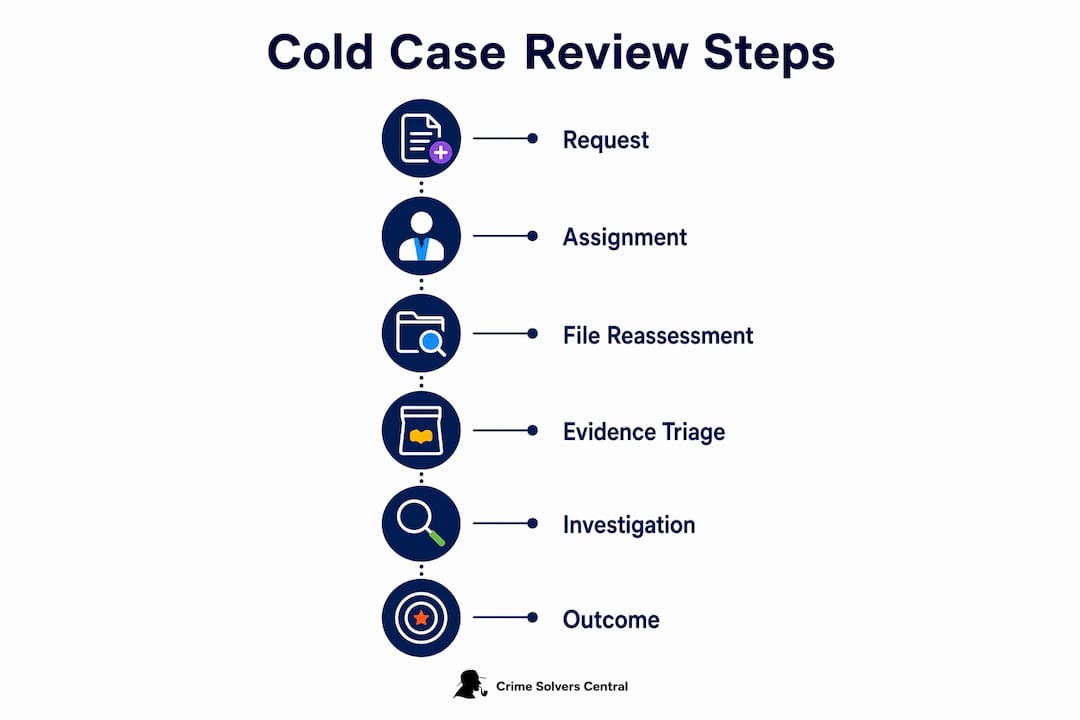
The review process typically involves a comprehensive re-read of the entire case file, including witness statements, crime scene reports, autopsy findings, and any evidence logs. Historical media coverage and retired investigator insights can provide useful context, but the reviewing detective must guard against inheriting the original team’s biases. The goal is to assess the evidence as it stands today, not to validate conclusions made years or decades ago.
Evidence triage is a critical and often misunderstood part of the process. Agencies do not test every piece of stored evidence. Instead, investigators prioritize items most likely to yield forensic results, based on the nature of the crime and the condition of the evidence. This is a resource decision, not an oversight. Crime labs have limited capacity, and sending low-probability samples for testing delays results on higher-priority items.
The table below outlines the core phases of a cold case review and what each involves:
| Review phase | What investigators do |
|---|---|
| File reassessment | Re-read all original reports, witness statements, and evidence logs |
| Evidence triage | Identify items with the highest forensic potential for DNA or digital testing |
| Witness re-contact | Locate and re-interview original witnesses; identify any new ones |
| Forensic submission | Submit prioritized evidence to the crime lab for updated testing |
| Progress updates | Communicate findings or status to the requesting party per legal requirements |
Dedicated cold case units produce better outcomes than assigning reviews to detectives already managing active caseloads. Former NYPD detective Miguel Iglesias has emphasized that agencies need dedicated units to avoid pulling cold case resources toward active investigations. Without that separation, cold cases consistently lose out when staffing pressure increases.
What role do families and advocates play in keeping cases alive?
Families are not passive participants in the cold case review process. They are often the reason a case gets reviewed at all. Persistent, polite follow-up with law enforcement about evidence status, CODIS database uploads, and the potential for retesting is a documented and effective advocacy step. Agencies respond to organized, informed families differently than to emotional or adversarial contact.
Organized documentation is the most practical tool a family or advocate can use. Maintaining timelines, factual summaries, and correspondence records helps investigators quickly understand the history of a case and identify gaps. A well-organized family file can cut hours off a detective’s initial review.
Public awareness campaigns and social media can generate new leads, but they require careful handling. Sharing case details publicly can alert suspects, compromise witness safety, or introduce misinformation that complicates future prosecution. The most effective campaigns focus on asking for information rather than naming suspects or drawing conclusions.
“Families should be the primary contacts in cold case advocacy, but they often need professional support to navigate the formal process without burning bridges with the agencies they need on their side.”
Advocacy organizations that specialize in amplifying overlooked cold case victims can serve as intermediaries, helping families communicate effectively with law enforcement while managing the emotional weight of the process. That combination of persistence and professionalism is what moves cases forward.
Key Takeaways
Cold case reviews advance when solvability factors, formal procedures, and sustained advocacy align around a specific case with documented new evidence.
| Point | Details |
|---|---|
| Solvability factors trigger reviews | New witnesses, DNA advances, or overlooked evidence are required to justify reopening a case. |
| Formal written requests matter | Agencies require documented applications; Oklahoma’s Senate Bill 1636 sets a 6-month review standard. |
| Fresh investigators improve outcomes | Assigning a new detective prevents inherited bias from the original investigation. |
| Evidence triage is standard practice | Agencies prioritize high-probability forensic items rather than testing all stored evidence. |
| Organized advocacy moves cases forward | Families with clear documentation and polite persistence are more effective than emotional or adversarial contact. |
What I’ve learned about cold case reviews after years in this space
Cold case reviews are not just procedural exercises. They are the last real chance many families have at understanding what happened to someone they loved. After spending years working with unresolved cases, the pattern I see most often is not a lack of evidence. It is a lack of structure on both sides of the process.
Families who approach agencies with disorganized files, emotional demands, or unrealistic timelines often find themselves dismissed or deprioritized. That is not fair, but it is the reality of how overwhelmed investigators operate. The families who get results are the ones who treat the process like a professional engagement. They document everything, ask specific questions, and follow up on a schedule.
The resource problem is real and underappreciated. Dedicated cold case units exist in some jurisdictions, but many agencies still assign reviews to detectives already carrying full active caseloads. That structure guarantees cold cases will always lose. Advocacy for dedicated units at the local government level is one of the most practical things a community can do to improve cold case outcomes.
The emotional complexity for families cannot be overstated. Initiating a review means reopening grief, managing uncertainty, and sometimes confronting the possibility that the case may never be solved. Clear, honest communication from law enforcement about what a review can and cannot achieve is not just courteous. It is necessary for families to make informed decisions about how to invest their time and energy.
— Crime
Crimesolverscentral: a resource for families and advocates
Families and advocates navigating the cold case review process need reliable, organized information. Crimesolverscentral maintains a national cold case database of over 264,913 cases, categorized by state and situation, giving families a structured starting point for research and documentation. The platform also connects community members with resources for advocacy, fundraising, and engagement with law enforcement. Whether you are preparing a formal review request or trying to understand where a case stands, Crimesolverscentral provides the case records and community support that make the process less isolating and more productive.
FAQ
How cold case reviews are initiated by families?
Families initiate cold case reviews by submitting a formal written request to the relevant law enforcement agency, identifying the case and describing any new information or evidence that justifies re-examination.
What is the standard timeline for a cold case review?
Under legislation like Oklahoma’s Senate Bill 1636, agencies must confirm receipt of a review request within 30 days and complete the review within 6 months, with provisions for extensions and periodic updates.
What solvability factors are needed to reopen a cold case?
Recognized solvability factors include new witness statements, deathbed confessions, previously overlooked records, and forensic advances such as DNA testing that were not available during the original investigation.
Who reviews cold cases within a law enforcement agency?
Cold case reviews are typically assigned to a detective who was not involved in the original investigation, or to a dedicated cold case unit, to prevent inherited bias from affecting the reassessment.
Can a denied cold case review request be resubmitted?
Under formal review statutes, a denied request generally cannot be resubmitted for 5 years unless new evidence emerges that was not available at the time of the original denial.