

How to Crowdsource Tips on Unsolved Homicide Cases

Every year, thousands of homicide cases go cold. Investigators run out of leads, families run out of answers, and communities are left carrying grief with nowhere to put it. The good news is that the public has more power than ever to change that outcome. Learning how to crowdsource tips on an unsolved homicide, what law enforcement calls “community-assisted investigation,” can be the difference between a case that stays cold and one that finally gets solved. This article walks you through exactly how to do it right.
Table of Contents
- Key takeaways
- How to crowdsource tips on an unsolved homicide
- Step-by-step guide to submitting your tip
- Common mistakes to avoid when contributing tips
- Tools and examples that amplify crowdsourced investigations
- Staying engaged without compromising the investigation
- My perspective on crowdsourcing and cold cases
- How Crimesolverscentral can help you take the next step
- FAQ
Key takeaways
| Point | Details |
|---|---|
| Use official channels only | Submit tips through Crime Stoppers, law enforcement portals, or verified apps to protect investigations. |
| Anonymity is protected | Crime Stoppers does not retain tipster identity and is not subject to freedom of information laws. |
| Specificity beats volume | Concrete, documented details move cases forward faster than vague hunches or secondhand rumors. |
| Technology amplifies impact | AI tools and genetic genealogy have solved cold cases that sat untouched for decades. |
| Persistence matters | Investigators face processing bottlenecks, so resubmitting updated tips over time keeps cases active. |
How to crowdsource tips on an unsolved homicide
Before you pick up the phone or fill out an online form, you need to understand what you are actually contributing to. Unsolved homicides, often called cold cases once they go inactive, are investigations where the trail has gone quiet. That does not mean the case is closed. It means detectives are waiting for new information to surface.
The types of information that genuinely help investigators fall into a few clear categories:
- Witness accounts: Did you see someone near the scene, hear something unusual, or notice a vehicle? Even partial details matter.
- Behavioral changes: Did someone in your circle suddenly change their habits, move away, or make unexplained purchases around the time of the crime?
- Physical evidence: Knowledge of a discarded item, a weapon, or a location that was never reported.
- Digital or social media activity: Screenshots, posts, or messages that seemed odd at the time but now carry new weight.
Credibility is everything. Investigators receive enormous volumes of tips on high-profile cases. Up to 18,000 calls and 13,000 digital tips can flood in within two weeks of a major case going public. What separates useful tips from noise is specificity. Vague impressions waste time. Concrete details with dates, names, and locations move investigations forward.
Crime Stoppers programs operate as neutral third parties and do not retain identifying information about tipsters. They are not subject to freedom of information laws, which means your identity is protected from court exposure and retaliation. That protection is not a loophole. It is by design, and it exists so that people in vulnerable positions can still come forward.
Pro Tip: If you are worried about your safety, call Crime Stoppers directly rather than contacting the investigating agency. The anonymity layer is stronger, and rewards of $3,000 to $1,000,000 are available depending on the case.
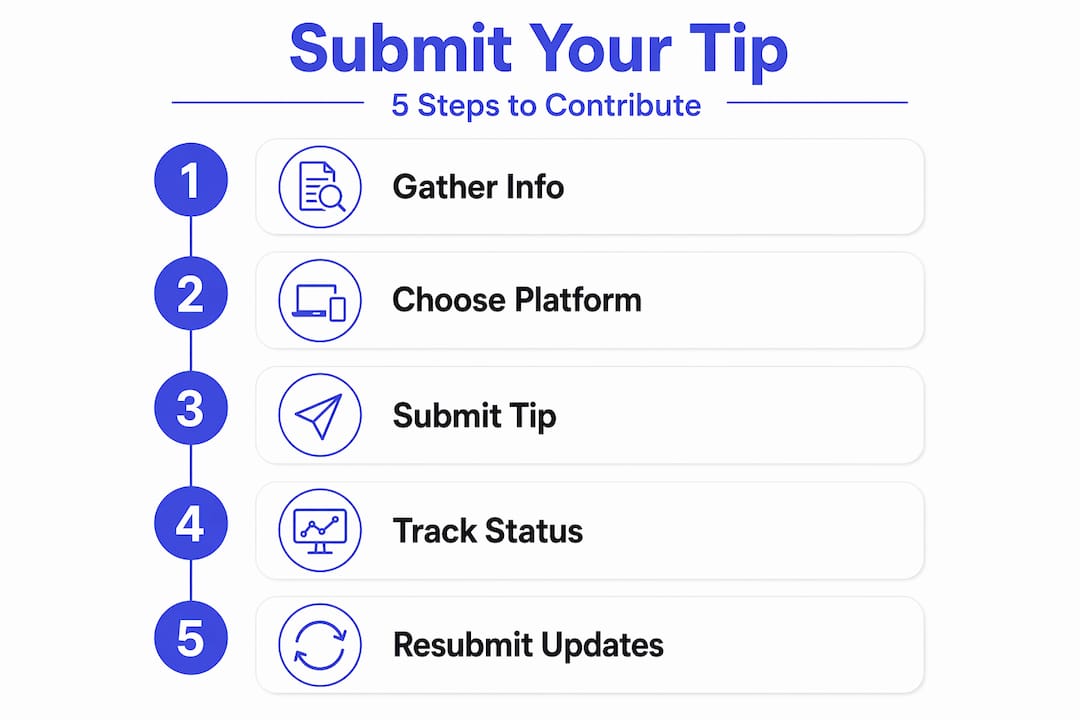
Step-by-step guide to submitting your tip
Once you know what you have, here is how to turn it into something investigators can actually use.
-
Write it down before you call. Memory degrades under pressure. Before you contact anyone, write out every detail you know: dates, times, locations, names, physical descriptions, and any context that might seem irrelevant but could matter. Investigators are trained to find connections you might not see.
-
Verify what you actually know versus what you heard. There is a real difference between “I saw a blue sedan parked outside that house on the night of the incident” and “my neighbor told me someone said they saw a car.” Submit what you personally witnessed or have direct evidence of. Secondhand information should be clearly labeled as such.
-
Choose the right reporting channel. For most people, the options are: the local law enforcement agency handling the case, a national tip line like the FBI’s online portal, Crime Stoppers (1-800-222-TIPS), or a verified crowdsourcing platform. Each has its own intake process. If the case involves a federal crime or crosses state lines, the FBI tip portal is often the most direct route.
-
Use the Crimesolverscentral database to identify the case details. Knowing the case number, the jurisdiction, and the assigned agency makes your tip far more likely to reach the right desk quickly.
-
Document that you submitted. Keep a record of when you submitted your tip, through which channel, and what information you provided. If you need to follow up or submit additional information later, this record is invaluable.
-
Do not contact witnesses or persons of interest yourself. This is where well-meaning people accidentally damage investigations. Tipsters must avoid approaching witnesses or suspects directly. Leave that work to trained investigators.
-
Expect a waiting period. After submitting, you likely will not hear back. That is not a sign your tip was ignored. It is standard protocol. Investigators cannot confirm or deny what they are pursuing without risking the integrity of the case.
Pro Tip: If you have new information weeks or months after your initial submission, submit it again as a separate tip with a note referencing your earlier contact. Cases often get solved when a second or third tip from different sources corroborates the same lead.
Common mistakes to avoid when contributing tips
The biggest threat to crowdsourced investigations is not a lack of information. It is the wrong kind of information, delivered the wrong way.
- Spreading unverified theories online. Posting speculation on social media before contacting investigators can tip off suspects, contaminate witness memories, and create legal complications for prosecutors.
- Treating it like a true crime puzzle. Audiences often prefer narratives with closure, which can push armchair detectives toward forcing a narrative rather than following facts.
- Harassing potential witnesses. Even if you are certain someone knows something, confronting them directly can destroy their willingness to cooperate with law enforcement.
- Giving up after one tip. Investigators face processing bottlenecks from sheer tip volume, not a lack of information. Suspect identities often exist somewhere in the database. Timely, persistent submission keeps your lead from getting buried.
“The bottleneck is rarely information. It’s the capacity to connect the right dots at the right time. Every credible tip that comes in, even one that seems redundant, could be the one that triggers that connection.”
Understanding how law enforcement vets public tips for homicides also helps you calibrate your expectations. Tips go through a triage process. High-specificity tips with verifiable details get prioritized. Tips that reference publicly available information or match what investigators already know are logged but may not generate immediate action. That does not make them worthless. Patterns across multiple tips often reveal what no single tip could.
Tools and examples that amplify crowdsourced investigations
Technology has changed what is possible when communities work together to help solve cold cases.
AI-powered evidence management is one of the most significant developments in recent years. Systems like iDEMS can transcribe audio, analyze video footage, and link evidence across decades of records far faster than any human team. When crowdsourced tips feed into these systems, the volume of data becomes an asset rather than a liability.

Genetic genealogy is another area where public participation has produced real results. Over 1,600 cold cases have been solved using this method, and roughly 120 of those were made possible through crowdfunding that covered the cost of DNA testing. That is not a footnote. That is proof that community financial support directly translates into solved murders.
Here is a comparison of the most commonly used platforms and tools for reporting unsolved murders and contributing to cold case investigations:
| Platform or tool | Best use case | Anonymity level | Cost to tipster |
|---|---|---|---|
| Crime Stoppers (1-800-222-TIPS) | Local and national tip submission | High | Free |
| FBI Tips Portal (tips.fbi.gov) | Federal or multi-state cases | Moderate | Free |
| Crimesolverscentral.com | Searching and reporting cold cases by state | High | Free |
| Genetic genealogy crowdfunding | Funding DNA testing for unidentified remains | N/A | Donor contribution |
| True crime podcasts and media | Raising public awareness on specific cases | N/A | N/A |
Families have also taken matters into their own hands in ways that have produced results. Families of homicide victims have formed nonprofits specifically to fund investigative genetic genealogy work, using crowdfunding to cover costs that law enforcement budgets cannot always absorb. This model has proven effective and is worth considering if you are a family member seeking to report an unsolved murder and push a case forward.
Pro Tip: If you are supporting a specific case, consider directing donations to a verified nonprofit tied to that family rather than a generic fund. Transparency about where the money goes builds community trust and keeps funding focused.
Staying engaged without compromising the investigation
Submitting one tip is a start. Staying involved responsibly over time is where communities genuinely shift outcomes.
There are several ways to remain constructively engaged:
- Join victim advocacy organizations. Groups like the National Center for Victims of Crime connect community members with structured support and advocacy work that complements law enforcement efforts.
- Share verified case information on social media. Use official case numbers, link to law enforcement press releases, and avoid speculation. Sharing a verified tip line number is more useful than sharing a theory.
- Attend community forums or town halls on public safety. These events often include law enforcement updates on cold cases and give you a direct line to investigators.
- Support nonprofits funding advanced forensic work. Financial barriers to forensic testing are one of the primary obstacles to solving cold cases. Donating to credible organizations that fund DNA analysis and investigative genealogy directly removes those barriers.
- Check in on affected families. The emotional toll of an unsolved homicide does not diminish with time. Showing up consistently for grieving families, even years after the crime, matters more than most people realize.
The goal is sustained, responsible engagement. Not a burst of attention that fades when the next news cycle arrives.
My perspective on crowdsourcing and cold cases
I have watched enough of these cases unfold to have a clear opinion: the public is both the most underutilized and the most misused resource in cold case investigations.
The misuse happens when enthusiasm outpaces discipline. I have seen well-meaning communities flood investigators with tips that were really just recycled social media speculation. That creates noise, not signal. It delays justice rather than accelerating it.
But the underutilization is the bigger problem. Most people who know something never come forward. They doubt themselves. They worry about retaliation. They assume someone else already reported it. That silence is where cold cases live.
What I have learned is that the most effective contributors are not the loudest voices in true crime forums. They are the people who quietly document what they know, submit it through the right channel, and follow up when they have something new. They treat it like a civic responsibility rather than a hobby.
The tools available today, from AI evidence analysis to genetic genealogy, mean that a single credible tip can now unlock connections that would have taken years to find manually. Your information has more power than it ever has. Use it carefully.
— Crime
How Crimesolverscentral can help you take the next step
If you are ready to contribute tips on an unsolved homicide but are not sure where to start, Crimesolverscentral is built for exactly this purpose.
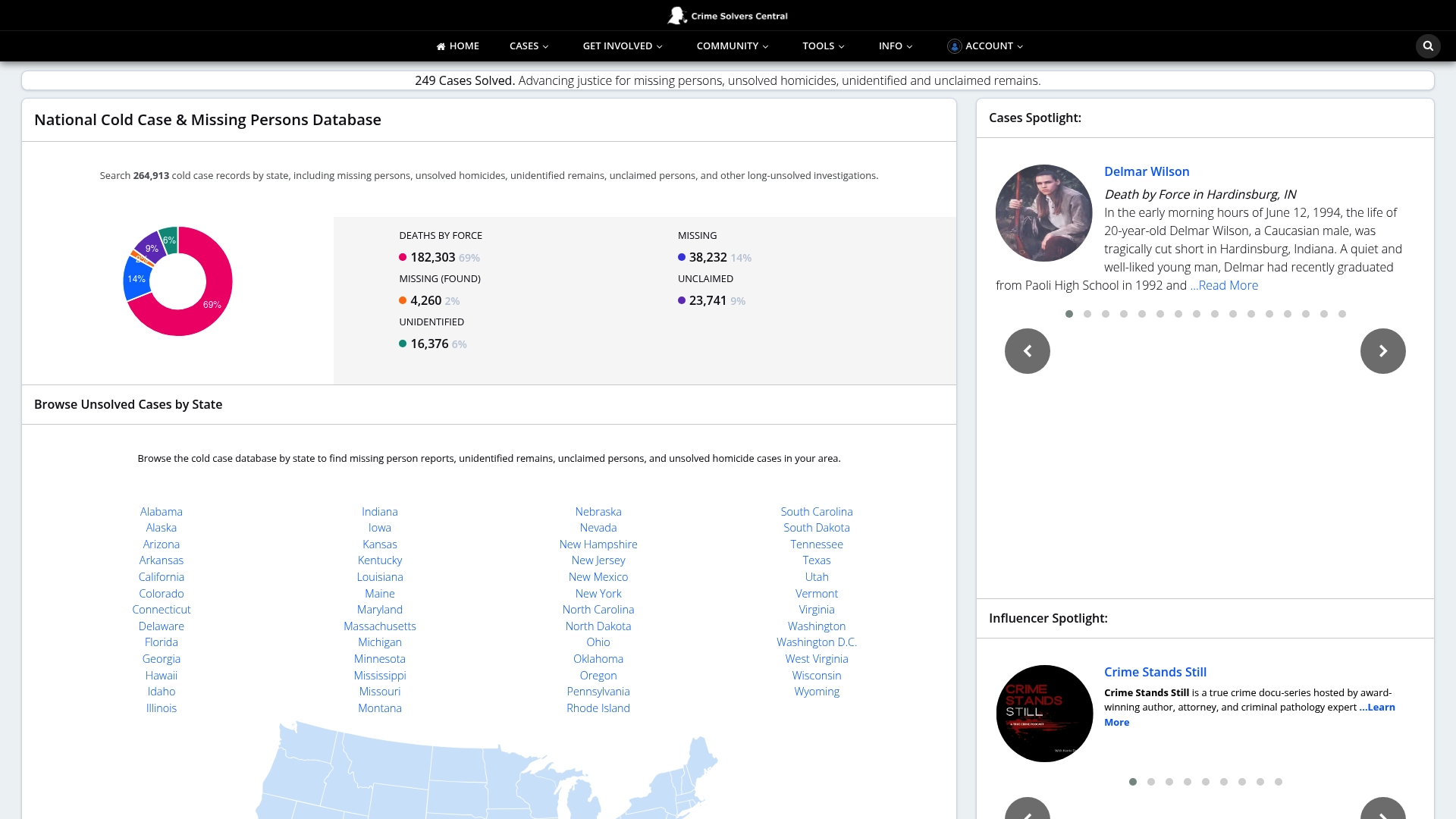
The platform hosts a national cold case database covering over 264,913 cases organized by state and situation. That means you can search for a specific case, confirm the details, and connect with the right reporting channels without having to piece together information from a dozen different sources. Community members can also participate through membership and fundraising initiatives that support ongoing investigations. Whether you are a grieving family member or a concerned neighbor, Crimesolverscentral gives you a structured, safe way to act on what you know.
FAQ
What does it mean to crowdsource tips on a homicide?
Crowdsourcing tips on a homicide means gathering information from the public, rather than relying solely on law enforcement, to generate leads in unsolved cases. It typically involves tip lines, online portals, and community platforms where individuals can submit what they know.
Is it safe to report an unsolved murder anonymously?
Yes. Crime Stoppers programs are not subject to freedom of information laws and do not retain identifying information about callers, making anonymous tip submission genuinely safe for most people.
How do I know if my tip is useful?
A useful tip includes specific, firsthand details such as dates, locations, names, or physical descriptions. Vague impressions or secondhand rumors are less helpful, though they can still be submitted with a clear note about their source.
Can the public really help solve cold cases?
Absolutely. Genetic genealogy alone has solved over 1,600 cases, many of them funded by community crowdfunding. Public tips have also been the catalyst in numerous high-profile homicide resolutions.
What should I avoid when submitting crowdsourced crime tips?
Avoid posting theories on social media before contacting investigators, approaching potential witnesses yourself, or submitting information you cannot personally verify. These actions can compromise investigations and reduce the value of your contribution.