

How to Identify Unidentified Remains: Database Guide
An unidentified remains database is a centralized system that stores physical, biological, and forensic records for human remains whose identity has not yet been confirmed. The National Missing and Unidentified Persons System, known as NamUs, is the only centralized federal program that provides a unified, secure database for missing persons and unidentified decedent records in the United States. For families searching for a loved one, researchers building case files, or community advocates pushing for justice, knowing how to use and contribute to an identify unidentified remains database is the most direct path toward resolution. Forensic methods including DNA analysis, dental comparison, and fingerprint matching all feed into these systems, and public participation plays a larger role than most people realize.
What are the main unidentified remains databases and how do they differ?
NamUs is the primary tool for unidentified remains identification in the U.S. It is publicly searchable, meaning families and community members can access case records directly without law enforcement credentials. Cases are cross-matched using physical descriptors, DNA profiles, dental records, and fingerprints. NamUs has resolved over 61,492 cases since its inception, with 11,300 of those identifications driven by DNA and other forensic comparison methods.
The FBI’s ViCAP (Violent Criminal Apprehension Program) serves a different function. ViCAP links violent crime patterns across jurisdictions and includes records for unidentified persons connected to homicide investigations. Access is restricted to law enforcement, which limits its direct usefulness for families but makes it a critical tool for investigators working across state lines.

Interpol’s Identify Me program operates at the international level. It focuses on unidentified female remains and uses a multimodal approach combining fingerprints, dental records, DNA, and facial recognition. For researchers and advocates working on cases with potential international dimensions, understanding what each system covers prevents wasted effort and missed connections.
| Database | Primary Users | Scope | Key Data Types |
|---|---|---|---|
| NamUs | Public, families, law enforcement | National (U.S.) | DNA, dental, fingerprints, photos |
| FBI ViCAP | Law enforcement only | National (U.S.) | Violent crime links, unidentified persons |
| Interpol Identify Me | Law enforcement, international agencies | International | Fingerprints, DNA, dental, facial recognition |
| State ME Databases | Law enforcement, coroners | State level | Physical descriptors, case notes |
Understanding the differences between these systems tells you where to submit information and where to search first. A family in Texas looking for a missing relative should start with NamUs and the Texas Department of Public Safety database before escalating to ViCAP through a law enforcement contact.
What information do you need to search a forensic remains database?
Effective database matching relies on detailed, specific identifying information rather than general descriptions. The quality of metadata entered by agencies and families directly determines whether a cross-match succeeds. Vague entries like “medium height, brown hair” produce far fewer matches than entries that include exact measurements, dental X-rays, and documented medical history.
The most useful identifying data falls into these categories:
- Physical descriptors: Height, weight, sex, estimated age, hair color and texture, eye color, distinguishing marks
- Dental records: X-rays, dental charts, records of fillings, crowns, or missing teeth
- DNA samples: Collected from the remains or from biological relatives for kinship analysis
- Personal effects: Clothing, jewelry, tattoos, surgical implants, or medical devices found with the remains
- Photographs: Both of the individual when living and of any personal effects recovered
DNA identification requires a known comparative sample. Kinship analysis is foundational to forensic DNA work, and samples from parents, children, or siblings are ranked highest in reliability. Without a comparative sample, DNA from remains alone cannot confirm identity.
CODIS (Combined DNA Index System) is the FBI’s national DNA database and is used by forensic labs to run profiles against existing records. Forensic genetic genealogy goes further by using consumer DNA databases to identify distant relatives and work backward to a possible identity. This method has resolved cases that sat cold for decades.
Pro Tip: When submitting DNA samples for kinship analysis, provide samples from the closest living biological relatives available. A parent’s sample is more reliable than a cousin’s, and labs like those operated by the Idaho State Police forensics division prioritize direct lineage samples for the most accurate results.
For a broader explanation of how these systems connect, the missing persons database guide on Crimesolverscentral covers the role of open databases in resolving cases through public and family engagement.
How do you search and submit to an unidentified remains database?
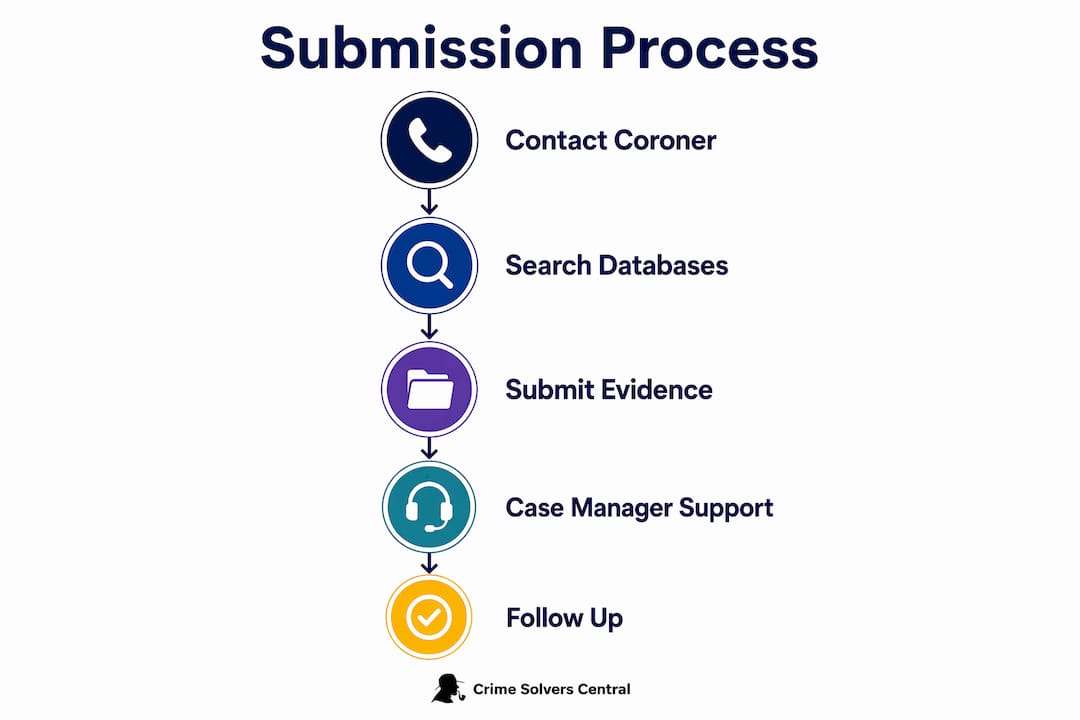
The search and submission process follows a clear sequence. Skipping steps or starting at the national level before exhausting local resources wastes time and can create duplicate records that complicate matching. Authorities may proceed to disposition after holding periods as short as a few days in some jurisdictions, so acting quickly matters.
- Contact the local coroner or medical examiner. Every unidentified remains case begins at the county level. The medical examiner holds the physical record and initiates the official case file.
- Search state-level databases. Most states maintain their own missing persons and unidentified decedent records. Texas, California, and Florida each have dedicated state systems that feed into NamUs.
- Search NamUs directly. Go to the NamUs public portal and use the advanced search filters. Enter sex, estimated age range, geographic region, and any physical identifiers. Cross-reference missing persons records against unidentified decedent records.
- Submit a case or add information. Families can submit missing persons cases directly through NamUs. Law enforcement and medical examiners submit unidentified remains cases. Both sides of the record must exist for a cross-match to occur.
- Provide supporting documentation. Upload dental records, DNA profiles, photographs, and any personal effects documentation. The more complete the submission, the higher the probability of a match.
- Follow up regularly. New cases are added to NamUs continuously. A search that returns no results today may return a match in three months as new records are entered.
| Step | Action | Who Does It |
|---|---|---|
| 1 | Contact local coroner or ME | Family or advocate |
| 2 | Search state database | Family, researcher |
| 3 | Search NamUs portal | Family, researcher, law enforcement |
| 4 | Submit case or add data | Family (missing persons), law enforcement (unidentified) |
| 5 | Upload supporting documents | Family, forensic lab, ME office |
| 6 | Follow up and recheck | Family, advocate, case manager |
Pro Tip: NamUs case managers are available at no cost to families and law enforcement. They can assist with submissions, help gather DNA samples, and coordinate with forensic labs. Contacting a NamUs regional case manager directly accelerates the process significantly.
The role of coroners in unidentified cases is a critical piece of this workflow that families often underestimate. Coroners control the physical evidence and the official case record, which means their cooperation determines how much information reaches national databases.
What forensic advancements improve unidentified remains identification today?
Modern forensic science has changed what is possible in cold cases and long-unresolved identifications. Next-generation sequencing technologies greatly improve identification of skeletal remains, particularly degraded ones where traditional DNA extraction methods fail. Minimally destructive protocols now allow labs to extract usable DNA from teeth and bone without destroying the sample entirely.
The key forensic tools currently driving identification rates include:
- Next-generation DNA sequencing: Extracts usable profiles from highly degraded remains, including skeletal material decades old
- Forensic genetic genealogy: Matches partial DNA profiles to distant relatives in consumer databases like those used by 23andMe or AncestryDNA, then builds family trees to narrow identity
- STR profiling and mitochondrial DNA analysis: Standard methods for comparing remains to known reference samples from relatives
- Multimodal comparison: Combining fingerprint, dental, anthropological, and radiographic data increases identification confidence when DNA alone is inconclusive
- Disaster Victim Identification (DVI) protocols: Structured processes that separate postmortem data from antemortem missing person data, then reconcile them through primary identifiers including fingerprints, dental records, and DNA
Forensic genetic genealogy deserves particular attention. It has resolved cases where no direct DNA match existed in CODIS. By identifying a third cousin through a consumer DNA database, investigators can map a family tree and narrow the identity of remains to a small group of candidates. This method works even on cases that have been cold for 30 or 40 years.
The advances in forensic genetic testing now give families genuine hope for cases that previously had no viable path forward. Improved sequencing means that remains recovered years ago and stored without a DNA profile can now be reprocessed with a higher chance of success.
What common mistakes should you avoid when using these databases?
The most damaging mistake families and advocates make is delaying the initial report. Holding periods in some jurisdictions can be as short as a few days before authorities proceed to disposition. A delayed report can mean the physical remains are no longer available for forensic analysis.
Other critical errors include:
- Submitting incomplete records: A NamUs entry without dental records or DNA data has a significantly lower chance of generating a match than a complete submission
- Relying on a single database: NamUs, ViCAP, and state systems each hold unique records. Searching only one system misses cases that exist in another
- Ignoring public-facing features: Over 50 cases were resolved in a single fiscal year through family recognition of photographs or personal effects in NamUs. Sharing case photos publicly is a legitimate and effective identification method
- Inconsistent data entry: Cross-jurisdiction matching is bottlenecked by non-standardized submissions. Using exact measurements and standardized terminology rather than informal descriptions improves matching success
- Not updating records: New information, such as a recovered dental record or a DNA sample from a newly located relative, should be added to the database immediately
Pro Tip: If you are helping a family navigate this process, review the common mistakes in missing persons searches documented by Crimesolverscentral. Avoiding procedural errors at the start saves months of delays later.
Key Takeaways
Identifying unidentified remains requires combining centralized databases like NamUs with complete forensic data, timely reporting, and consistent public engagement to maximize the chance of a match.
| Point | Details |
|---|---|
| NamUs is the primary U.S. tool | It is the only centralized federal database publicly searchable by families and advocates. |
| Complete submissions drive matches | Dental records, DNA, and physical descriptors together produce far better results than partial entries. |
| Act before holding periods expire | Some jurisdictions proceed to disposition in days, making immediate reporting critical. |
| Forensic genealogy unlocks cold cases | Next-generation sequencing and genealogy databases can identify remains decades after recovery. |
| Public recognition resolves real cases | Over 50 NamUs cases were resolved in one year through family or public recognition of photos. |
What I have learned from watching these cases unfold
The conventional wisdom says identification is a forensic lab problem. I disagree. The cases that get resolved fastest are the ones where a family member submitted a complete NamUs entry, uploaded a photograph, and shared the public case link. The forensic technology matters enormously, but it only works when the data feeding it is complete and timely.
What strikes me most about the NamUs model is how deliberately it was built for public participation. Most people assume these systems are locked behind law enforcement access. NamUs is the opposite. A family member sitting at home can search the unidentified decedent database, recognize a physical description, and trigger a resolution that a forensic lab alone would never have reached. That is not a minor feature. It is the reason more than 50 cases closed in a single year through photographs and personal effects alone.
The forensic advances in next-generation sequencing are genuinely exciting. Remains that were unidentifiable ten years ago can now yield a usable DNA profile. But technology without data is useless. The single biggest gap I see is families who wait, who assume law enforcement is handling it, or who submit partial records and move on. The database only works when everyone who has information puts it in.
My honest advice: treat the database submission like building a legal case file. Every detail matters. Every record helps. And follow up every few months, because new unidentified remains cases are added constantly, and a match that did not exist last year may exist today.
— Crime
Crimesolverscentral and the cold case resources available to you
Crimesolverscentral maintains a cold case database by state covering over 264,913 missing persons and unsolved homicide cases, organized by state and situation for direct access. Families and advocates can search cases, contribute to active investigations, and connect with community members working toward the same goal of identification and justice. The platform also supports health and safety initiatives and community membership for those who want to stay involved beyond a single search. For anyone navigating the process of unidentified remains identification, Crimesolverscentral provides a structured starting point alongside the national systems covered in this guide. The public database benefits for law enforcement and families are well documented, and Crimesolverscentral puts those benefits directly in the hands of the people who need them most.
FAQ
What is NamUs and who can use it?
NamUs is the National Missing and Unidentified Persons System, the only centralized federal database for missing and unidentified persons records in the U.S. It is publicly searchable, meaning families, researchers, and community advocates can access and submit information without law enforcement credentials.
How does DNA help identify unidentified remains?
DNA from remains is compared against profiles from biological relatives or existing records in CODIS. Forensic genetic genealogy extends this further by matching partial profiles to distant relatives in consumer databases, allowing investigators to narrow identity even without a direct match.
How long do authorities hold unidentified remains before disposition?
Holding periods vary by jurisdiction and can be as short as a few days in some counties. Families and advocates should contact the local medical examiner immediately and submit to NamUs without delay to preserve options.
What is the difference between NamUs and FBI ViCAP?
NamUs is publicly accessible and focuses on missing persons and unidentified decedents across all circumstances. ViCAP is restricted to law enforcement and focuses specifically on violent crime patterns and homicide-linked unidentified persons cases.
Can the public actually help identify unidentified remains?
Yes. NamUs is designed for public participation, and over 50 cases were resolved in a single fiscal year through family or public recognition of photographs and personal effects posted in the database.