

Mass Murderers: Psychology, Motives, and Prevention

Mass murderers are defined as individuals who kill three or more people in a single location during one incident, a threshold established by the FBI’s official classification of mass murder. This definition separates them from serial killers, who operate across multiple events separated by cooling-off periods, and from the now-retired category of spree killers. For researchers, journalists, and law enforcement professionals, precise terminology is not a formality. It shapes how cases are investigated, how data is collected, and how policy responses are designed. The psychology of mass murderers involves layered stressors, not a single trigger, and the societal conditions that predict these events are more structural than most public narratives acknowledge.
How do mass murderers differ from serial killers?
The core distinction between mass murderers and serial killers is time. Serial killers commit multiple murders across separate events, with a cooling-off period between each. Mass murderers act in a single, concentrated incident. That temporal difference produces entirely different behavioral profiles, investigative approaches, and forensic signatures.

The FBI retired the “spree killer” label in 2005 because the cooling-off period criterion proved inconsistent and arbitrary in practice. Law enforcement now uses a two-category framework: mass murder and serial murder. This simplification matters for resource allocation. Investigators working a mass murder case focus on a single crime scene and a compressed timeline. Serial murder investigations span geography and years.
| Category | Timing | Location | Cooling-off period |
|---|---|---|---|
| Mass murder | Single incident | One location | None |
| Serial murder | Multiple events | Multiple locations | Yes, between events |
| Spree killing (retired) | Continuous sequence | Multiple locations | Inconsistent, now abandoned |
Geographically, mass murder is contained. Serial murder spreads. That distinction affects everything from forensic evidence collection to jurisdictional coordination between law enforcement agencies. Researchers studying infamous mass killers and serial offenders must apply these categories consistently to produce comparable data across studies.
What psychological patterns and motives drive mass murderers?
The psychology of mass murderers is not reducible to mental illness. Research analyzing 171 U.S. mass public shootings from 1999 to 2024 found that perpetrators averaged 4.78 co-occurring stressors at the time of their attacks. That figure reflects a cumulative burden, not a single breaking point.
Common stressors documented across perpetrator profiles include:
- Job loss or chronic unemployment
- Relationship breakdown or romantic rejection
- Financial crisis or debt
- Legal problems or pending criminal charges
- Social isolation and perceived humiliation
- Documented suicidal ideation in the weeks or months before an attack
Mass public shootings frequently resemble suicide crises with outward-directed violence added. This framing reorients threat assessment. Warning signs like suicidal ideation, behavioral deterioration, and expressions of hopelessness are not incidental. They are predictive.
Mental illness as a standalone predictor is consistently overstated in public discourse. Most people with mental illness never commit violence. Attributing mass murder primarily to psychiatric diagnosis misdirects policy and stigmatizes a population that is more often a victim of violence than a perpetrator. The more accurate frame is cumulative strain, a concept drawn from Merton’s anomie and strain theory, which holds that individuals who experience blocked access to social goals under conditions of structural inequality face elevated risk of deviant behavior.
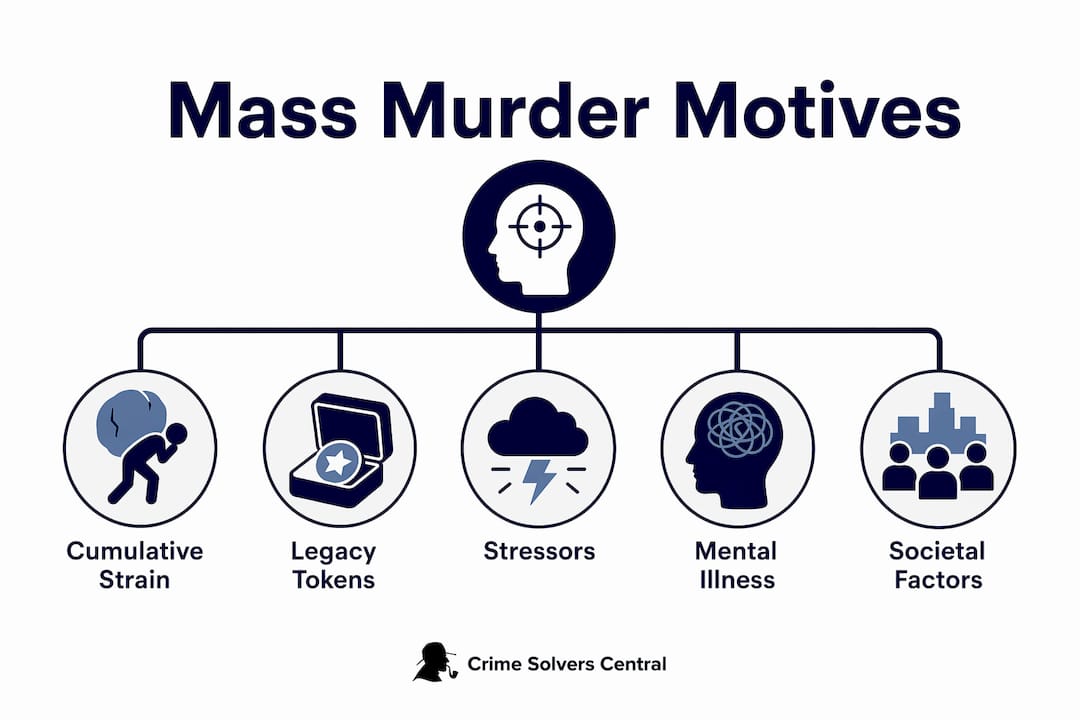
Legacy tokens, including manifestos, videos, and social media posts, are a distinct psychological feature of many famous mass murder cases. Qualitative analysis of perpetrator writings shows these documents are crafted to construct notoriety, not to confess genuine motives. Public-facing documents differ substantially from private writings, reflecting performative identity construction rather than raw psychological distress.
Pro Tip: When analyzing a perpetrator’s manifesto, treat it as a public relations document, not a confession. Cross-reference it with private communications, behavioral records, and witness accounts to identify the actual strain pattern underneath the constructed narrative.
Which societal factors predict mass shooting incidents?
Structural conditions predict mass shooting incidents more reliably than individual pathology. State-level analysis of data from 2018 to 2024 identifies income inequality, measured by the Gini coefficient, as the strongest predictor of mass shooting frequency, with a correlation coefficient of b = 14.73 and p = .007. States with higher income inequality experience more mass shootings, independent of gun laws or mental illness rates.
Mental health infrastructure is a protective factor. States with higher mental health provider density show fewer mass shooting incidents, with a correlation of r = -0.431. Access to treatment reduces risk at the population level. That finding points toward a structural intervention with measurable effect.
| Predictor | Correlation with mass shootings | Direction |
|---|---|---|
| Income inequality (Gini coefficient) | b = 14.73, p = .007 | Positive (higher inequality = more shootings) |
| Mental health provider density | r = -0.431 | Negative (more providers = fewer shootings) |
| Gun ownership rate | r = 0.044 | No significant correlation |
| Gun law stringency | r = -0.121 | No significant correlation |
Gun ownership rates and gun law stringency show no significant correlations with mass shooting frequency when socioeconomic factors are controlled. That finding does not argue against gun policy. It argues that gun policy alone, without addressing structural inequality and mental health access, is insufficient as a prevention strategy.
A counterintuitive finding in this research: states with higher reported mental illness prevalence do not necessarily have more mass shootings. Better diagnostic infrastructure means more people are identified and counted. States with poor mental health systems undercount illness and underserve residents, creating conditions where untreated strain accumulates. The pathway to violence model captures this dynamic precisely. Violence emerges from overlapping, unaddressed stressors, not from a single diagnosable condition.
What are the implications for prevention and media reporting?
Violence prevention works best at the systems level. Threat assessment programs that track cumulative strain patterns, rather than searching for a single red flag, catch more cases earlier. Researchers studying crime hot spot analysis and community risk identification apply similar logic: risk is distributed and structural, not randomly individual.
- Invest in mental health infrastructure. Increase provider density in underserved states and communities. The correlation between provider access and reduced mass shooting rates is one of the clearest findings in current research.
- Apply cumulative strain assessment. Threat assessment teams should document overlapping stressors, not just isolated incidents. A single warning sign is less predictive than three or four converging ones.
- Address income inequality through policy. Housing, employment, and economic mobility programs reduce the structural conditions that generate mass violence risk.
- Train educators and community members. Violence prevention education that reaches teachers and school staff closes gaps that student-focused programs miss.
- Limit perpetrator notoriety in media coverage. Research on contagion effects shows that detailed coverage of perpetrator identity and motive increases the risk of copycat incidents. Responsible reporting focuses on victims and systemic context.
- Support community recovery. Post-incident coordination between mental health services, law enforcement, and community organizations reduces long-term trauma and prevents secondary harm.
Pro Tip: Journalists covering mass shooting incidents should consult reporting guidelines from organizations like the American Foundation for Suicide Prevention, which document how coverage framing affects contagion risk. The same principles that apply to suicide reporting apply to mass violence.
How can researchers and journalists use offender profiles responsibly?
Profiles of mass murderers are most useful when they draw on multiple data sources. Single-source reporting, whether from a manifesto, a law enforcement statement, or a witness account, produces incomplete pictures. Triangulated reporting that combines behavioral records, psychological assessments, and structural context produces findings that hold up to scrutiny.
Legacy tokens require particular care. Because perpetrator manifestos are performative, treating them as transparent windows into motive produces misleading analysis. Researchers should situate these documents within the perpetrator’s documented strain history and social context. Journalists should report on them with explicit framing that acknowledges their constructed nature.
Systemic predictors deserve more column space than individual pathology. Reporting that focuses on income inequality, mental health access, and community strain gives readers a more accurate and more useful picture than profiles centered on personal biography. Crimesolverscentral provides researchers and journalists with access to unsolved homicide statistics and case data that support rigorous, multi-source analysis of violent crime patterns.
Ethical reporting also requires transparency about data limitations. Mass murder databases vary in their inclusion criteria, and definitional inconsistencies across studies make direct comparisons difficult. Researchers should state their definitions clearly and note where data gaps exist. Journalists should reflect those limitations in their coverage rather than presenting findings as more definitive than the underlying research supports.
Key takeaways
Mass murder is a structural and psychological phenomenon driven by cumulative strain, not a single cause, and prevention requires systemic investment in economic equity and mental health infrastructure.
| Point | Details |
|---|---|
| FBI definition matters | Mass murder requires three or more deaths in one location; serial murder involves a cooling-off period between events. |
| Cumulative strain drives risk | Perpetrators average 4.78 co-occurring stressors, making multi-factor assessment more accurate than single-cause explanations. |
| Income inequality is the top predictor | State-level data shows Gini coefficient correlates more strongly with mass shootings than gun laws or mental illness rates. |
| Mental health access reduces risk | Higher provider density correlates with fewer mass shooting incidents at r = -0.431, pointing to a clear structural intervention. |
| Manifestos are performative | Perpetrator legacy tokens are crafted for notoriety, not confession; researchers and journalists must analyze them critically. |
What I’ve learned from studying the causes of mass violence
The most persistent mistake in public discourse about infamous mass killers is the search for a single explanation. Reporters want a motive. Policymakers want a lever. The public wants a story that makes sense. The research does not cooperate with any of those demands.
What I have found, working through case files and empirical studies, is that the pathway to mass violence is almost always a slow accumulation. Job loss compounds relationship failure. Social isolation compounds financial stress. Each stressor alone is survivable. Together, they become something different. The cases that changed investigative practice almost always reveal this pattern in retrospect, visible in behavioral records that were never connected in real time.
The mental illness narrative frustrates me most. It is not wrong that psychological distress plays a role. It is wrong that it plays the role most people assign to it. Focusing prevention resources on identifying “dangerous” psychiatric patients, rather than building the mental health infrastructure that catches people before they reach crisis, is a policy failure dressed up as common sense. The data on provider density makes this clear. We do not need to predict who will snap. We need to build systems that reduce the conditions under which snapping becomes possible.
— Crime
Crimesolverscentral: a resource for serious researchers
Researchers and journalists studying mass violence need access to organized, reliable case data. Crimesolverscentral maintains a national database of over 264,913 cases, cataloged by state and situation, covering missing persons and unsolved homicides. The platform supports community engagement, case tracking, and connections between investigators and the public. For anyone building a rigorous picture of violent crime patterns in the United States, the cold case database offers a structured starting point that goes well beyond what general news archives provide. Crimesolverscentral also features testimonials from families and investigators who have used the platform to advance cases that had gone cold for years.
FAQ
What is the FBI’s definition of mass murder?
The FBI defines mass murder as an incident involving three or more deaths at a single location. This threshold distinguishes mass murder from serial murder, which involves multiple events separated by a cooling-off period.
How do serial killers vs mass murderers differ behaviorally?
Serial killers operate across multiple events over time, with deliberate pauses between killings. Mass murderers act in a single, concentrated incident, often driven by cumulative psychological and social strain rather than predatory planning.
What are the most common motives of mass murderers?
Research shows perpetrators typically carry an average of 4.78 co-occurring stressors, including job loss, relationship breakdown, financial crisis, and social isolation. No single motive dominates; cumulative strain is the consistent pattern.
Does mental illness cause mass shootings?
Mental illness is not a reliable standalone predictor of mass shootings. States with higher mental illness prevalence do not necessarily have more incidents. Low mental health provider density, not illness rates, correlates with higher mass shooting frequency.
Why do mass murderers leave manifestos?
Perpetrator manifestos are primarily performative documents crafted to construct a public identity and secure notoriety. Qualitative research shows they differ substantially from private writings and should not be treated as straightforward confessions of motive.