

Missing Children: What Families and Advocates Must Know

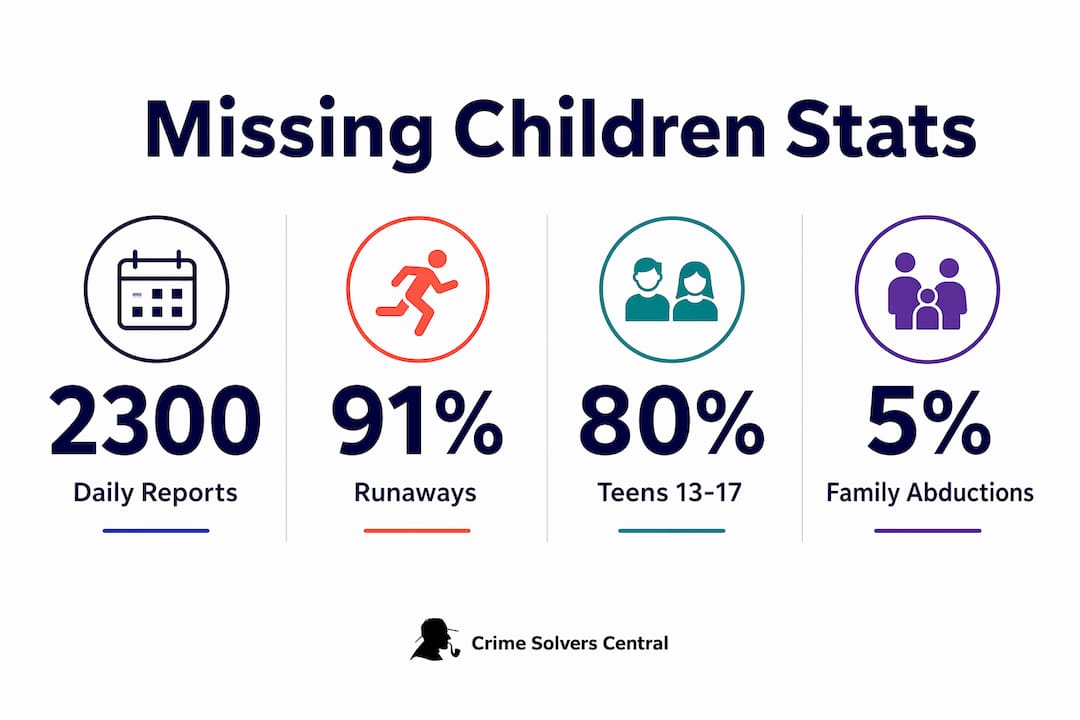
Missing children cases in the United States average about 2,300 reports per day, with the National Crime Information Center logging over 363,000 entries in 2023 alone. That volume sounds alarming, but the full picture is more nuanced. The vast majority of children are recovered safely within the year, and most cases involve runaways or family situations rather than stranger abductions. Understanding the real patterns behind these numbers is the first step toward responding effectively, whether you are a parent, an advocate, or a community volunteer.
What types of missing children cases exist?
Missing children cases fall into five distinct categories, and the differences between them shape how families and law enforcement should respond.
Runaways account for 91% of cases reported to the National Center for Missing & Exploited Children (NCMEC). That figure reframes the public perception of missing children entirely. Most of these children leave voluntarily, often fleeing unsafe home environments, abuse, or mental health crises.

Family abductions, where a parent or relative takes a child in violation of a custody order, represent roughly 5% of cases. These situations can cross state or international lines quickly, which is why the FBI coordinates with local agencies and prosecuting offices in international parental kidnapping cases. Non-family or stranger abductions are statistically rare, accounting for less than 1% of reports, but they carry the highest risk of serious harm.
Two categories receive less public attention but demand it. Approximately 1 in 7 children reported to NCMEC were likely victims of sex trafficking. These children are often first entered into the system as runaways, which means the trafficking connection goes undetected without careful screening. Lost or wandering children, typically very young, form a smaller subset and are usually resolved quickly with community help.
Case type breakdown at a glance:
| Case Type | Share of Reports | Key Characteristic |
|---|---|---|
| Runaways | ~91% | Voluntary departure, often reflects home instability |
| Family abductions | ~5% | Custody violations, may cross state lines |
| Trafficking related | ~1 in 7 of NCMEC cases | Often misclassified as runaways initially |
| Stranger abductions | Less than 1% | Rare but highest severity |
| Lost or wandering | Small subset | Typically very young children, fast resolution |
Pro Tip: If a child you know has run away before, document each incident with dates, locations, and any known contacts. This record becomes critical if a future disappearance involves trafficking.
Who is most at risk among missing children?
Older teens carry the greatest statistical burden. Teens aged 13–17 make up nearly 80% of missing children reports. That concentration reflects the runaway dynamic: adolescents have the mobility and motivation to leave, especially when home conditions are unsafe.
Race and systemic inequality shape the data in ways that demand honest attention. Black children represent approximately 34% of missing cases while comprising only 14% of the child population. That gap reflects systemic disparities in housing stability, access to mental health services, and media coverage. Cases involving Black children historically receive less news attention, which reduces the public tip volume that drives recoveries.
Youth in foster care face elevated risk compared to children in stable family settings. The instability of placement changes, combined with gaps in supervision, creates conditions where disappearances go unnoticed longer. Girls are slightly more often reported missing than boys, a pattern tied to the higher rate of trafficking targeting female youth.
Key risk factors at a glance:
- Teens aged 13–17 (nearly 80% of all reports)
- Black children (34% of cases, 14% of population)
- Youth in foster care or group home placements
- Children with untreated mental health conditions
- Youth with prior runaway history or online contact with unknown adults
Online enticement has become a primary pathway for runaways who connect with traffickers or predators before leaving home. Recognizing that risk early, through open conversations about online safety, is one of the most direct forms of prevention available to families and community workers.
How do law enforcement and nonprofits find missing children?
The recovery system for missing children runs on coordination between federal agencies, local police, and nonprofit organizations. Each layer plays a distinct role.
The FBI maintains jurisdiction over international parental kidnapping and cases that cross state lines. Local police enter reports into the National Crime Information Center (NCIC), the federal database that law enforcement agencies nationwide can query in real time. NCMEC operates the CyberTipline and the hotline 1-800-THE-LOST, providing 24/7 reporting access and connecting families to investigators and support services.
Alert systems are the most visible part of the public response. The AMBER Alert system carries a 92% success recovery rate and has helped recover over 1,200 children since its launch. AMBER Alerts activate when law enforcement confirms an abduction, has a suspect description or vehicle information, and believes the child is in danger. Not every missing child qualifies, which is why families sometimes feel frustrated when an alert is not issued.
Steps law enforcement and nonprofits take in an active case:
- Enter the child into NCIC immediately, with no mandatory waiting period required by federal law.
- Distribute alerts through AMBER, state emergency systems, and wireless emergency broadcasts.
- Coordinate with NCMEC for case support, family resources, and forensic services.
- Use social media distribution to reach local communities fast.
- Collect and analyze tips from the public, which contribute to over 50% of successful recoveries.
Technology has expanded the toolkit significantly. Facial recognition software, geofencing alerts, and digital forensics on devices help investigators trace a child’s movements. Social media sharing amplifies reach beyond traditional media, engaging communities that might not watch local news. Nonprofits focused on child and family resources also provide trauma counseling, legal guidance, and financial support to families navigating the process.
Pro Tip: When contacting NCMEC or local police, bring a recent photo taken within the last 30 days. Older photos slow the identification process and reduce the effectiveness of public alerts.
What to do if a child goes missing
Speed is the single most important variable in recovery. Reporting within the first hour leads to a 97% recovery rate, according to NCMEC research. Every hour of delay narrows the geographic search area that remains practical.
Immediate steps for families:
- Call 911 and file a local police report. Federal law requires police to enter the child into NCIC immediately. Do not accept a “waiting period” response.
- Contact NCMEC at 1-800-THE-LOST to open a case and access support services.
- If the case involves international travel or a custody violation across state lines, file both local and federal reports to activate FBI coordination.
- Provide the clearest, most recent photo available, along with physical descriptions, clothing, known contacts, and any digital device information.
- Ask law enforcement to request an AMBER Alert if the criteria are met. If they decline, ask for the specific reason in writing.
- Share information through social media immediately, using the child’s name, photo, and last known location.
Families often make avoidable mistakes that slow the process. Waiting to see if the child comes home on their own is the most common. Avoid common reporting delays by treating any unexplained absence as urgent from the first moment.
Community volunteers play a real role. Sharing verified information through neighborhood networks, participating in organized searches, and submitting tips to law enforcement all contribute directly to recovery. Public tips drive more than half of successful outcomes, which means every community member is a potential asset. Learning how to build a case file helps advocates organize information that investigators can actually use.
Key Takeaways
Rapid reporting combined with coordinated law enforcement and community involvement produces the highest recovery rates for missing children.
| Point | Details |
|---|---|
| Speed of reporting matters most | Reporting within the first hour produces a 97% recovery rate per NCMEC data. |
| Runaways dominate the statistics | About 91% of cases involve runaways, often reflecting deeper social or family instability. |
| Demographic disparities are real | Black children represent 34% of missing cases despite being 14% of the child population. |
| AMBER Alerts work when criteria are met | The AMBER Alert system carries a 92% success recovery rate and has recovered over 1,200 children. |
| Community tips drive recoveries | Public tips contribute to over 50% of successful recoveries, making community involvement critical. |
What the data on missing children reveals about our priorities
The statistic that stops me every time is the runaway figure. Nine out of ten missing children reports involve a child who chose to leave. That is not a law enforcement failure. It is a signal that something in that child’s life became unbearable enough to make the street feel safer than home. We spend enormous energy on recovery, which is right and necessary. We spend far less on the conditions that push children out the door in the first place.
The racial disparity in missing children cases is not a data anomaly. It reflects which families receive less media coverage, which communities have fewer resources to sustain a search, and which children are more likely to be misclassified as runaways when they are actually trafficking victims. Advocates who want to make a real difference should focus attention on these overlooked cases, not just the ones that make the news.
Technology has genuinely improved outcomes. Social media sharing, facial recognition, and real-time database access have shortened recovery timelines in ways that were not possible a decade ago. But technology only works when someone files the report. The families who wait, hoping the child will come back on their own, lose the window where speed matters most.
Trauma-informed support for recovered children is the piece most communities still get wrong. A child who ran away or was trafficked needs mental health care, not interrogation. The recovery is not over when the child is found. Sustained support determines whether they stay safe long term.
— Crime
Crimesolverscentral and the search for missing children
Crimesolverscentral maintains a national database of over 264,913 cases, organized by state and situation, giving families and advocates a direct way to search for information on missing persons, including children. The platform supports community members through membership, fundraising, and health and safety initiatives. Families who have used the database describe it as a resource that kept their cases visible when official channels moved slowly. Advocates can search the cold case database by state to identify patterns, locate overlooked cases, and connect with others working toward the same outcomes. If you are looking for a place to direct your energy, this is a practical starting point.
FAQ
How many children go missing in the US each year?
Over 363,000 missing child entries were recorded in the NCIC database in 2023, which equals roughly 2,300 reports per day. The majority are recovered within the year.
What is the most common type of missing child case?
Runaways account for about 91% of cases reported to NCMEC. Stranger abductions are statistically rare, representing less than 1% of reports.
How quickly should I report a missing child?
Report immediately. Reporting within the first hour is linked to a 97% recovery rate. There is no legal waiting period required before filing a missing persons report.
What role does the community play in recovering missing kids?
Public tips contribute to over 50% of successful recoveries. Sharing verified information, participating in organized searches, and calling in tips to law enforcement all directly improve outcomes.
Where can I find missing children resources and case information?
NCMEC operates a 24/7 hotline at 1-800-THE-LOST and the CyberTipline for online exploitation reports. Crimesolverscentral provides a searchable missing persons database organized by state for families and advocates seeking case information.