

Missing Person Flyers: Families, Use One Photo and Call Police

Use a clear, one-photo poster with essential vitals and the investigating agency’s phone number or 1-800-THE-LOST, then print and share it immediately. Pick a template sized for its intended use, with a large headshot, last-seen details and one official contact. Before you publish, call local law enforcement to confirm which number belongs on the page, and save a printable file.
TL;DR:
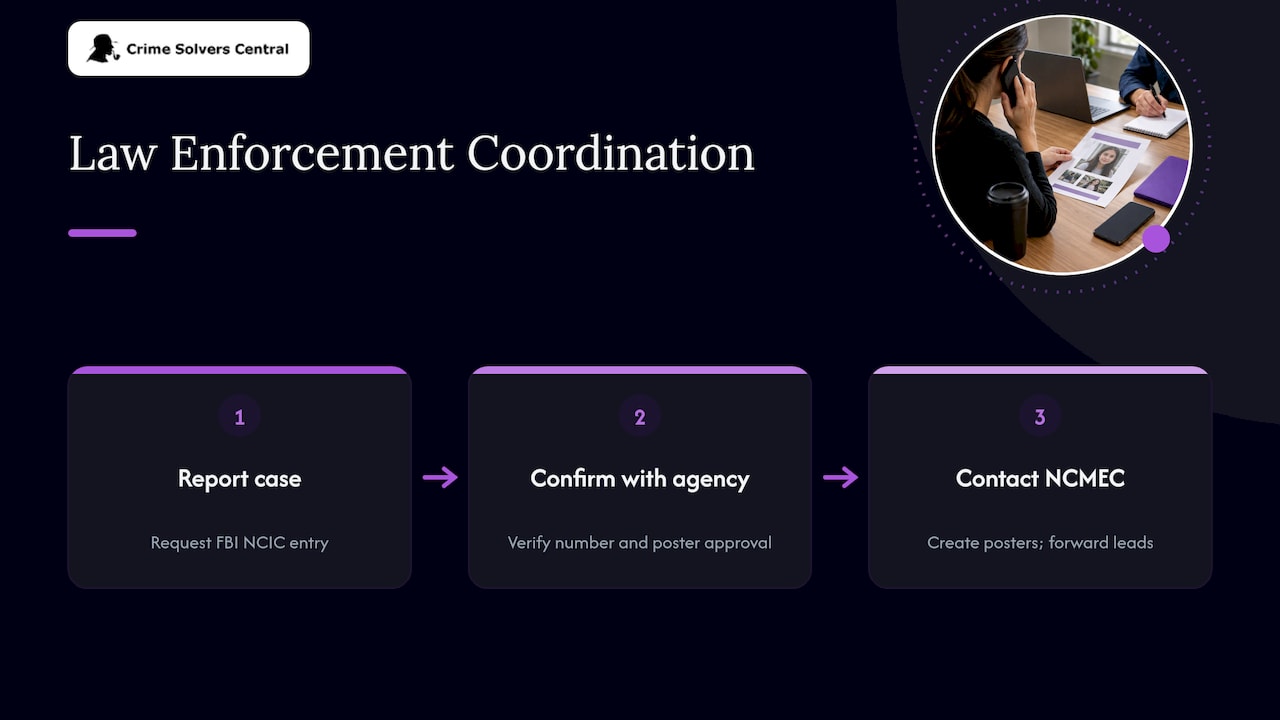
- There is no waiting period to report a missing person in the United States; ask police to enter the case in the FBI’s NCIC database.
- Before wide distribution, confirm the agency’s phone number and whether investigators will approve or supply a poster; NCMEC can create and circulate one.
- List the full name, recent photo, last seen date and place, physical details, the agency number, and NCMEC’s 1-800-THE-LOST hotline; omit personal contacts and unverified claims.
- Ask businesses before posting, and note that USPS generally accepts only missing child posters supplied by NCMEC for postal facility bulletin boards.
- Assign one person to maintain the master file, verify changes with investigators, and remove or correct older print and social copies whenever details change.
Table of Contents
- Which missing person flyer templates should you start with?
- What design rules make a flyer readable at a glance?
- What should a missing person poster say, and what should it leave out?
- How do you print and share the flyer for the widest reach?
- Why should you coordinate with law enforcement before wide distribution?
- How do you keep flyer information accurate over time?
- How do you design a missing person flyer for multiple languages?
- Should you add a QR code to a missing person flyer?
- Our perspective: a flyer is only as strong as the coordination behind it
- FAQ
- Sources
Which missing person flyer templates should you start with?
You do not need to design from scratch. You need the right format for where the flyer will live, and a template that leaves room for the facts that matter.
Choose by use case:
- Large poster: best for community boards, store windows, transit stops and anywhere people read from a distance.
- Handout: best for door-to-door distribution, volunteer packets and church or school tables.
- Square and story images: best for social feeds, where one image has to carry the whole message at phone size.
- Downloadable Word or PDF templates: easiest if you want to type, print and revise at home without learning new software.
- Web-based poster makers: useful when you want a free starting layout and quick resizing between print and social formats.
- Free stock and PSD poster assets: a good fit if a volunteer designer is helping and needs editable layers.
Whatever you open, apply three selection rules. First, the photo area should be large, because the face is what people recognize. Second, the headline area should hold “MISSING” or a name in big type. Third, the template needs a dedicated block for the agency contact and last-seen details, so those never get squeezed into a corner.
The U.S. Department of Justice family guide includes an appendix poster template and ties it to coordination with law enforcement, which makes it a reasonable reference for what a complete layout looks like. You can read it in When Your Child Is Missing: A Family Survival Guide. If you are working through the first hours after a report, our guide on the first steps for families after a runaway or missing person report walks through what to do before you ever open a design tool.
What design rules make a flyer readable at a glance?
People may glance at a flyer only briefly. Design for that moment, not for a careful reader.
Follow this order and these rules:
- Photo: use a recent, high-quality head-and-shoulders image, cropped tight to the face. Avoid group shots, sunglasses and heavy filters.
- Headline: put “MISSING” or the person’s name at the top in very large type, then the photo, then the vitals in short bullets.
- Typography: choose a clean sans-serif or a clear serif font. Make body text large enough to read from a comfortable distance.
- Contrast: use dark text on a light background, or the reverse. Skip pale grays, thin script fonts and text laid over a busy photo.
- Layout: keep one column of information with plenty of white space. Crowded flyers get ignored.
- Accessibility: when you post the image online, add a text description or repeat the core facts in the caption. Do not let color or graphics carry essential information alone.
On that last point, accessibility guidance for printed and digital materials recommends high-contrast, simple fonts with clear character height and warns against relying only on graphics for critical details, since screen readers cannot interpret them. See the Minnesota State accessibility guidance for the reasoning.
Pro Tip: Build a simplified social version of the same flyer with identical core facts and a single photo, so the print poster and the online image never contradict each other.
For more on the habits that help and hurt a search effort, our rundown of common mistakes in missing persons searches covers errors that often start with a cluttered or inaccurate flyer.
What should a missing person poster say, and what should it leave out?
Treat this as a checklist you can paste into the template and fill in one line at a time. Missing any of these fields makes a flyer less useful to the person who might recognize the face.
Include these fields:
- Full name and date of birth or age
- A recent, clear photo
- Date and location last seen
- Gender, height and weight
- Eye and hair color
- Identifying marks such as tattoos or scars
- Clothing at the time last seen, if known
- The investigating law enforcement agency’s official number, plus the NCMEC hotline, 1-800-THE-LOST (1-800-843-5678)
NCMEC says a poster needs the full name, date of birth, gender, height, weight, date and place of disappearance and a clear recent photo, along with a direct call to action and either the investigating agency or its 24/7 hotline. Its guidance is laid out in Don’t Be Fooled: Tips for Spotting Fake Missing Child Posters.
Leave these off:
- Your home address, personal phone number or personal email
- Unverified private allegations or rumors
- Details that could endanger the person, such as trafficking status or involvement with social services
Scammers target families who list personal contact details, which is why the Federal Trade Commission advises routing contact through official channels. Its alert on scammers creating fake emergencies explains how that plays out.
Sample call to action: “If you have information, call [agency number] or 1-800-THE-LOST.”
How do you print and share the flyer for the widest reach?
Export your final file at a high resolution so faces stay sharp in print. Use large posters for community boards and smaller sheets for handouts. If a poster will hang outdoors, laminate it or use a weatherproof sleeve, because rain can quickly make paper unreadable.
Where and how to share:
- Last-seen area first: the people most likely to recognize the person are the people who were near the place and time. Start there, then widen to places the person frequented.
- Community boards and businesses: ask permission, and follow each venue’s posting rules.
- Transit stops and local shops: high foot traffic, but check the rules before you tape anything up.
- Social media: post one clear image, include the official contact, ask respectfully for shares and consider a short hashtag so volunteers can track reach.
- Donated printing: ask local print shops, nonprofits and churches about discounted or free copies, and keep a volunteer list so distribution is covered.
One caution on post offices. USPS policy states that postal facilities generally display only missing-children posters provided by NCMEC, so a homemade flyer will not be accepted for a lobby board. Details are in the USPS Postal Bulletin. The DOJ guide for families of missing American Indian and Alaska Native adults also notes that local businesses may donate printing and that volunteers can help with placement, as described in When a Loved One Goes Missing.
Why should you coordinate with law enforcement before wide distribution?
A flyer that goes out before police know about it can scramble tips, expose details investigators want held back, and send calls to a number nobody monitors. Coordination fixes all three.
Start with the report. There is no required waiting period to report a missing person in the United States, and you should ask the agency to enter the case into the FBI’s NCIC database. Tanana Chiefs Conference summarizes that guidance.
Then ask the investigating agency two things: which contact number to print, and whether it will approve or supply an official poster. Experts also advise designating a single family media contact and checking with investigators before wide dissemination, as the DOJ family survival guide explains.
After law enforcement has been notified, call NCMEC at 1-800-THE-LOST. According to NCMEC’s guidance for families, it can rapidly create and disseminate posters and forward leads to the investigating agency. It also offers case management, poster distribution and a 24-hour call center, as described on its missing from care page. One verified contact keeps every tip in one place.
How do you keep flyer information accurate over time?
A flyer is a snapshot, and snapshots go stale. A wrong detail can send the public looking for someone who no longer matches the description, or leave out the one clue that would have jogged a memory.
Build a short routine:
- Assign one owner. One family member or volunteer keeps the master file and approves every change, so no one prints an old draft by accident.
- Confirm facts with investigators. Before you add or change a detail, check it with the agency handling the case, especially clothing, vehicles and timelines.
- Version your files. Name each export with a date, such as “flyer-v3-March-12,” and delete older print copies from shared folders.
- Proofread against a source. Compare name spelling, date of birth, height and phone numbers to an official record. NCMEC flags misspellings, syntax errors and missing official contacts as red flags on fake posters, so careless errors can also make your real one look suspicious.
- Retire old copies. When you reprint, collect or cover posters that carry outdated information.
- Announce corrections. Update social posts and pin the new version. Do not quietly edit a shared image that many people have already saved.
Review the flyer regularly while the case is open, and any time investigators release new information. If the contact number changes, treat that as an emergency reprint. Keeping everything tied to a single verified number also protects the family from copycat posters and from callers who try to exploit a crisis, the pattern the FTC describes in Frosty the Con Man.
How do you design a missing person flyer for multiple languages?
A flyer only works if the neighbors who might have seen something can read it. In many communities, that means more than one language.
Practical choices:
- Pick languages from the area. Ask community leaders, schools and faith groups which languages are common near the last-seen location, and translate into those first.
- Use a human translator. Machine translation can mangle names, dates and instructions. Have a fluent speaker check the final text, and ask a second person to read it back.
- Keep the English core intact. Put the same facts in the same order in every version: name, photo, last seen, vitals, contact. People comparing two versions should see matching information.
- Choose a layout. Side-by-side columns can work on larger posters. For smaller handouts, make separate single-language sheets instead of squeezing languages onto one page.
- Mind fonts and direction. Confirm that your font supports the language’s characters, and set right-to-left languages correctly so numbers and phone digits do not flip.
- Do not translate proper names. Keep the person’s name, the agency name and phone numbers exactly as official records show them.
- Match the call to action. Check with the agency on whether its tip line has interpreters, and say so on the flyer if it does.
Share each language version where speakers of that language gather: community centers, local radio, houses of worship, grocery stores and group chats. One accurate flyer in the right language will travel farther than a perfect one nobody can read.
Should you add a QR code to a missing person flyer?
A QR code can send a phone straight to the latest official information, which means the paper copy in a window never has to be reprinted to stay current. Used well, it keeps the printed flyer simple while the digital page does the updating.
Make it safe and useful:
- Link to an official or approved page. Point the code to the investigating agency’s case page, a verified NCMEC poster or a page the agency has signed off on. Do not link to a personal profile or a donation request.
- Keep the code large. Print it large enough to scan with white space around it, and test it on phones before making copies.
- Add a plain-text backup. Always print the phone number next to the code, since not everyone can or will scan.
- Use a short, stable link. Choose a link you control so you can change the destination later without reprinting.
- Label it clearly. A short line such as “Scan for updates” tells people what they will get.
- Watch for tampering. Scammers sometimes paste their own codes over real ones. Check posted flyers periodically, and tell volunteers to report any sticker covering the original.
On social media, a single image with the official contact and a link in the caption does the same job. Keep the digital page current, and mirror every correction you make on the flyer. If you want to see how families track cases across states, our guide to the official missing persons database is a useful companion.
Our perspective: a flyer is only as strong as the coordination behind it
We run Crime Solvers Central as a national cold-case resource, and our flyer builder and community tools exist to help families and volunteers produce clear posters quickly. We also see what goes wrong when excitement outruns coordination. Call law enforcement first, confirm the number you publish, and use the official hotlines on every page you print. The best flyer is the one investigators trust enough to circulate with you.
— Crime
FAQ
What to put on a missing person poster?
Include a recent photo, the full name, date of birth or age, physical description and the date and place last seen. Add the investigating agency’s phone number and the NCMEC hotline, 1-800-THE-LOST. Leave off home addresses and personal contact details.
How can I make my own homemade posters?
Start with an editable template in Word, PDF or a free web poster maker. Put a large photo and a bold “MISSING” headline at the top, then add vitals and contact information. Have law enforcement confirm the details before you print.
What are some cool things to put on a poster?
For a missing person flyer, clarity beats creativity. Stick to a sharp photo, strong contrast and a short list of facts. A scannable QR code that links to an official update page is the one extra that adds real value.
How to write a message for a missing person?
Keep it short, factual and direct. State who is missing, when and where the person was last seen, and what action you want the public to take. Close with a line such as “If you have information, call [agency number] or 1-800-THE-LOST.”
Sources
- Don’t Be Fooled: Tips for Spotting Fake Missing Child Posters
- When Your Child Is Missing: A Family Survival Guide
- About