

Act Fast: 4 Steps for U.S. Families After a Runaway or Missing Person
A runaway is someone who left a known location on their own; a missing person is anyone whose whereabouts are unknown, for any reason. The label matters less than the facts behind it: police classifications can change as soon as new evidence appears, and systems like NCIC and AMBER Alert respond to risk indicators, not to the word a family first used.
TL;DR:
- Police must take a juvenile runaway report and enter it into NCIC within two hours after receiving it; no waiting period applies.
- Ask whether investigators have classified the case as endangered if there are threats, signs of struggle, coercion, or sudden silence from someone usually in contact.
- Gather a recent photo, clothing details, device and social media information, and likely destinations; preserve messages and activity timestamps instead of editing accounts.
- Ask the agency whether AMBER Alert criteria apply; state coordinators decide activation, and a runaway label alone does not settle the question.
- In most states, turning 18 makes voluntary departure an adult choice, and police generally cannot compel a return without a separate concern.
Table of Contents
- What do “runaway” and “missing person” actually mean?
- How NCIC entries and the Missing Person Circumstances code work
- How police response changes based on risk, not labels
- What the numbers say about runaway cases and risk
- What to do in the first hours after someone goes missing
- Where to turn for help right now
- What the law actually says about runaway status
- Why people run, and why it is rarely simple
- What happens after someone is found
- Early steps that reduce the chance of a repeat incident
- Custody disputes and jurisdiction complicate runaway cases
- Why accurate classification matters to community investigations
- FAQ
- Sources
What do “runaway” and “missing person” actually mean?
“Missing person” is the umbrella term: anyone whose location is unknown to the people who need to find them, regardless of why. “Runaway” is a narrower, voluntary subset, usually applied to a minor who left home or placement without permission and without signs of force.
The gray zone is where families get confused. A teenager who left after a fight and is staying with a friend is typically coded as a runaway. A teenager who left willingly but is now in contact with someone dangerous, or who stops answering calls entirely, can be reclassified as endangered within hours. Age and custody status also shape the picture: an 18-year-old who leaves voluntarily is an adult making a legal choice, while a 15-year-old in the same situation is still a juvenile missing person case that law enforcement must act on.
A few corrections worth making up front:
- Police are required to take a runaway report and enter it into NCIC; there is no waiting period for juveniles.
- “Runaway” is not a legal judgment about the person, it is an investigative category describing how they left.
- A case coded as runaway today can be recoded as endangered or involuntary the moment new facts emerge.
How NCIC entries and the Missing Person Circumstances code work
Every missing-person report that reaches a law enforcement agency can be entered into the FBI’s NCIC Missing Person File, a national database that other agencies search during traffic stops, welfare checks, and death investigations. The Missing Person Circumstances (MPC) field is the part that tells responding officers why the person is believed to be missing.
Common MPC categories include:
- Runaway: the person left voluntarily and is believed safe but unlocated.
- Endangered: the person’s safety is in doubt due to age, health, or circumstances.
- Involuntary: evidence suggests the person did not leave by choice.
- Juvenile: used alongside other codes to flag that the missing person is a minor.
The MPC field is optional, which means not every entry carries one, but when agencies do use it the coding shapes who gets notified and how urgently. Federal guidance tied to the DOJ’s missing person entry fact sheet requires juvenile reports to be entered into NCIC within two hours of the report being received, and records stay active and searchable until the person is located or the entry is canceled.
How police response changes based on risk, not labels
Officers responding to a missing-person call do not simply accept the first label a family offers. Standard triage includes:
- Interviewing the reporting party and anyone who last saw the person.
- Checking the person’s phone, computer, and social media activity for recent contact.
- Preserving the last known location as a scene if anything looks disturbed.
- Searching likely destinations: friends’ homes, transit hubs, known hangouts.
AMBER Alert best-practices guidance explicitly warns officers against assuming an adolescent left voluntarily, because that assumption can delay the search window that matters most in an actual abduction. A case moves from runaway to endangered or involuntary when investigators find signs of foul play, confirmed threats from a third party, a pattern of coercion, or a sudden, unexplained silence from someone who was previously in regular contact.
Pro Tip: If officers use the word “runaway” on first contact, ask directly whether the case has been coded as endangered given any specific details you can share, since that question alone can prompt a second look.
What the numbers say about runaway cases and risk
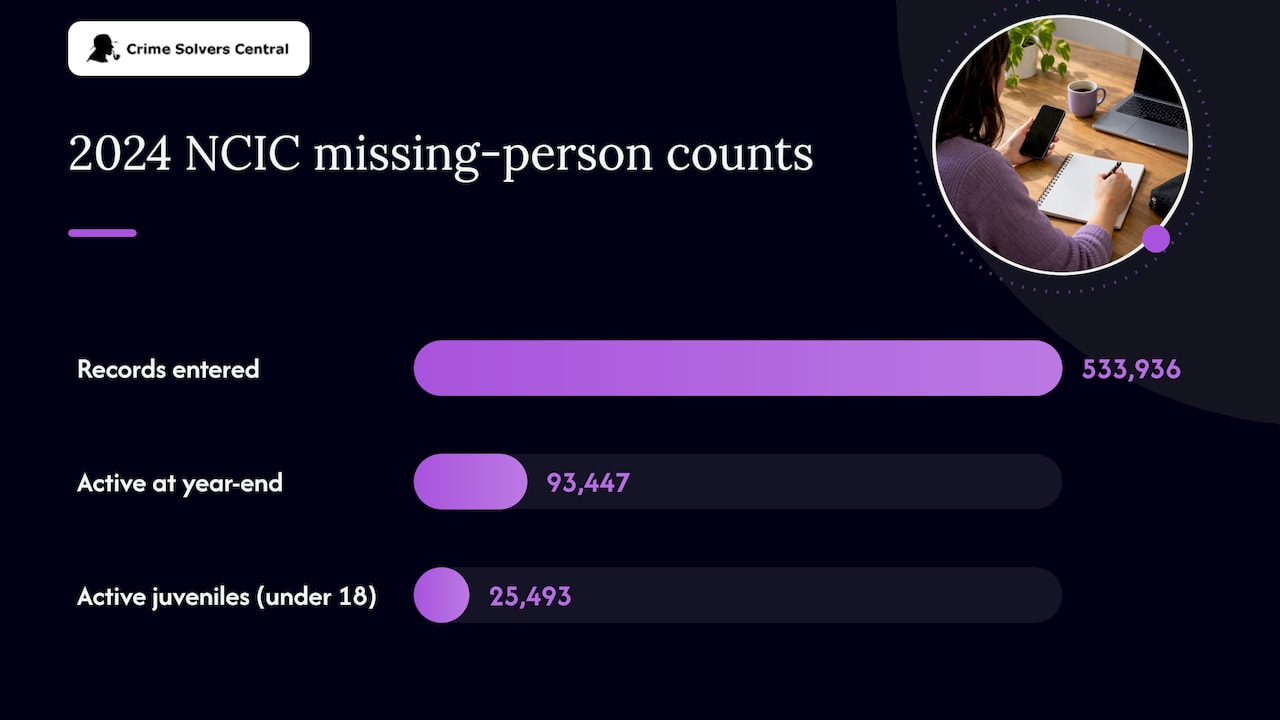
During 2024, agencies entered 533,936 missing-person records into NCIC, with 93,447 active at year’s end, including 25,493 juveniles under 18.
The majority of coded entries were Runaway when agencies used the optional MPC field in 2024, based on FBI NCIC data showing most MPC-coded entries. That high share explains why most missing-minor cases resolve without an abduction ever being involved, but it does not mean every coded entry is low-risk: the same data set is the reason investigators treat the MPC field as a starting point, not a verdict. Research under the NISMART framework groups missing-children episodes into five categories, including family abduction, nonfamily abduction, runaway or thrown-away, lost or injured, and benign explanations like a missed curfew. Families should treat prior threats, signs of forced entry or struggle, and sudden device silence as reasons to push for an endangered classification immediately rather than wait.
What to do in the first hours after someone goes missing
The first few hours shape how fast an investigation moves. Follow these steps in order:
- Call local law enforcement immediately and get a case number before you hang up.
- Ask explicitly whether the report will be entered into NCIC and request the entering officer’s name or badge number.
- Contact the National Runaway Switchboard and NCMEC to log the case with national clearinghouses.
- Ask the responding agency directly whether AMBER Alert criteria apply given the specifics you’ve shared.
Bring or gather this information before or during the call:
- A recent, clear photo and a full physical description, including clothing last worn.
- Device details: phone model, carrier, and any location-sharing apps already installed.
- Social media handles, recent posts, and names of people the person was last in contact with.
- A list of likely locations: friends’ homes, routine spots, past patterns if this has happened before.
Federal guidance referenced in the OJJDP family quick-reference guide sets a two-hour window for juvenile NCIC entry, so if that window passes without confirmation, call back and ask for a status update. Preserve everything digital: take screenshots of last messages, note timestamps of app activity, and avoid deleting or editing social accounts, since investigators may need that history intact.
Pro Tip: Keep a written log of every call you make, including the time, the agency, and the name of whoever you spoke with. It becomes invaluable if the case needs to be escalated later.
For a more detailed walkthrough of building this documentation, see how to build a missing person case file.
Where to turn for help right now
A handful of organizations exist specifically to support families through this process:
- National Runaway Switchboard (1-800-RUNAWAY): confidential crisis support, mediation, and help coordinating a return home.
- NCMEC and state missing-child clearinghouses: formal reporting channels that coordinate with law enforcement and can distribute alerts.
- AMBER Alert coordinators: state-level officials who decide whether a case meets activation criteria; the AMBER Alert official site lists contacts and current guidance.
- Safety and tracking resources: for families weighing prevention tools, safety steps if someone is trying to abduct you and a neutral comparison of satellite messengers versus GPS trackers cover practical, consent-based options.
For state-by-state entries already in the system, our overview of active NCIC records by state is a useful starting point.
What the law actually says about runaway status
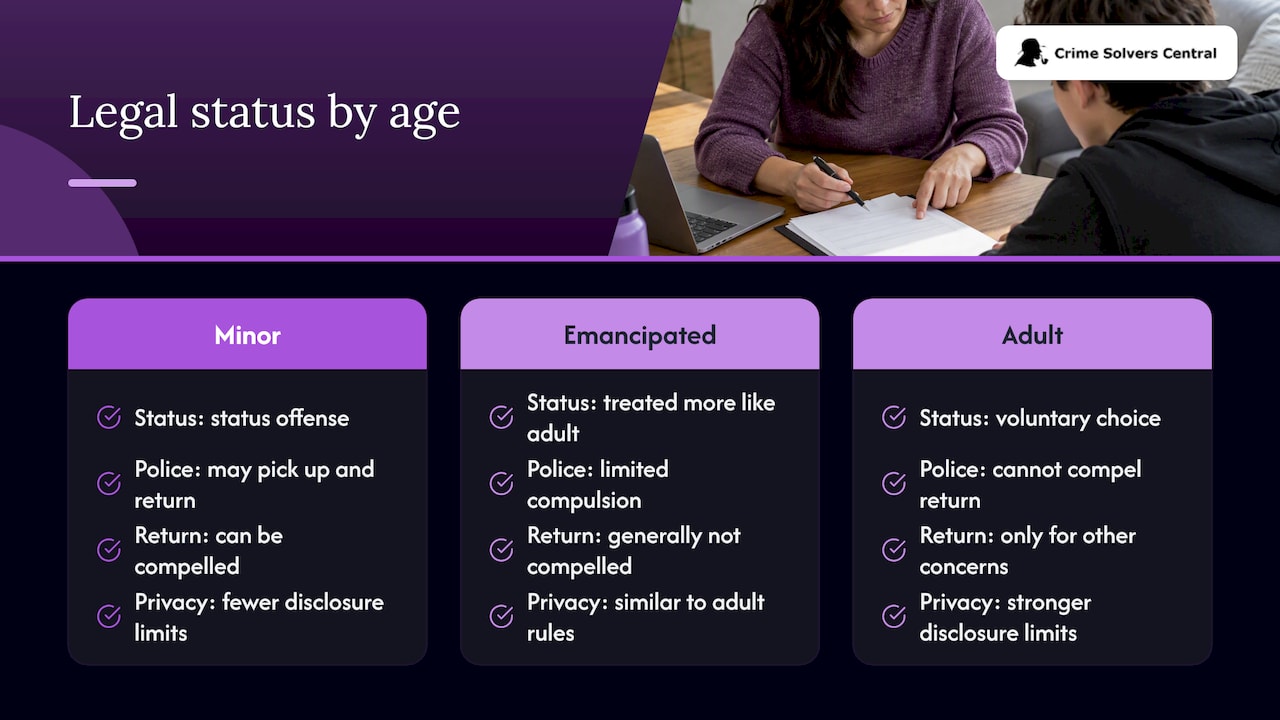
Running away is not, by itself, a crime in most states; it is typically handled as a status offense, meaning it is only an issue because of the person’s age, not because of any underlying illegal act. That distinction matters because it shapes how police and courts are permitted to respond: a runaway minor can be picked up and returned to a parent or guardian, but is not arrested or charged the way an adult offender would be.
The legal picture shifts at the age of majority, which is 18 in most states, though a handful of set 16 or 17 for certain purposes. Once someone reaches that threshold, leaving home voluntarily is a legal adult decision, not a status offense, and law enforcement generally cannot compel a return against the person’s will absent a separate concern like a mental health crisis or an outstanding warrant. Emancipated minors occupy a middle category: a court-recognized emancipated 16 or 17-year-old is legally treated more like an adult for the purpose of voluntary absence, even though they have not reached full age of majority.
These legal boundaries also affect what police can tell a worried family. Privacy protections sometimes limit what officers disclose about an adult who has been located but does not want their location shared, which can feel like a dead end even after the case is technically resolved.
Why people run, and why it is rarely simple
Runaway behavior is overwhelmingly a response to an intolerable situation rather than impulsive rebellion. Conflict at home, including arguments over rules, sexuality, or a new household member, is one of the most common triggers. Abuse or neglect, whether physical, emotional, or sexual, pushes many young people to leave as a form of self-protection rather than defiance.
Other cases are driven by mental health struggles, substance use, or pressure from peers and romantic partners who encourage leaving. Economic strain, housing instability, or a recent move can also make staying feel unbearable even without an acute crisis at home.
This is a meaningful contrast with other missing-person categories, where the person had no agency in their disappearance. A family abduction or a stranger abduction involves someone acting against the missing person’s will; a runaway case, by definition, involves a choice, even if that choice was made under serious duress. Treating every runaway as simply “acting out” misses the point: the behavior is frequently a signal that something at home or in the person’s life needs to change, not a problem that ends the moment the person is located.
What happens after someone is found
Outcomes differ sharply depending on how a case was classified from the start. Runaway cases, which make up the overwhelming majority of coded juvenile entries in NCIC, typically resolve with the person returning on their own or being located within days, often at a friend’s or relative’s home.
Involuntary and endangered cases carry a more uncertain timeline and a wider range of outcomes, since they can involve a stranger, a noncustodial parent, or an unknown risk that takes longer to unravel. The NISMART typology separates these categories precisely because recovery patterns, investigative needs, and risk profiles differ so much between them.
Recovery is rarely the end of the story. A young person who ran away once, especially due to unresolved conflict or abuse at home, has a meaningfully higher chance of leaving again unless the underlying issue is addressed. That is why many responding agencies and family advocates push for a follow-up conversation or referral to counseling rather than treating a safe return as case closed. For families supporting someone through this cycle, our guide on what families and advocates must know walks through what tends to help after the immediate crisis passes.
Early steps that reduce the chance of a repeat incident
Most runaway episodes do not come out of nowhere. There is usually a buildup: escalating arguments, withdrawal from family routines, a shift in friend groups, or a sudden change in mood or secrecy around a phone. Catching that pattern early gives families a chance to intervene before a first or second departure happens.
Practical early intervention looks like:
- Creating a low-pressure way for a teenager to voice frustration before it becomes a reason to leave.
- Addressing conflict over rules, identity, or a new household member directly rather than letting it fester.
- Watching for signs of bullying, romantic coercion, or substance use, all of which are common precursors.
- Keeping communication channels open even after a blowup, so a young person has somewhere to return to.
Family counseling and school-based support services are frequently more effective at preventing a repeat episode than discipline alone, since the goal is resolving the underlying conflict rather than simply enforcing compliance. Avoiding some of the common missteps families make during an active search also matters; our breakdown of common mistakes in missing-persons searches covers the errors that slow investigations down.
Custody disputes and jurisdiction complicate runaway cases
Runaway cases involving divorced or separated parents introduce a layer most families do not expect: the question of which parent has legal custody at the moment the minor left. A minor who leaves one parent’s home to stay with the other, non-custodial, parent is still technically a runaway in the eyes of the reporting agency, even though the destination was a known family member.
Jurisdiction adds another wrinkle. A report filed in one city does not automatically transfer if the minor crosses into another county or state, and agencies must coordinate through NCIC and sometimes through separate interstate compacts to keep the case active everywhere it needs to be. This is especially relevant when a minor runs to stay with an out-of-state relative or friend, since local police in the new location may not immediately know a report exists elsewhere.
Custodial disputes can also complicate who is legally allowed to receive updates on the case, since a parent without custody may have limited standing to request information even if they are the one who reported the child missing. When a custody order is contested or unclear, it is worth asking the reporting agency directly how jurisdiction and custody status affect what gets shared and with whom.
Why accurate classification matters to community investigations
Good classification is not paperwork, it is what decides whether a case gets the right level of urgency from the start. We built our missing persons database because families and volunteers need a place to track case details, documents, and updates as classifications evolve, not just a static flyer.
Community members use case profiles, forums, and volunteer coordination tools to support searches already underway, always through documented and safe channels rather than speculation.
— Crime
FAQ
Do the police look for runaway minors?
Yes, police are required to take a report and enter it into NCIC within the federal timeline for juveniles, and they continue to search regardless of the runaway label. The coding affects how notifications are routed, not whether the case gets worked.
What qualifies as a runaway?
A runaway is generally a minor who leaves home, school, or a placement voluntarily and without permission, with no evidence of force or coercion. The classification can change quickly if new facts suggest the person did not leave entirely by choice.
What percent of missing children cases are coded as runaways?
In 2024, the majority of NCIC entries coded with a Missing Person Circumstances field were Runaway, according to FBI NCIC data. That MPC field is optional, so it reflects only the subset of entries where agencies specified a circumstance.
Is a 17-year-old considered a runaway under state law?
In most states, including Michigan, anyone under 18 who leaves home without permission is treated as a juvenile runaway case for reporting purposes, since the age of majority is 18. Specific procedures and status-offense rules vary by state, so a local agency or state clearinghouse is the right place to confirm details for a particular case.
Sources
- 2024 NCIC Missing and Unidentified Person Statistics (FBI)
- Fact sheet: How to Enter Missing Person Records (DOJ)
- AMBER Alert best-practices guide (OJP)