

Serial Killer Victims Database: A Researcher’s Guide

If you need research-ready data on serial killers and their victims, start with five sources: the Radford/FGCU Serial Killer Database, the Radford Serial Killer Information Center’s annual statistics reports, NamUs and NIJ-linked forensic programs, the Consolidated Serial Homicide Offender Database on Harvard Dataverse, and select curated community datasets used only for leads, not conclusions. Each does something different.
- Radford/FGCU: Historic reports have cited thousands of offenders and over thirteen thousand victims in summary counts. Access is via public PDF reports and an offender database maintained by Radford University criminology faculty.
- NamUs/NIJ: Not a killer database at all. It’s a missing-persons and unidentified-remains system that cross-references DNA and dental records, often the missing link between a suspected serial case and a confirmed victim.
- Harvard Dataverse: A machine-readable, downloadable dataset built for statistical analysis rather than casual browsing.
- Community wikis and Serial.Cloud-style projects: Fast, broad coverage, but built largely from media reporting rather than court records.
For active, operational cold-case work, that is, tracking a real missing person or unsolved homicide rather than analyzing historical patterns, Crimesolverscentral’s state-by-state case catalog fills a different gap entirely, one this guide covers later.
Key Takeaways
Choosing the right serial killer victims database comes down to matching institutional rigor and documented sourcing to your specific research question.
| Point | Details |
|---|---|
| Start with Radford/FGCU | Its academic sourcing and multi-decade coverage make it the default reference for offender and victim data. |
| Check the definition standard | Confirm whether a dataset uses the FBI’s 2005 two-victim threshold or the older three-victim standard before comparing counts. |
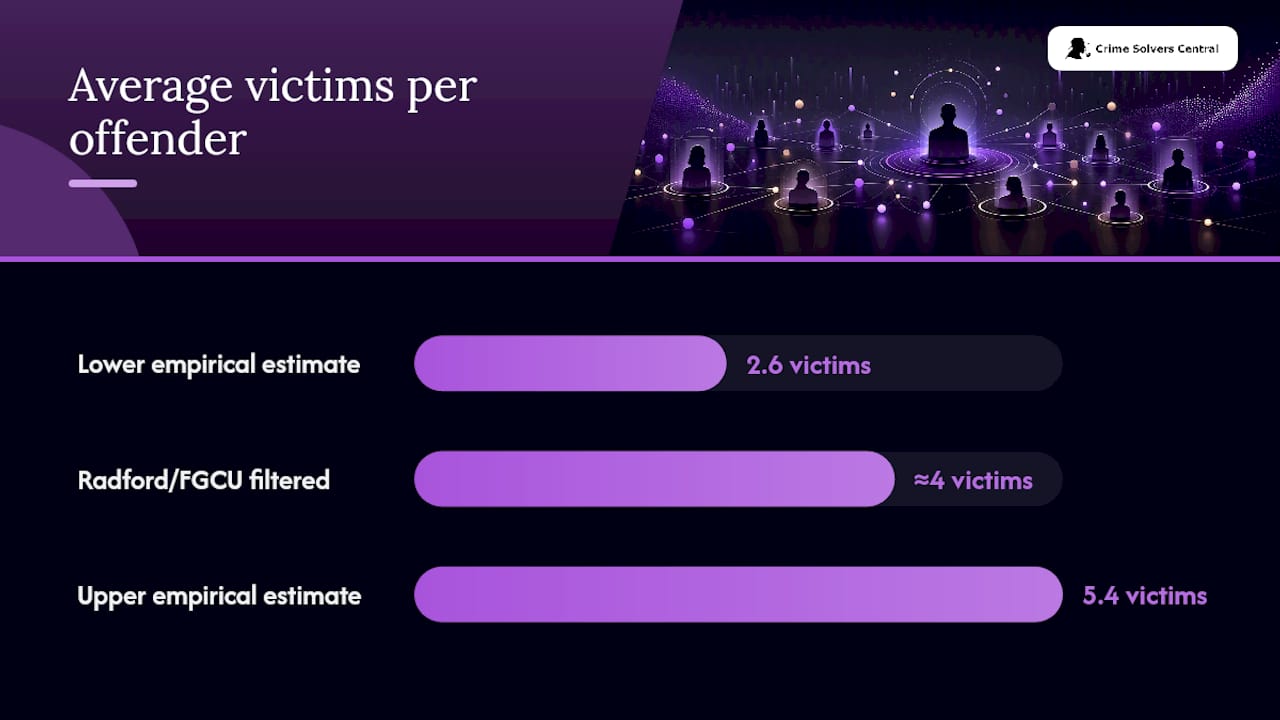
| Expect wide variance in averages | Published victims-per-offender figures range from about 2.6 to 5.4, depending on sample filtering and career-status censoring. |
| Verify before you cite | Cross-check media-sourced entries against court records, and log every duplicate or merge decision. |
| Use Crimesolverscentral for active cases | Its state-by-state cold-case catalog and membership tools support real-time investigative work, not historical analysis. |
Table of Contents
- What Makes a Serial Killer Victims Database Research Grade?
- Which Databases Should Researchers Actually Use?
- How Reliable Is Serial Killer Victim Data, Really?
- How Do You Access and Use This Data Responsibly?
- Why One Well-Vetted Database Beats a Dozen Scraped Lists
- Where Crimesolverscentral Fits for Operational Research
- Sources
- FAQ
What Makes a Serial Killer Victims Database Research Grade?
Not every list of names and dates qualifies as a usable dataset. A database earns academic trust when it documents specific fields consistently across every entry, not just for the famous cases.
At minimum, look for these fields before you cite or build on a dataset:
- Timeline data: dates of first and last known offense, arrest date, and conviction date, not just “active years.”
- Victim demographics: age, sex, race, and relationship to offender (stranger, acquaintance, family).
- Modus operandi (MO): method of killing, victim selection pattern, and disposal method.
- Legal status: convicted, charged, suspected, or exonerated, clearly separated.
- Geographic detail: state and county at minimum; coordinates if the dataset supports spatial analysis.
- Primary-source citations: court filings, prison records, or trial transcripts linked to each entry, not just a news article.
Metadata matters just as much as the fields themselves. Check the dataset’s stated inclusion criteria, when it was last updated, who curates it, and whether entries carry a suggested citation format. A dataset with no visible update timestamp is a dataset you can’t defend in a literature review.
On the technical side, downloadable CSV or JSON beats a static PDF every time you need to run statistics, and any dataset without a clear license or usage terms should raise questions about whether you can legally reuse or redistribute it.
Pro Tip: Check which definition of “serial murder” a dataset uses before you trust its counts. The FBI revised its working definition in 2005, lowering the threshold from three victims or more to two victims or more, and many older reports and newer projects don’t specify which standard they followed. That single choice can shift an offender count by hundreds of cases.
Which Databases Should Researchers Actually Use?
The five major resources differ enough in scope and rigor that picking the wrong one for your project wastes time.
The Radford/FGCU Serial Killer Database, built and maintained by Radford University criminology researchers, remains the most cited academic resource in the field. Its public statistics reports have listed thousands of offender profiles going back to the 19th century, with over 13,000 associated victim records in summary counts. Academic teams have filtered this data into working samples, for instance, a study using 2,888 US-based offenders active between 1940 and 2022, for survival analysis on criminal careers. It’s the closest thing the field has to a standard reference set.
The Radford Serial Killer Information Center’s annual statistical summaries condense that same underlying data into public-facing PDFs, useful for classroom teaching or quick citation without downloading the full raw dataset.
NIJ and NamUs don’t function as offender databases, they’re forensic identification infrastructure. NIJ documents cases, including the Gacy and Ridgway investigations, where DNA funding and NamUs partnerships identified previously unknown victims and linked multiple homicides to the same offender. If your research question involves victim identification rather than offender profiling, this is where the real analytical value sits.
The Consolidated Serial Homicide Offender Database on Harvard Dataverse is built for reuse. It’s structured for statistical software and machine learning pipelines rather than manual browsing, which makes it the practical choice if your project involves pattern modeling across hundreds of cases at once.
Community-curated projects, wiki-style databases and Serial.Cloud among them, fill coverage gaps fast but lean heavily on media reporting rather than court documents. They’re useful for generating leads or cross-checking a name, but treat every entry as provisional until you can trace it to a primary source.
How Reliable Is Serial Killer Victim Data, Really?
Every dataset in this space carries the same structural risks, and knowing them upfront saves you from publishing a flawed conclusion.
Four problems show up repeatedly:
- Definition drift. Projects that never adopted the FBI’s 2005 two-victim threshold still use the older three-victim standard, making cross-dataset comparisons unreliable unless you check each source’s methodology.
- Media-sourced bias. Entries pulled from newspaper archives or true-crime books often lack court verification, and researchers are advised to validate them against conviction records before citing.
- Duplicate and merged records. Multi-contributor projects frequently list the same offender twice under slightly different name spellings or case numbers.
- Right-censored careers. Offenders still incarcerated or still active produce artificially low victim counts if a dataset was compiled before their case fully resolved, which skews averages downward.
Published figures on victims-per-offender illustrate why this matters. Empirical studies put the average between roughly 2.6 and 5.4 victims per killer, with wide variance depending on sample filtering. One analysis using a filtered, closed-career Radford/FGCU sample calculated an average of approximately four suspected murders per offender. That gap between 2.6 and 5.4 isn’t noise, it reflects real differences in which offenders each study included and excluded.
Separately, some researchers argue the true victim count runs higher than any database captures, because an unknown number of serial-murder victims stay in missing-persons or unidentified-remains systems without ever being formally linked to a known offender.
Pro Tip: Before merging two datasets, run a duplicate-detection pass on name, birthdate, and location fields, then keep a scrub log documenting every record you dropped or merged and why. That log is what makes your final sample defensible in peer review.
How Do You Access and Use This Data Responsibly?
Getting usable data out of these systems takes a few deliberate steps, and skipping the verification step is where most secondhand research goes wrong.
- Locate the dataset’s official page rather than a mirrored copy, since PDFs and CSVs circulate widely and older versions persist online long after updates.
- Check the license terms before you plan to redistribute or publish derived data.
- Download or request access, noting that some resources are single PDF reports while others (like Harvard Dataverse) offer direct CSV or JSON download.
- Spot-check a sample of entries against known cases you can verify independently before trusting the full set.
After download, standardize date formats, confirm character encoding didn’t corrupt any names, and assign a consistent ID key across merged sources.
If you find an error, most curated projects accept corrections through an official repository contact or curator email, and legitimate submissions should include documentary evidence, court records or primary sources, not secondhand claims. Some platforms cap bulk downloads or gate full records behind membership, so budget time for that. Crimesolverscentral’s guide on submitting tips to cold-case repositories walks through the ethical side of that process.
Why One Well-Vetted Database Beats a Dozen Scraped Lists
Linking a single, well-documented dataset to NamUs or a CODIS-backed identification program multiplies its research value far more than collecting five loosely sourced spreadsheets. Solving one victim’s identity through DNA matching often unlocks several linked cases at once, a genuine cascade effect visible in NIJ’s own case documentation. Crowd-sourced lists without a documented chain of custody back to court records aren’t worthless, but they’re leads, not evidence. Treat them that way and your conclusions hold up.
Where Crimesolverscentral Fits for Operational Research
Academic datasets answer historical and statistical questions well, but they weren’t built to track an active, unresolved case in real time. Crimesolverscentral fills that gap as an operational database rather than a research archive: over 264,913 cases of missing persons, unsolved homicides, and unidentified remains, organized by state and case status, with searchable profiles investigators and family advocates can actually work from. Members get full case files, digital evidence boards, forums, and volunteer coordination tools that a static academic dataset simply doesn’t offer. If your research points you toward a specific unresolved case rather than a population-level pattern, that’s where an operational tool like Crimesolverscentral earns its place alongside the datasets above. Visit the cold case database by state to search active cases or start a membership for full access.
Sources
- Serial killer statistics (Radford/Serial Killer Information Center)
- Serial Killer Connections Through Cold Cases | National Institute of Justice
- Academic analysis using the Radford/FGCU database (sample filtering and survival analysis)
- Why CSUN (supporting empirical averages)
- Consolidated Serial Homicide Offender Database (Harvard Dataverse)
FAQ
Is There a Database of Serial Killers?
Yes. The Radford/FGCU Serial Killer Database is the most cited academic resource, and the Consolidated Serial Homicide Offender Database on Harvard Dataverse offers a downloadable version for statistical work.
What Happens After Someone Is Murdered in an Unsolved Case?
Unsolved homicide cases typically enter state and federal repositories, and unidentified remains may be logged in NamUs while investigators pursue DNA matching and cross-jurisdiction linkage through programs NIJ has documented. Crimesolverscentral’s state-by-state case catalog tracks many of these cases publicly while they remain open.
Are There Any Active Serial Killers Today?
Some cases remain unsolved with patterns suggesting an active offender, though confirming an active serial case requires linking multiple homicides through MO and forensic evidence, work that NamUs and DNA programs increasingly support.
How Many Victims Does the Average Serial Killer Have?
Empirical studies put the average between roughly 2.6 and 5.4 victims, with one filtered academic sample calculating an average near 3.94. The wide range reflects differences in sample filtering, definition standards, and whether censored (still-active) careers were included.