

Serial Killers: Psychology, Patterns, and the Truth

A serial killer is defined as someone who unlawfully kills two or more victims in separate incidents, a standard the FBI adopted to mobilize investigative resources faster. This definition matters because it shapes when federal agencies intervene, how cases get classified, and which forensic tools investigators deploy. The psychology behind these offenders is far more complex than true crime documentaries suggest. Understanding the real science, from psychopathy research to linkage blindness, separates fact from the myths that dominate popular culture. Crimesolverscentral maintains a national database of over 264,913 cases, including unsolved homicides that may involve serial offenders.
What makes someone a serial killer by definition?
The FBI defines a serial killer as an individual who commits two or more separate murders, with a cooling-off period between events. That cooling-off period is the critical forensic marker. It separates serial murder from spree killing, where multiple victims die across a short continuous episode, and from mass murder, which involves multiple victims in a single event.
The threshold was lowered from three victims to two. That change was deliberate. It allows law enforcement to classify a case as serial murder earlier, triggering federal resources and inter-agency coordination before more victims are harmed. The timing of intervention directly affects whether a perpetrator is caught.
The cooling-off period also carries psychological significance. During that interval, the offender returns to ordinary life, often maintaining a job, relationships, and a normal social appearance. That return to routine is not incidental. It reflects a calculated emotional reset that distinguishes serial offenders from those acting on sudden, uncontrolled impulse.

What psychological traits define serial killers?
Antisocial Personality Disorder (ASPD) appears frequently in serial offender profiles, but ASPD alone does not predict serial violence. Psychopathy is the strongest predictor of violent offending within ASPD populations. Psychopathy scores explained a substantial portion of variance in violent offending, with violent offenders scoring significantly higher than sexual offenders on standardized measures.
Psychopathy itself is rare. Prevalence in the general adult population sits at approximately 1.2% when measured by the PCL-R, with broader studies reaching up to 4.5%. That rarity means most people with ASPD will never commit serial violence. The specific combination of traits matters far more than any single diagnosis.
Research confirms that no single factor predicts prolific serial murder. Instead, five distinct configurational pathways explain the most extreme cases, a principle researchers call conjunctural causation. The relevant combinations typically include:
- Psychopathy combined with narcissism and sadism
- Childhood trauma intersecting with attachment disorders and emotional dysregulation
- Cognitive rigidity paired with fantasy-driven thinking and poor impulse control
- Neurological factors such as frontal lobe dysfunction affecting empathy and decision-making
- Social isolation reinforcing deviant fantasy cycles without corrective social feedback
Pro Tip: When reading serial killer profiles in academic or forensic contexts, look for which specific trait combinations are present, not just whether psychopathy is mentioned. The configuration matters more than any single diagnosis.
High-fidelity forensic assessments focus on cognitive schemas and aggression regulation rather than the broad stereotypes popularized by media. That distinction matters for both accurate profiling and for understanding why so many notorious murderers evaded detection for years.
How do serial killers select victims and operate?
Victim selection follows patterns rooted in offender fantasy and practical opportunity. Most serial killers target people they perceive as vulnerable or accessible, including individuals in specific professions, geographic areas, or social circumstances. The selection is rarely random. It reflects a mental template the offender has rehearsed repeatedly before acting.
Serial killers often maintain a “mask of sanity,” appearing outwardly normal and socially integrated. Ted Bundy worked on a suicide prevention hotline. John Wayne Gacy hosted neighborhood parties. Dennis Rader served as a church council president. Their social integration was not accidental. It provided cover, access to victims, and a credible alibi structure.
“The most dangerous offenders are not the ones who look dangerous. They are the ones who have learned to look trustworthy. That gap between appearance and reality is what makes serial murder so difficult to detect and so devastating to communities.”
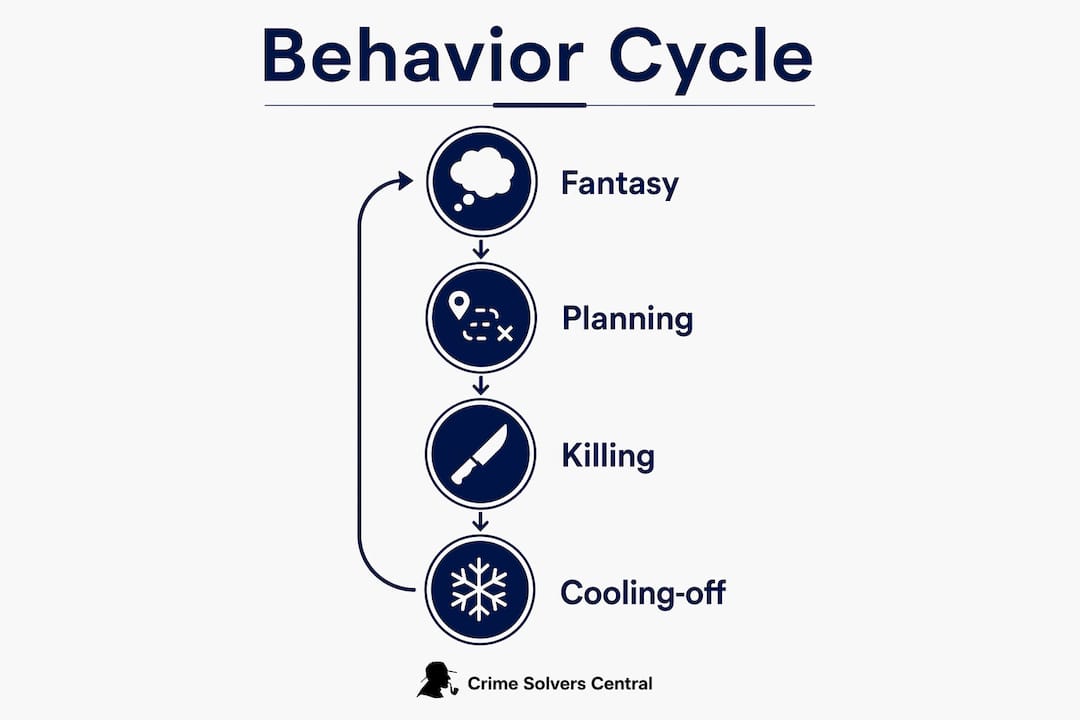
The psychological cycle that drives serial offending typically follows four stages: fantasy, planning, killing, and a cooling-off period. The fantasy stage often begins years before the first offense. Planning involves identifying targets, rehearsing scenarios, and selecting methods. The cooling-off period allows the offender to process the event and begin the cycle again. Understanding this cycle helps investigators predict behavior and identify patterns across cases.
Behavioral patterns also complicate case linkage. An offender who changes geographic area, alters their method, or targets different victim types across killings can appear as multiple unrelated cases to local investigators. That operational variation is one reason why unsolved homicide statistics remain stubbornly high in jurisdictions without centralized data sharing.
What challenges do investigators face in serial murder cases?
Linkage blindness is the primary investigative obstacle in serial murder cases. It occurs when separate law enforcement agencies fail to recognize that multiple crimes share a common offender. ViCAP and CODIS are the two federal databases designed to address this directly. ViCAP collects behavioral and case data from violent crimes. CODIS stores DNA profiles for forensic matching across jurisdictions.
The investigative process involves several coordinated steps:
- Document each crime scene with standardized behavioral data, including victim type, method, and geographic location.
- Submit case data to ViCAP so federal analysts can identify behavioral similarities across jurisdictions.
- Collect and submit biological evidence to CODIS for DNA comparison against existing profiles.
- Request FBI behavioral analysis support when cases meet the threshold for serial classification.
- Establish inter-agency task forces to share intelligence and coordinate arrest strategies.
| Challenge | Tool or Response |
|---|---|
| Linkage blindness | ViCAP behavioral database |
| DNA identification gaps | CODIS forensic database |
| Jurisdictional isolation | Federal task force coordination |
| Investigator bias | Multidisciplinary review teams |
| Cold case stagnation | Public databases like Crimesolverscentral |
Criminal profiling creates probabilistic hypotheses, not definitive identifications. Profiling alone frequently causes misdirection and confirmation bias. The most effective investigations treat profiling as one input within a broader multidisciplinary approach that includes forensic science, geographic analysis, and digital evidence.
Pro Tip: If you follow cold cases closely, check whether a case has been submitted to ViCAP. Many local agencies still do not submit voluntarily, which means potential connections go undetected for years. Advocacy for mandatory submission is one of the most practical reforms in this field.
Why documentation matters in cold cases cannot be overstated. Incomplete records at the local level are one of the most common reasons serial cases remain unsolved for decades.
How does media distort public understanding of serial killers?
Public and media portrayals propagate myths about serial killers that negatively affect both public perception and investigative accuracy. True crime documentaries, podcasts, and dramatized series frequently present offenders as uniquely brilliant, supernaturally evasive, or romantically tragic. None of those framings reflect the forensic record.
The consequences of media distortion are concrete:
- Skewed public fear leads people to overestimate the threat from strangers while underestimating risks from known individuals.
- False expertise from commentators without forensic credentials floods public discourse with inaccurate profiling claims.
- Investigative bias can develop when detectives absorb media-driven stereotypes and apply them to real cases.
- Victim selection myths persist, including the false belief that serial killers exclusively target young women, when the actual victim pool is far more varied.
“The commercialization of serial murder as entertainment has created a parallel mythology that competes with the actual science. When that mythology enters investigative thinking, it costs lives.”
Female serial killers represent a particularly distorted area of public understanding. Offenders like Aileen Wuornos, Nannie Doss, and Belle Gunness operated for years partly because investigators and communities did not fit them into the prevailing mental image of a serial murderer. The stereotype of the male loner predator actively delayed their identification.
Responsible consumption of true crime media means treating it as a starting point, not a source of forensic authority. Resources like overlooked cold case victims provide a more grounded perspective on who actually becomes a victim and why those cases go unsolved. Personal safety awareness, including understanding non-lethal self-defense options, is a practical response to realistic risk assessment rather than media-driven fear.
Key Takeaways
Serial murder is defined by specific legal thresholds, psychological configurations, and behavioral patterns that no single profile can capture.
| Point | Details |
|---|---|
| FBI definition | Two or more separate killings with a cooling-off period triggers federal classification and resources. |
| Psychopathy as predictor | Psychopathy, not ASPD alone, is the strongest predictor of violent serial offending. |
| Conjunctural causation | No single trait causes serial murder; specific combinations of narcissism, sadism, and trauma are required. |
| Linkage blindness | ViCAP and CODIS exist specifically to connect crimes across jurisdictions that local agencies miss. |
| Media distortion | Fictionalized portrayals create investigative bias and skew public fear away from realistic risk. |
What the evidence actually tells us about these cases
The most persistent myth in this field is that serial killers are easy to spot once you know what to look for. The forensic record says the opposite. The offenders who killed the most victims were the ones who looked the least suspicious. That is not a coincidence. It is a selection effect. The ones who looked dangerous got caught early.
What strikes me most about the academic research is how consistently it contradicts the profiling mythology that dominates true crime media. Conjunctural causation means that a checklist of traits will always fail you. The same traits that appear in a prolific killer also appear in people who never commit any violence. Context, opportunity, and the specific combination of factors matter far more than any single warning sign.
The investigative failures in famous serial killer cases, from the Yorkshire Ripper investigation to the Green River Killer’s decade-long evasion, share a common thread. Investigators anchored too early on a profile and filtered out evidence that did not fit. That is a cognitive bias problem, not a resource problem. More funding does not fix confirmation bias. Multidisciplinary review, mandatory data sharing, and honest case audits do.
For true crime readers, the most useful shift is from fascination with the offender to focus on the investigative process. The cases that got solved tell us more about what works than the cases that stayed cold. And the cases that stayed cold often did so because of systemic failures that better documentation and data sharing could have prevented.
— Crime
Crimesolverscentral and the cold case database
Crimesolverscentral maintains a searchable cold case database covering over 264,913 cases organized by state and case type, including unsolved homicides that may involve serial offenders. Law enforcement agencies, researchers, and community members can access this resource to identify patterns, flag connections, and support active investigations. The platform also supports public involvement through membership and safety initiatives, giving true crime readers a way to contribute beyond passive consumption. Cases that have gone cold for years sometimes break open when a second set of eyes finds a connection that local investigators missed. Crimesolverscentral exists to make those connections possible.
FAQ
What is the FBI’s official definition of a serial killer?
The FBI defines a serial killer as someone who commits two or more separate murders with a cooling-off period between events. This threshold was lowered from three victims to two to allow faster federal intervention.
What psychological disorder is most common in serial killers?
Psychopathy is the strongest predictor of violent serial offending, more so than Antisocial Personality Disorder alone. Research shows psychopathy scores explain a significant portion of variance in violent offending among ASPD populations.
How do investigators link crimes to a single serial offender?
Investigators use ViCAP for behavioral data and CODIS for DNA matching to identify connections across jurisdictions. Linkage blindness, the failure to recognize related crimes, remains the most common obstacle.
Are serial killers easy to identify in their communities?
Serial killers frequently maintain a normal social appearance, holding jobs and community roles that make them appear trustworthy. This “mask of sanity” is one reason many famous serial killers evaded detection for years.
Does criminal profiling reliably identify serial killers?
Criminal profiling produces probabilistic hypotheses, not definitive identifications. It works best as one component of a multidisciplinary investigation and carries real risks of confirmation bias when used in isolation.