

The Role of Public Records in Investigations

Public records are government-maintained or officially filed documents that serve as the primary evidentiary foundation in most investigations. The role of public records in investigations goes far beyond simple fact-checking. These records verify identities, confirm transactions, establish timelines, and surface relationships that subjects actively work to conceal. Private investigators, journalists, and researchers who treat public records as anchors rather than afterthoughts consistently produce more reliable findings. Koda Group Inc. describes public records as documents that anchor factual assertions to official filings and timestamps, requiring cross-referencing to extract full investigative value.
What types of public records are most valuable in investigations?
Public records form the foundational data layer in intelligence-led investigations, covering a wide range of official document categories. Each category answers a different investigative question. Knowing which record type to pull first saves hours of wasted effort.
The most frequently used categories include:
- Corporate registries. These reveal ownership structures, registered agents, and incorporation dates. They expose shell companies and undisclosed business relationships that subjects rarely volunteer.
- Court filings. Civil and criminal case records document prior disputes, judgments, restraining orders, and bankruptcy proceedings. A subject’s litigation history often predicts future behavior.
- Property records. Deed transfers, mortgage filings, and tax assessments trace asset movements. Investigators use these to identify hidden wealth or confirm a subject’s physical presence in a jurisdiction.
- Regulatory actions and licenses. Professional license databases and agency enforcement records reveal disciplinary history. A contractor with three suspended licenses tells a different story than their resume suggests.
- Sanctions lists and watchlists. OFAC, Interpol, and FBI databases flag individuals and entities under active restrictions. These are non-negotiable starting points in financial crime and national security investigations.
Each record type supports a specific investigative goal. Corporate filings aid asset tracing. Court records support identity verification and risk profiling. Property records confirm physical connections to locations. Combining multiple categories produces a picture no single record can provide alone.
How do public records complement other investigative sources?

Public records carry a specific authority that social media posts, confidential sources, and open-source intelligence cannot replicate. They are created by official bodies, time-stamped at filing, and subject to legal penalties for falsification. That provenance makes them the most reliable corroboration tool available.
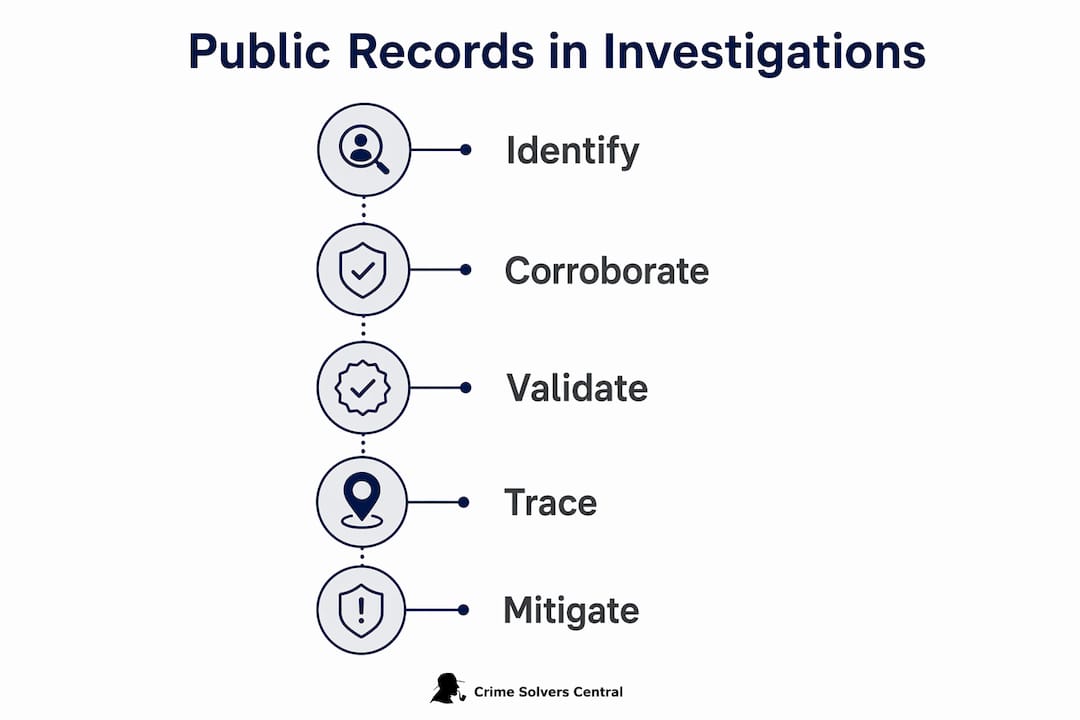
Cross-referencing public records against unverified claims is the fastest way to test a lead’s credibility. A source tells you a subject owns a warehouse in Newark. A property record search either confirms or kills that claim in minutes. Social media might show a photo of the warehouse. The deed shows who actually owns it.
The structured approach to cross-referencing matters as much as the records themselves. Cross-referencing corporate filings, property records, licensing data, and litigation history together reduces errors and false leads significantly. Each additional record type either reinforces or contradicts the emerging picture.
- Start with identity verification using government-issued license records or court filings.
- Layer in corporate registry data to map business relationships.
- Pull property records to confirm physical and financial connections.
- Check regulatory and sanctions databases to flag known risks.
- Compare findings against open-source intelligence to identify contradictions.
Pro Tip: Never treat a single public record as conclusive. Treat it as a hypothesis. The next record either supports or challenges it. Investigators who skip this step produce findings that collapse under scrutiny.
What are the limitations and legal considerations when accessing public records?
Access to public records is not unlimited. Legal frameworks at the federal, state, and local levels all impose restrictions that investigators must plan around. Ignoring these restrictions does not just slow an investigation. It can compromise it entirely.
Federal restrictions and FOIA exemptions
Federal criminal investigations restrict public access to investigative materials through grand jury secrecy rules and FOIA exemptions. Rule 6(e) of the Federal Rules of Criminal Procedure protects grand jury files whose disclosure could reveal investigative subjects or timelines. The Kalbers v. DOJ ruling confirmed that even pre-existing documents can be withheld if they were obtained through a grand jury subpoena. The restriction follows the provenance of possession, not just the content of the document.
State-level variability
State access laws vary dramatically. New Jersey’s Open Public Records Act permits agencies to withhold records when disclosure would be inimical to the public interest during an active investigation. The same law protects access to records that were publicly available before an investigation began. Investigators must know the specific rules of each jurisdiction they work in.
Practical timelines and costs
Processing times and fees add friction to every request. Boston, for example, requires initial responses within 10 business days, with provisions for extensions and fee estimates on large requests. Requests submitted through portals like GovQA are tracked and processed more efficiently than informal submissions. Detailed, specific requests reduce denials and speed up fulfillment.
| Access challenge | Impact on investigation | Mitigation strategy |
|---|---|---|
| Grand jury secrecy (Rule 6e) | Key documents withheld even if pre-existing | Request non-grand jury versions through separate FOIA channels |
| State investigation exemptions | Active case records unavailable | Request records predating the investigation’s start date |
| Redactions for privacy | Critical identifiers removed | Cross-reference with property or licensing records to fill gaps |
| Processing delays and fees | Slows timeline, increases cost | Use detailed requests and official portals like GovQA |
Pro Tip: When a FOIA request is denied, file a follow-up specifically requesting the index of withheld documents (a Vaughn index). It often reveals more about what exists than the original denial suggests.
How can investigators structure public records searches for maximum efficiency?
Volume is not the goal in public records research. Analytical structure is. Investigators who run dozens of searches without a documented methodology produce findings that are difficult to defend and easy to challenge. The IACP Cyber Center teaches that structured workflows, not search volume, build reliable leads and reduce misinterpretation.
A structured approach includes these core practices:
- Define the investigative question first. Every search should answer a specific question. “Who owns this entity?” is a better starting point than “find everything about this person.”
- Document confidence levels for every finding. Label each piece of information as confirmed, corroborated, or unverified. This prevents unverified claims from migrating into final reports as facts.
- Plan for alternative leads before you need them. Structured search workflows reduce confirmation bias by requiring investigators to identify what would disprove their current hypothesis, not just what supports it.
- Link across jurisdictions. A subject who appears clean in one state may have active litigation, license suspensions, or property disputes in another. Multi-jurisdictional searches catch what single-state searches miss.
- Build timelines as you go. Chronological mapping of filings, transactions, and regulatory actions reveals patterns that a flat list of records cannot show.
Confirmation bias is the most common error in public records research. Investigators who find early evidence supporting a theory tend to stop searching. Rigorous documentation of confidence levels and planned pivots directly counters this tendency. The goal is to produce unbiased results that hold up under independent review, not to confirm what you already suspect.
Public records also work best when combined with other research methods. Crimesolverscentral’s guide on cold case research workflows shows how structured record searches apply directly to long-unsolved cases where documentation gaps are common. Investigators working missing persons or unsolved homicides face the same structural challenges as those working financial fraud. The methodology transfers.
Key Takeaways
Public records are the most reliable evidentiary foundation available to investigators because they carry official provenance, legal timestamps, and cross-referenceable detail that no other source can match.
| Point | Details |
|---|---|
| Public records as anchors | Treat every record as a hypothesis to test, not a conclusion to accept. |
| Cross-reference multiple categories | Combining corporate, property, court, and licensing records reduces false leads. |
| Legal access limits are real | FOIA exemptions, grand jury secrecy, and state laws can block key documents. |
| Structured workflows beat volume | Documenting confidence levels and planned pivots prevents confirmation bias. |
| Timelines and costs matter | Plan for processing delays and use detailed requests to reduce denials. |
What I have learned from years of working with public records
Most investigators treat public records as a starting point. The best ones treat them as a discipline.
The records themselves have not changed much. What has changed is the complexity of the investigations they support. Subjects now operate across multiple jurisdictions, use layered corporate structures, and move assets through entities that exist only on paper. A single corporate registry search used to be enough. Now it is just the first step in a chain that might run through Delaware, Nevada, and three foreign jurisdictions before you find the actual beneficial owner.
The access problem is getting harder, not easier. Federal agencies have become more aggressive about applying FOIA exemptions. State agencies are slower to respond and quicker to redact. Investigators who do not understand the legal framework around access waste months chasing records they were never going to get. Understanding government relations for nonprofits and advocacy organizations shows how access barriers affect even well-resourced institutions, not just individual investigators.
The most important shift I have seen is in how investigators document their work. Confidence levels, source provenance, and planned alternative leads used to be optional. Now they are the difference between a finding that survives legal challenge and one that gets thrown out. Public records are only as strong as the methodology behind them.
— Crime
Crimesolverscentral and public records for investigators
Crimesolverscentral maintains a national database of over 264,913 cold cases, all categorized by state and situation. For investigators working missing persons or unsolved homicides, that catalog functions as a structured public records resource built specifically for investigative research. The platform connects private investigators, journalists, and researchers with case data that supports lead development and timeline building. Crimesolverscentral also publishes guides on leveraging national case databases for investigators who need to move from raw records to actionable leads. Access the full cold case database to search cases by state and find the documentation your investigation needs.
FAQ
What are public records in an investigation?
Public records are government-maintained or officially filed documents used to verify identities, confirm transactions, and establish timelines. They include court filings, corporate registries, property records, and regulatory actions.
How do public records aid investigations?
Public records anchor investigative facts to official, time-stamped documentation and allow investigators to corroborate unverified claims or surface undisclosed relationships.
What legal limits apply when accessing public records?
Federal FOIA exemptions, Rule 6(e) grand jury secrecy, and state-level investigation exemptions can all restrict access. Jurisdictional rules vary, and some records are withheld based on how they were obtained, not just their content.
How long does a public records request take?
Timelines vary by jurisdiction. Boston requires an initial response within 10 business days, with extensions permitted for complex requests. Using official portals and submitting detailed requests reduces processing time.
How do investigators avoid confirmation bias with public records?
Documenting confidence levels for each finding and planning alternative leads before they are needed are the two most effective methods. Structured workflows that require investigators to test against their hypothesis, not just for it, produce the most reliable results.