

Where to Find True Crime Case Files You Can Trust

The most reliable true crime case files live in three places: federal court records on PACER, missing-persons data through NamUs (the National Missing and Unidentified Persons System), and audio series that build episodes directly from those documents rather than secondhand blog posts. If you want a shortcut, start with a podcast that names its sources on air, then verify the details yourself before you repeat them.
Do this before you trust any account of a case:
- Listen to at least one episode from a document-driven series like Casefile or Serial to see how sourcing sounds when it’s done right.
- Pull the primary documents yourself through PACER, a state court portal, or NamUs.
- Cross-check names, dates, and case numbers against at least two sources.
- Contact the agency or victim services unit directly if you plan to publish new claims.
- Check whether the National Institute of Justice or a state cold-case unit has published anything on the case.
Key Takeaways
Reliable true crime storytelling depends on sourcing case files from primary records like PACER, NamUs, and court dockets rather than secondhand summaries.
| Point | Details |
|---|---|
| Start with primary sources | Pull documents from PACER, state court portals, or NamUs before trusting any secondhand account. |
| Read documents in order | Start with the statement of facts, then the plea agreement, then the sentencing memo. |
| Verify before publishing | Cross-check every claim against a court filing or police report, and route new evidence to investigators. |
| Watch for digitization gaps | OCR errors on handwritten or aged records still require human review before facts are treated as confirmed. |
| Use a structured database | Crime Solvers Central organizes many cases by state and situation for researchers who need a starting point. |
Table of Contents
- What’s Actually Inside a True Crime Case File
- How to Request and Locate Official Case Files
- How to Tell If a Case-File Episode Is Actually Reliable
- How Cold-Case Units Are Digitizing Files and Using AI
- Producing an Episode Without Crossing a Line
- What You Can Publish and What Stays Sealed
- A Deeper Case Archive for Serious Researchers and Producers
- Primary Sources Worth Bookmarking
- Sources
- FAQ
What’s Actually Inside a True Crime Case File
A case file isn’t one document. It’s a stack of them, and each one does a different job in a story. Police reports and incident logs establish the timeline. Witness statements carry the human voice and the contradictions that make an episode compelling. Forensic reports and autopsy findings anchor the physical facts. Arrest affidavits explain probable cause. Indictments spell out the charges. Plea agreements and sentencing memos reveal what actually got proven versus what got negotiated away. Victim impact statements and evidence inventories round out the record.
Full inventory to expect:
- Police reports and incident logs
- Witness and suspect statements
- Forensic and autopsy reports
- Arrest affidavits and indictments
- Plea agreements and sentencing memos
- Victim impact statements
- Evidence inventories and case photos
Pro Tip: Read the statement of facts first, then the plea agreement, then the sentencing memo. Together they give you the prosecution’s version of events, what the defendant admitted to, and how the judge weighed it. Everything else fills in detail around that spine.
How to Request and Locate Official Case Files
- Identify the jurisdiction. Federal charges go through PACER; state charges go through the county or state court portal.
- Search NamUs first for missing-persons or unidentified-remains cases, since many never generate a court file at all.
- Check local archives, historical society records, or coroner’s offices for anything predating digital court systems.
- Contact the agency’s records unit or victim services division directly if the file isn’t public online.
- If it’s a genuine cold case, reach out to a dedicated cold-case unit, since NIJ guidance recommends these units for cases unresolved three years or longer.
Expect fees for copies, processing delays of weeks to months depending on the agency, and redactions around juvenile records, medical details, and ongoing investigative leads. Sealed files usually stay sealed unless a court orders otherwise.
Pro Tip: When you contact an agency, lead with the case number, full names, and dates involved, and state plainly why you’re asking. A vague “tell me about this case” email gets ignored. A specific, purposeful request gets a response.
How to Tell If a Case-File Episode Is Actually Reliable
A trustworthy episode names its sources on air, not just in show notes nobody reads. Listen for specific document types, an indictment here, a plea deal there, rather than vague phrases like “sources say.” Reliable producers also draw a clear line between what’s alleged and what’s been proven in court, and they tend to include some input from family members or investigators rather than relying entirely on old news clips.
Signals worth trusting:
- Explicit citation of court documents and case numbers
- Named document types (indictment, plea agreement, sentencing memo)
- Family or investigator input, not just archival news audio
- Clear separation of allegation versus proven fact
Red flags run the other direction: claims sourced only to anonymous social media threads, confident narration about what a suspect “must have” felt or thought, and zero mention of where any fact actually came from. According to PACER-focused research on true crime sourcing, citing the exact case number and document type is one of the simplest things a producer can do to let listeners verify a claim themselves, and it’s rare enough that when you hear it, it’s a good sign.
How Cold-Case Units Are Digitizing Files and Using AI
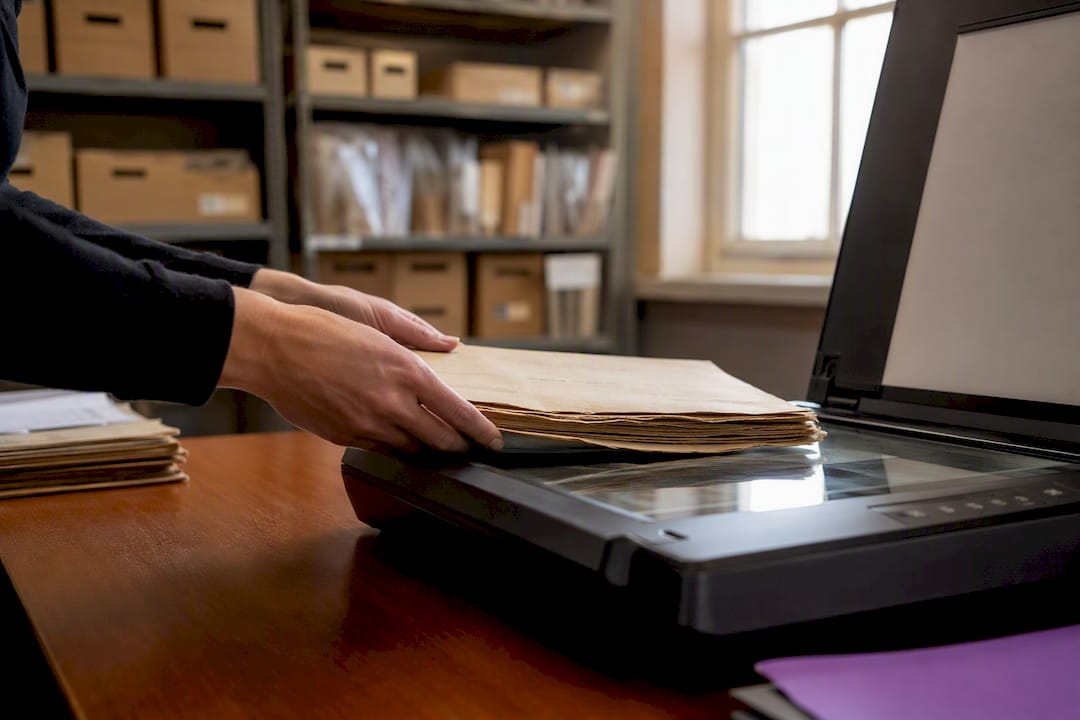
Paper case files are the biggest bottleneck in cold-case work, and agencies are starting to fix that with digitization. Scanning old murder books, running OCR, and tagging documents by variable like motive, relationship, or evidence type lets investigators search across thousands of pages in seconds instead of physically re-reading boxes of files. The NIJ’s research brief on text analytics describes exactly this kind of system, built to surface names and connections buried across decentralized records.
Agencies including the LAPD and the New Jersey State Police have built searchable homicide libraries this way, tagging cases by variables that make cross-case pattern hunting possible for the first time. That kind of system can flag evidence that was collected decades ago and never tested, including untested sexual assault kits, opening the door to familial DNA or forensic genetic genealogy searches that simply weren’t available when the crime happened.
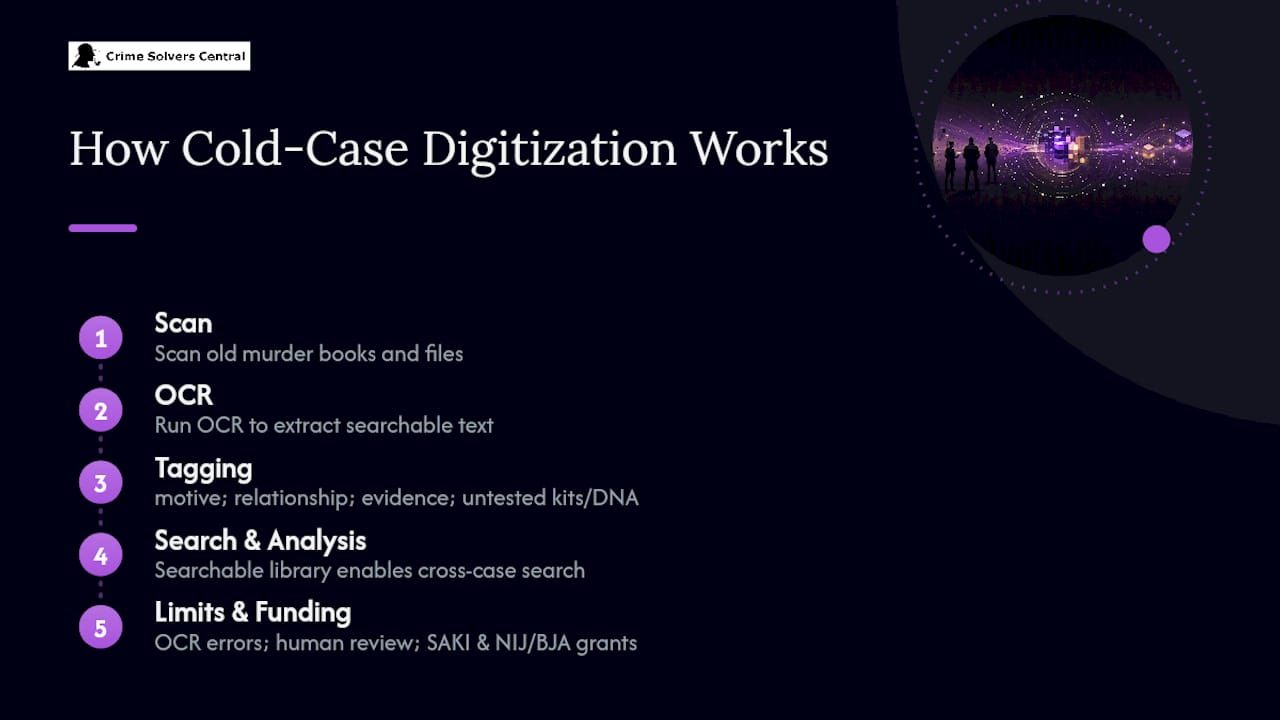
It isn’t a clean fix. OCR chokes on handwritten notes and water-damaged pages, and every automated match still needs a human to check it against the original document before anyone treats it as fact. Digitizing and maintaining these systems also costs real money and staff time, which is why programs like SAKI and NIJ/BJA grants exist to help under-resourced agencies get there at all.
What this means for you as a researcher: agencies with digitized systems are more likely to respond quickly and specifically to a well-framed inquiry, because the information is easier for them to pull. That’s one more reason a request naming exact case numbers and document types tends to get faster answers.
Producing an Episode Without Crossing a Line
Verify every claim against a primary document before it goes in the script. Label allegations as allegations, not settled fact, especially for anyone who was never charged. If you turn up genuinely new evidence, hand it to the investigating agency rather than posting it yourself. Build in a content warning and a resource line for listeners affected by violence.
- Confirm facts against police reports, court filings, or forensic records.
- Route new leads or evidence to law enforcement, not social media.
- Keep a citation list for every factual claim in the script.
- Run a permissions and editorial review pass before publishing.
Don’t touch or relocate physical evidence under any circumstance. Don’t name uncharged individuals without solid documentary backing. Don’t publish sealed records, juvenile files, or private medical details, even if someone hands them to you.
What You Can Publish and What Stays Sealed
Indictments, verdicts, and most sentencing records are public once a case is charged. Juvenile records, certain medical and psychiatric records, and files a judge has specifically sealed are not, regardless of how newsworthy they seem.
Naming an uncharged suspect or repeating an unverified allegation carries real defamation exposure, separate from any ethical concern.
- Public: indictments, verdicts, most sentencing documents
- Often sealed: juvenile records, certain medical/psychiatric records, judge-sealed files
- High risk: naming uncharged suspects, republishing unverified claims
Jurisdictional rules vary substantially. When a request or a script touches sealed material, sensitive victim details, or an uncharged individual, get a lawyer to look at it before you publish, not after.
Why provenance is the whole game in audio storytelling
Case files are not neutral. They’re built by people, filtered through what got tested, what got charged, and what a family was willing to share. Treating any document as gospel, without asking who compiled it and why, is how good-faith storytelling turns into misinformation.
The strongest episodes come from producers who work like researchers first and storytellers second: pull the record, name the document, flag the uncertainty. Crime Solvers Central’s searchable cold-case database exists partly for that reason, giving researchers a structured starting point instead of a scattered search across a dozen county portals. Respecting families and investigators isn’t a compliance checkbox. It’s what makes the work worth trusting.
A Deeper Case Archive for Serious Researchers and Producers
PACER, NamUs, and state portals get you the raw documents, but they were never built for narrative research, and stitching them together case by case eats hours you could spend writing. Crime Solvers Central exists specifically to close that gap: a national database of many cases, organized by state and situation, built for people who need structure rather than a dozen disconnected search tools.

Membership unlocks full case details, digital evidence boards, sourcing links, and forum access, useful whether you’re a family member tracking a loved one’s case, an amateur researcher mapping connections across similar crimes, or a podcaster who needs verified documentation before a script goes to recording. The community and volunteer tools also mean you’re not researching in isolation. Browse the cold case database by state to see whether a case you’re following already has a structured file waiting, and check membership options for full access to case documentation and evidence tools.
Primary Sources Worth Bookmarking
For cold cases specifically, the NIJ’s cold-case best-practices guide explains how multidisciplinary units review unresolved files and what triggers a fresh look. For missing persons and unidentified remains, NamUs remains the most complete public repository. For solved federal cases, PACER supplies the indictment-to-sentencing paper trail, while state court portals cover most homicide prosecutions.
- NIJ cold-case guidance: review standards and unit structure for unresolved cases
- NamUs: missing-persons and unidentified-remains records, searchable by state
- PACER: federal court filings, best for indictments through sentencing
- State/county court portals: state-level prosecutions, varies by jurisdiction
- Local archives and coroner records: older cases predating digital court systems
Crime Solvers Central’s guide to DNA advancements in cold cases is a useful companion once you’ve identified a case with retestable evidence on file.
Sources
Casefile has built its entire reputation on restraint. Episodes lean on court filings, police statements, and inquest records, narrated in a flat, fact-first style that resists the urge to speculate. Serial did something similar for Adnan Syed, treating trial transcripts and appellate filings as the spine of the story rather than décor around a theory. Both are worth studying if you want to know what “sourced” sounds like on tape.
Behind the audio, the paper trail lives in a few specific places. PACER handles federal criminal cases and is the fastest way to pull an indictment, plea agreement, or sentencing memo. State court portals cover most homicide and assault prosecutions, since the bulk of violent crime is charged at the state level. NamUs is the go-to for missing-persons and unidentified-remains cases, especially cold ones with no active prosecution to generate court paperwork. Local archives and coroners’ offices fill in the older material that never made it online.
Solved cases tend to have a clean paper trail: charging documents, a plea or verdict, sentencing records. Cold and unresolved cases scatter across NamUs entries, old newspaper morgues, and whatever a local cold-case unit has digitized, though exact counts vary. If you’re chasing a case with no conviction, expect to spend more time in archives than in court dockets. Crime Solvers Central’s catalog of famous cold cases is a decent starting map for which unresolved cases have public documentation worth chasing.
- National Best Practices for Implementing and Sustaining a Cold Case Investigation Unit
FAQ
Who narrates Casefile?
Casefile is narrated by an anonymous host known only as “Casefile,” a deliberate choice the show has kept since launch to keep the focus on the case rather than the narrator.
What are some of the best true crime podcasts to start with?
Casefile and Serial are consistently cited as the strongest examples of document-driven, fact-first true crime audio, both structured around court records and primary statements rather than speculation.
Where can I watch or listen to true crime case files?
Audio series like Casefile are available on Apple Podcasts and most major platforms, while primary documents behind those stories live on PACER, state court portals, and NamUs.
What is considered one of the most famous criminal cases in true crime media?
Cases covered by Serial, particularly the Adnan Syed prosecution, remain among the most widely discussed because the show built its narrative directly around trial transcripts and appellate filings.
How do I find case files for a missing-persons case?
Start with NamUs, which centralizes missing-persons and unidentified-remains records by state, then contact the investigating agency’s records unit for any documents not yet public.