

Where to Find Active True Crime Message Boards Right Now

The best true crime message boards fall into five categories: moderated case-specific forums, community-run sleuth platforms, social media groups, podcast-driven discussion hubs, and membership cold-case databases with built-in research tools. Each serves a different purpose, and picking the wrong one for your goal wastes time and can do real harm.
The single rule that matters more than any other: post evidence, not speculation, and never name a private individual as a suspect based on your own hunch. Websleuthing done right mirrors police-source categories almost exactly. Done wrong, it ends careers, reputations, and sometimes lives.
Before you post anywhere, know your options:
- Moderated case forums for deep, threaded timelines on a single case
- Community-run sleuth boards for archival sharing and niche topics
- Social media groups and chat apps for fast amplification, loosely moderated
- Podcast communities for coordinated crowd research tied to episode drops
- Membership databases for structured case files, digital evidence boards, and volunteer tools
Read the participation steps below before you make your first post.
Key Takeaways
Evidence-first posting, source citation, and routing sensitive tips through moderators separate productive true crime message boards from harmful ones.
| Point | Details |
|---|---|
| Match the platform to your goal | Use moderated case forums for deep timelines, social groups for fast amplification, and databases for structured research. |
| Never name private individuals | Unverified suspect naming causes real harm and rarely gets legal recourse due to broad platform protections. |
| Cite public sources every time | Timestamp findings and cite court dockets, obituaries, or news archives rather than posting hunches. |
| Focus on cross-checkable identifiers | Age range, time since death, distinct tattoos, and discovery location are the details that actually help match cases. |
| Choose structured platforms for serious work | Crimesolverscentral’s case database and volunteer tools organize contributions into a workflow instead of scattered speculation. |
Authoritative Reading and Internal Guides
- True Crime Community: Your Ethical Cold-Case Playbook
- How to Identify Unidentified Remains: Database Guide
- SJSU research on websleuthing and serious leisure
- What’s the deal with ‘websleuthing’? (SAGE)
Table of Contents
- Types of True Crime Message Boards and What Each One Is Best For
- How to Join and Participate Responsibly
- The Research Tools Amateur Sleuths Actually Use
- Ethical Risks, Legal Reality, and How to Reduce Harm
- Why Evidence-First Communities Outperform Free-for-All Forums
- How Crimesolverscentral Supports Ethical Sleuthing
- Sources
- FAQ
Types of True Crime Message Boards and What Each One Is Best For
Not every true crime forum wants the same thing from you. Some reward patience and citation discipline. Others reward speed. Knowing the difference keeps you out of trouble and makes your contributions count.
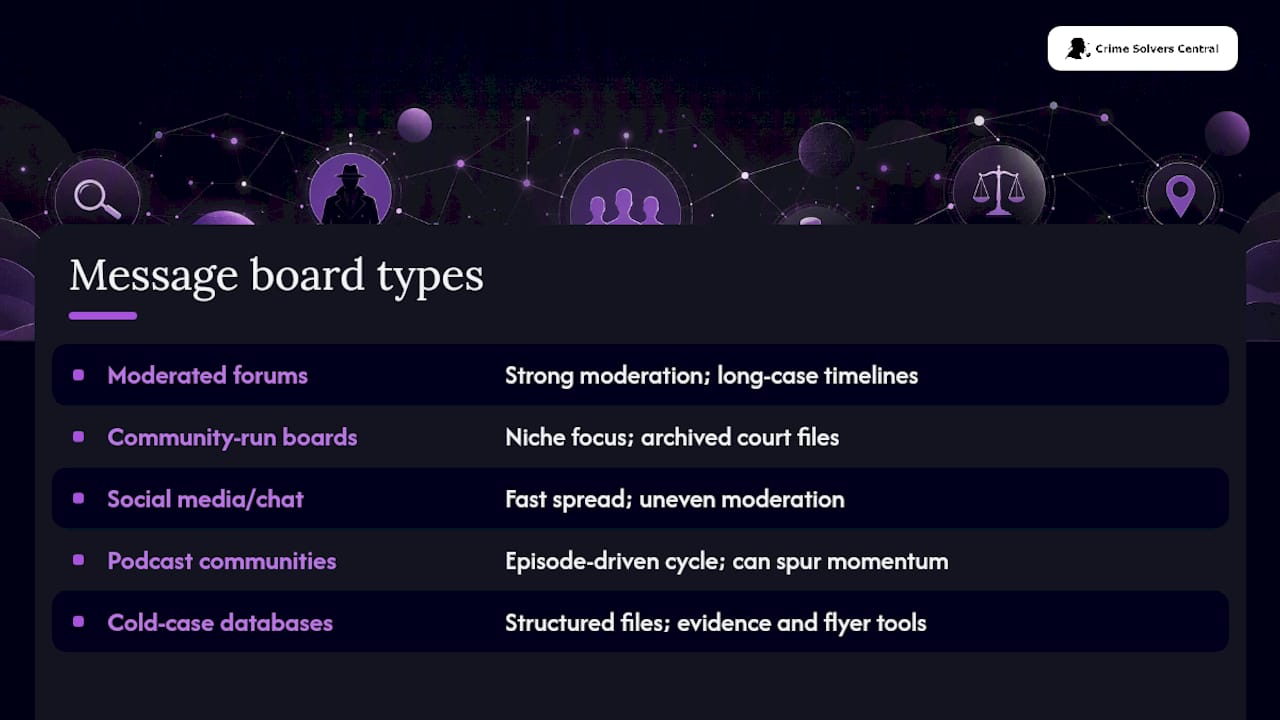
Moderated, case-focused forums work best for long-haul cases with years of scattered facts. Their strength is thread continuity: a single case can accumulate thousands of posts, and strong moderation keeps the timeline coherent instead of collapsing into arguments. These boards suit people who want to trace a case’s entire history, not just react to the newest headline.
Community-run boards and niche forums fill a different gap. They tend to specialize, one board for unidentified remains, another for missing hikers, another for a single decade’s unsolved homicides, and they lean on long-time members who archive court documents, old news clippings, and case file scans that mainstream sites never bother collecting.
Social media groups and chat apps move fast and moderate unevenly. A Facebook group or Discord server can spread a missing person flyer to thousands of people within an hour, which is genuinely valuable, but the same speed means unverified claims travel just as quickly as verified ones.
Podcast-driven sleuth communities often follow a repeatable pattern: an episode airs, listeners discuss it, someone amplifies a specific detail, and occasionally that momentum reaches the victim’s family or investigators directly. Research into true crime podcast ethnography documents this six-step cycle, from initial investigation through community discussion to formal momentum.
Membership cold-case databases offer something the others typically don’t: structured case files organized by state and status, plus tools like digital evidence boards and flyer builders that turn scattered chatter into an organized workflow.
How to Join and Participate Responsibly
Getting into a true crime community the right way takes about ten minutes and saves you from the two most common rookie mistakes: getting banned in your first week, or accidentally harming a real family.
- Read the rules before you post anything. Most active forums pin their posting guidelines, and skipping them is the fastest way to get flagged.
- Set up a factual, low-profile account. Skip anything dramatic or identifying in your username or bio.
- Format tips so moderators can act on them fast. Lead with a short timeline, cite the public source, timestamp what you found, and clearly separate fact from your own hypothesis.
- Escalate carefully. If your research touches a family or a live investigation, route it through the forum’s designated contact process rather than tagging a grieving relative directly.
- Watch for red flags. Threads that name private individuals without public charges, that dox addresses or workplaces, or that reward speculation with upvotes are worth leaving.
Pro Tip: Before you post a theory, ask yourself if you’d be comfortable saying it to the missing person’s parent. If the answer is no, it doesn’t belong on the board.
A well-run community shows itself quickly: active moderators who respond within a day, pinned evidence-first posting templates, and a visible history of edited or removed posts when claims went unverified. If a board has none of that, treat everything you read there with real skepticism. Our guide on how to post in true crime discussions walks through formatting a first tip step by step.
The Research Tools Amateur Sleuths Actually Use
Most productive websleuthing doesn’t involve anything exotic. It relies on public records most people forget exist: newspaper archives for old coverage, court dockets for case status, obituaries for family connections, and state or federal missing-person databases for baseline case details.
Basic open-source intelligence work adds a few more moves:
- Reverse-image search to check whether a photo circulating online is actually from the case in question
- Building a plain-text timeline of confirmed events before adding any interpretation
- Cross-referencing identifiers like age range, location, and any documented forensic detail
One academic analysis found that websleuth communities independently arrive at seven of the nine source categories that police investigators use, a strong signal that disciplined amateur research tracks real investigative method rather than guesswork.
Matching unidentified remains to a missing-person report, arguably the highest-value outcome in this space, usually comes down to a narrow set of cross-checkable facts: estimated age, time since death, distinctive tattoos or medical hardware, and the geographic point of discovery. That focus is what separates a useful tip from noise, and it’s the model behind SJSU’s research on websleuthing as serious leisure.
Curated case databases with digital evidence boards and flyer builders speed all of this up by keeping sources attached to a case file instead of scattered across forum replies. Worth remembering: some records, like sealed autopsy files or active investigative notes, stay law-enforcement-only no matter how good your search skills are.
Ethical Risks, Legal Reality, and How to Reduce Harm
Amateur crime discussion carries three recurring harms: misidentifying an innocent person, harassment campaigns against victims or their families, and privacy violations that follow someone for years after a thread moves on.
The legal backdrop makes this worse than it looks. Platforms generally carry broad protection from liability for what users post, which means victims of online speculation often have little practical recourse even when a false accusation ruins a real person’s life. Suing an anonymous poster is expensive, slow, and frequently goes nowhere.
Strong communities counter this with hard rules, not vague etiquette. A CTC Sentinel analysis of true crime fandom points out that interest in a case can drift toward glorifying the people involved in it if moderation doesn’t actively push back, which is exactly why evidence thresholds and no-naming policies exist in the first place.
A no-naming policy for unconfirmed suspects, a rule requiring a public source link on every claim, and a habit of routing sensitive tips to moderators before they go public. These three practices, more than any technology, separate a responsible forum from a harmful one.
Before you post anything sensitive, run it through this checklist: verify the source is public, redact any personal detail that isn’t already published, and ask a moderator if you’re unsure whether a claim crosses a line.
Why Evidence-First Communities Outperform Free-for-All Forums
Loosely moderated forums generate volume. Structured, evidence-first platforms generate leads that actually go somewhere. Crimesolverscentral’s approach, a national case database organized by state and status, paired with community tools that channel contributions into a workflow, reflects what the research on collaborative case-solving consistently shows: organized crowdsourcing beats scattered speculation.
Volunteer coordination and shared evidence boards cut down on duplicated effort and reduce the chance that an unverified claim spreads before anyone checks it. If you’re serious about contributing, read a case guide before you post publicly. It changes what you contribute and how fast it gets taken seriously.
— Crime
How Crimesolverscentral Supports Ethical Sleuthing
If you want somewhere to put real research energy that isn’t a free-for-all comment thread, Crimesolverscentral gives you a structured alternative to open forums: a large national database of cases organized by state and status, with membership tools built specifically for evidence-based work instead of speculation.
Members get access to digital evidence boards for organizing findings by case, a flyer builder for amplification that actually reaches the right audience, and volunteer coordination tools that route contributions where they’re useful instead of letting them scatter across comment sections. Moderation and posting guidance are built into the platform, which means less risk of the harassment and misidentification problems that plague unmoderated boards, and more collaboration with the families who are actually affected.
Browse the Cold Case Database by state to see how a case near you is documented, or start with a guide on collaborating with communities on unsolved crimes before your first post.
Sources
- SJSU research on websleuthing / serious leisure
- True Crime Podcasting as Participatory Journalism: A Digital Ethnography of Collaborative Case Solving
- Section 230 and platform liability reporting
- True Crime Community: understanding the depths of digital fandom (CTC Sentinel)
FAQ
Has Websleuths Ever Actually Solved a Case?
Websleuth-style communities have contributed to matching unidentified remains with missing-person reports by cross-referencing public identifiers like age, location, and distinctive features, a documented outcome of structured amateur research.
What Are the Best Websites for True Crime Sleuths?
The strongest options combine moderated, evidence-first discussion with structured case data, which is why membership databases with built-in research tools tend to outperform open social media groups for serious work.
What Are the Top True Crime Podcasts for Community Discussion?
Rather than a fixed ranking, look for podcasts with active listener communities that follow a clear cycle of investigation, discussion, and amplification, a pattern documented in podcast ethnography research.
Is It Safe to Discuss Suspects on True Crime Message Boards?
Only when a suspect has been publicly named by law enforcement or court filings; naming private individuals based on speculation risks real harm and rarely comes with legal protection for the person harmed.
What Makes a True Crime Forum Well Moderated?
Look for pinned posting rules, active moderators who respond within a day, evidence-first templates, and a visible history of removing unverified claims before they spread.