

True Crime Podcase: 5 Steps Families Use to Build Credible Tip Packets

A “true crime podcase,” as we use the term here, means a searchable cold case database where member-only case files and investigative tools help families and advocates dig into unsolved cases. Your best immediate step is to search a verified database like Crime Solvers Central and route any new information you find through official channels rather than social media.
TL;DR:
- Most databases cover only specific jurisdictions and case types, so verify their scope and update frequency before relying on them.
- Connecting to forensic services like DNA analysis and cross-matching between missing and unidentified records enhances the chances of identification.
- Document all findings with source links and access dates to maintain case integrity and improve credibility with investigators.
- Routes tips exclusively through official channels like NamUs or agency contacts, avoiding public accusations to protect case credibility and family privacy.
- Membership tiers offer increasingly detailed access and tools, with paid options recommended for advocates actively managing or connecting multiple cases.
Table of Contents
- What a cold case database includes and how it supports official investigations
- How to evaluate a cold case database before you rely on it
- How families and advocates should use a database safely and effectively
- Ethical, trauma-informed engagement and what to avoid
- Official databases and forensic services worth cross-checking
- Why organized databases and community coordination matter
- Getting started with a Crime Solvers Central membership
- FAQ
- Sources
What a cold case database includes and how it supports official investigations
A searchable cold case database typically organizes missing persons, unidentified remains, and unclaimed person records by state, case type, and status. Each entry usually carries a source and agency trail: which department filed the report, when it was last updated, and what evidence or physical descriptors are on record.
Public access and professional access are not the same thing. The National Missing and Unidentified Persons System supports public searches while reserving sensitive case details for vetted professional users, a distinction built into the system to protect investigations and families alike.
What makes these platforms genuinely useful is how they connect to forensic and analytic services behind the scenes:
- Case records can trigger cross-matching between missing-person files and unidentified-remains files across jurisdictions.
- Forensic pathways like DNA comparison, dental records, and fingerprint analysis (AFIS) turn a database entry into an actionable lead.
- Analytical teams can request indication-of-life checks or chase down next-of-kin information that a family search alone would miss.
How to evaluate a cold case database before you rely on it
Not every database deserves your trust, and some will waste your time or, worse, mislead you. Before you build a search strategy around any platform, run it through a short checklist.
- Scope: Confirm which case types (missing persons, unidentified remains, unsolved homicides) and which jurisdictions the database actually covers.
- Transparency: Look for a visible agency or source trail, a last-updated date, and clear status labels rather than vague summaries.
- Search power: Favor platforms that support geographic filtering, keyword or Boolean search, and cross-matching between missing and unidentified records.
- Forensic and advisory support: Strong databases connect to Cold Case Advisors and analytical services that help vet tips and locate next of kin.
- Access model and privacy policy: Understand what is free, what requires membership, and how the platform vets contributors before publishing sensitive details.
Pro Tip: Bookmark the exact record URL and note the access date every time you review a case file, since database content changes as investigations progress.
How families and advocates should use a database safely and effectively
Searching a cold case database well is a skill, and doing it carelessly can waste an investigator’s time or compromise a case. Follow a sequence instead of clicking around at random.
- Search deliberately: Use Boolean terms, date ranges, and geographic filters, then cross-check missing-person entries against unidentified-remains records in the same region.
- Document everything: Save source URLs, access dates, agency case numbers, and copies of any original photos or documents you find, since provenance matters later.
- Build a vetted tip packet: Corroborate facts with more than one source, record witness names and contact details accurately, and note exactly where each piece of evidence came from.
- Submit through official channels: Route tips through NamUs submission tools, a Cold Case Advisor where one is assigned, or the investigating agency directly. Our step-by-step NamUs search guide walks through that process in detail. Never post accusations publicly.
- Channel community energy productively: Fundraising, respectful publicity, and volunteer organization support a case far more than amateur investigation does. Our guide on collaborating with communities covers how to structure that work.
Pro Tip: A tip packet with clear provenance (who said what, when, and how you verified it) gets taken far more seriously by investigators than a stack of screenshots.
Ethical, trauma-informed engagement and what to avoid
Cold cases involve real grief, and how you talk about a case affects both the family and the investigation. The NIJ’s national best-practices guide for cold case units recommends victim-centered communication and careful evidence handling, and that standard applies just as much to community researchers.
A few rules keep your engagement constructive rather than harmful:
- Use victim-centered, non-sensational language, and avoid speculation dressed up as fact.
- Never post unvetted accusations, personal addresses, or sensitive evidence publicly, since doing so can tip off a suspect or retraumatize a family.
- Follow whatever communication practices the investigating agency requests, and keep tips in formal channels so they retain credibility.
- Recognize when a family needs victim services or counseling support rather than another round of questions, and point them toward appropriate resources instead.
Official databases and forensic services worth cross-checking
No single platform holds every case, so cross-checking against official systems matters.
- NamUs: Offers searchable public summaries alongside professional user tiers, Cold Case Advisors, and analytical services that help vet leads and locate next of kin.
- FBI ViCAP: Organizes violent crime cases, including homicides and unidentified persons, and is most useful when a case shows signs of matching a pattern across jurisdictions.
- CODIS and forensic labs: DNA profiles uploaded through accredited labs can connect cold cases to new leads, though a profile alone does not guarantee a quick identification.
NamUs records do not necessarily represent every missing or unidentified case, since case entry is voluntary in most jurisdictions: a “no hit” search result means a case is not yet logged, not that it has been resolved.
Why organized databases and community coordination matter
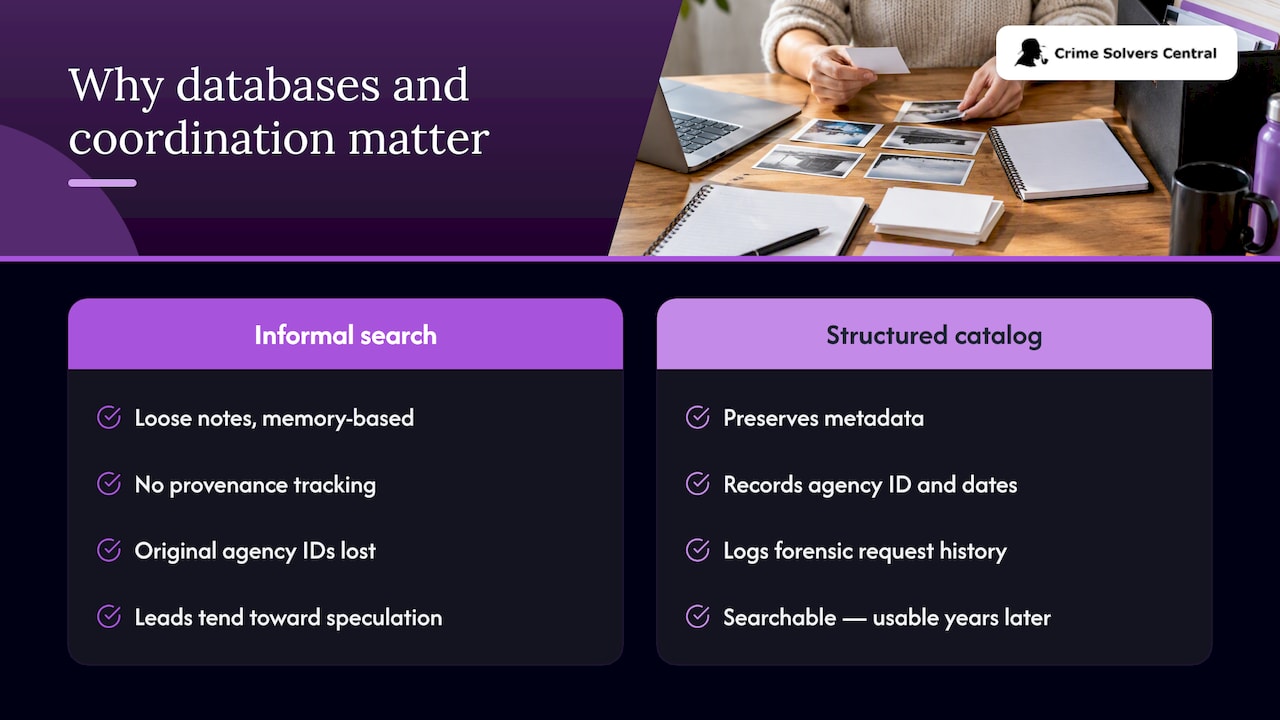
Structured, categorized case catalogs do something informal searching cannot: they preserve metadata and evidence provenance that investigators can act on years later. A record that keeps its original agency ID, submission date, and forensic request history stays usable even after memories fade or personnel change.
That is the role we try to play at Crime Solvers Central, pairing a searchable case catalog with the kind of community coordination that routes real leads to real investigators instead of amateur speculation.
— Crime
Getting started with a Crime Solvers Central membership
We built our membership around what families and dedicated advocates actually need: full case files searchable by state and case type, digital evidence boards, AI image progression tools, volunteer coordination, and vetted community forums where discussion stays focused and respectful.
A paid membership makes sense if you need more than a summary, specifically a family member piecing together a timeline, or an advocate coordinating volunteers and fundraising around a specific case. Free visitors can browse summaries, but full case details and community tools sit behind membership.
- Jr. Detective: $3.97 per month or $39 per year.
- Sr. Detective: $9.97 per month or $99 per year, adding deeper case access and tools.
- True Crime Influencer: $39.97 per month or $399 per year, built for advocates driving public engagement.
Start by browsing our cold case database by state to see how cases in your area are documented, then choose the plan that matches how deeply you plan to get involved.
FAQ
What is a true crime podcase in this context?
In this guide, a true crime podcase refers to a searchable cold case database, not an audio show. It organizes missing persons, unidentified remains, and unsolved homicide records with member-only case files and investigative tools.
How do I submit a tip to a cold case database?
Document your evidence with source links, dates, and agency identifiers, then submit through the database’s official tip route or a Cold Case Advisor where one is assigned to the case. Avoid posting unverified claims publicly, since formal channels protect both your credibility and the investigation.
Is NamUs free to search?
NamUs allows public searches of case summaries, while more sensitive details are reserved for vetted professional users. The National Institute of Justice oversees the program and maintains that access structure to protect ongoing investigations.
How long does it take for a case to progress after I submit information?
Timelines vary widely depending on the agency’s caseload, the forensic resources needed, and whether your tip opens a new lead. A useful lead still requires vetting and investigative follow-through, so patience and continued documentation matter more than a fixed timeline.
What does a Crime Solvers Central membership include?
Membership unlocks full case files organized by state, digital evidence boards, AI image progression tools, and vetted community forums for coordinating volunteer work. Plans start at $3.97 per month for the Jr. Detective tier.
Sources
- National Missing and Unidentified Persons System | National Institute of Justice
- Services | NamUs
- FBI ViCAP — unidentified persons