

Unclaimed Bodies Database: 5 Search Steps for U.S. Families

Start your search in the primary national public database for missing, unidentified, and unclaimed persons, and call your local medical examiner or coroner’s office the same day. Create a free account to unlock full search features, since professional and family accounts both have access to forensic details that help confirm a match. A separate federal investigative repository also lists select unidentified cases tied to violent crime, which can matter if your situation involves a homicide investigation.
TL;DR:
- Search physical traits, dental and X ray details, name variants, and estimated birth dates first; widen location and date filters if no results appear.
- NamUs profiles need about 18 key fields for publication, so a sparse record may reflect incomplete agency data rather than a dead end.
- Contact the county where the person was found, not where they lived, and ask about unidentified or unclaimed cases using the correct term.
- Because reporting is voluntary and some cases appear only after 180 days or agency approval, request local records and ask about DNA comparison.
Table of Contents
- National and federal databases: what they are and who they’re for
- How to search these databases field by field
- Contacting your local medical examiner or coroner’s office
- Why some searches turn up nothing: data gaps and retention limits
- How Crime Solvers Central supports searches: our database, guides, and community tools
- Why combining national and local searches works better
- If you need deeper records or community support
- FAQ
- Sources
National and federal databases: what they are and who they’re for
The National Missing and Unidentified Persons System, known as NamUs, is the country’s main public clearinghouse for these records. Local coroners, medical examiners, and law enforcement agencies submit case information, and the program has assisted in over 46,600 case resolutions since 2007, with the public database holding more than 54,000 records as of mid-2023, according to the National Institute of Justice. Anyone can search it for free, but the depth of what you see depends on your account type.
- Public accounts let families and the general public browse case summaries and submit tips or reference information.
- Professional accounts, reserved for coroners, medical examiners, and law enforcement, unlock restricted fields like full forensic reports and internal case notes.
- The FBI’s ViCAP program serves a different purpose: it’s an investigative tool used to link violent crime cases across jurisdictions, with only select unidentified-person listings made public.
Families searching for a missing relative should start with NamUs. Investigators working a potential homicide should check both NamUs and ViCAP, since the latter’s cross-jurisdictional linking can surface patterns a single database won’t show.
How to search these databases field by field
Effective searches depend on using every identifying detail you have, not just a name. Start broad, then narrow.
- Enter physical descriptors first: height, weight, hair and eye color, scars, and tattoos, since these fields often catch matches that name searches miss.
- Add dental records or X-ray features if available. These are some of the most reliable identifiers in unclaimed-remains cases.
- Try name variants, including nicknames, maiden names, and partial spellings, paired with an estimated date-of-birth range rather than an exact date.
- Use location and date-found filters, then widen the radius or timeframe if your first search returns nothing. People are sometimes found far from where they went missing.
- Register for a free account to access advanced search tools, including Boolean operators and CSV exports, which let you save and compare results offline, per the NamUs advanced search guide.
A complete record needs around 18 key fields, including sex assigned at birth, dental information, and investigating agency contact details, before it can be published, according to NamUs case entry guidance. That’s useful to know: a sparse profile you find might just be waiting on more data, not a dead end.
Pro Tip: If a search comes back empty, remove one filter at a time instead of changing several, so you can tell which field was too restrictive.
When your own search stalls, that’s the point to ask your local medical examiner’s office for a manual case check or to request a DNA or fingerprint comparison directly.
Our step-by-step NamUs search guide walks through the interface with screenshots if you want a visual reference while you search.
Contacting your local medical examiner or coroner’s office
National databases pull from local records, so a direct call often surfaces information that hasn’t been entered online yet. Start by identifying the correct county medical examiner or coroner, since jurisdiction depends on where a person was found, not where they lived.
- Call or email the office directly and ask whether they have any unidentified or unclaimed cases matching your description, using specific terms rather than a general inquiry.
- Bring government-issued ID for yourself, along with dental records, medical history, and photos of any known scars or tattoos belonging to your missing relative.
- If DNA comparison is possible, ask about chain-of-custody requirements before submitting a reference sample, since improperly handled samples can be rejected.
- Use “unidentified” when the person’s identity is unknown and “unclaimed” when identity is confirmed but no next of kin has come forward. Mixing these terms up, per NamUs FAQ guidance, can route your call to the wrong department.
- Ask directly whether the office can enter or update the case in NamUs, since publication typically requires agency permission and a Regional System Administrator’s review.
Our guide on how coroners handle unidentified cases breaks down what happens inside these offices after your call.
Why some searches turn up nothing: data gaps and retention limits
Reporting to NamUs is often voluntary, and many jurisdictions don’t consistently publish identified-but-unclaimed remains. NBC News reporting found that only a minority of states mandate reporting, and interviews with county offices revealed that some rarely use national portals for certain categories of remains at all. That gap means an empty search result doesn’t rule out a match. It might just mean the case was never entered.
Retention practices also vary widely by county and state, affecting how long remains stay available for identification before burial or cremation.
If your search comes up empty, these follow-ups can help:
- File a public records request (FOIA or state equivalent) with the relevant county office.
- Call the local office directly instead of relying on the database alone.
- Submit a family reference DNA sample through NamUs or your local agency for future comparison.
Some cases also aren’t entered until 180 days have passed or until an agency formally approves publication, so persistence matters.
How Crime Solvers Central supports searches: our database, guides, and community tools
We maintain a national case catalog of cold cases, organized by state and situation, so you can cross-reference what you find in official databases against our own records. Members get access to deeper case files, digital evidence boards, and active forums where other families and investigators share leads.
- Our database guide for matching dental and biometric details walks through the same identifying features NamUs asks for.
- Our overview of missing persons database basics helps you understand timelines before you start searching.
- Community volunteers and advocacy campaigns on our platform have helped prompt local agencies to review or update cases that had gone stagnant.
We see our role as layering community persistence on top of the official process, not replacing it.
Why combining national and local searches works better
A dual approach, meaning an active national database search paired with direct county coroner outreach, tends to surface more leads than either path alone. We’ve seen families make progress specifically because community volunteers kept pressure on local offices while also tracking national database updates. Coordinating with investigators and local volunteer networks, rather than searching in isolation, gives a case the best chance of staying active.
— Crime
If you need deeper records or community support
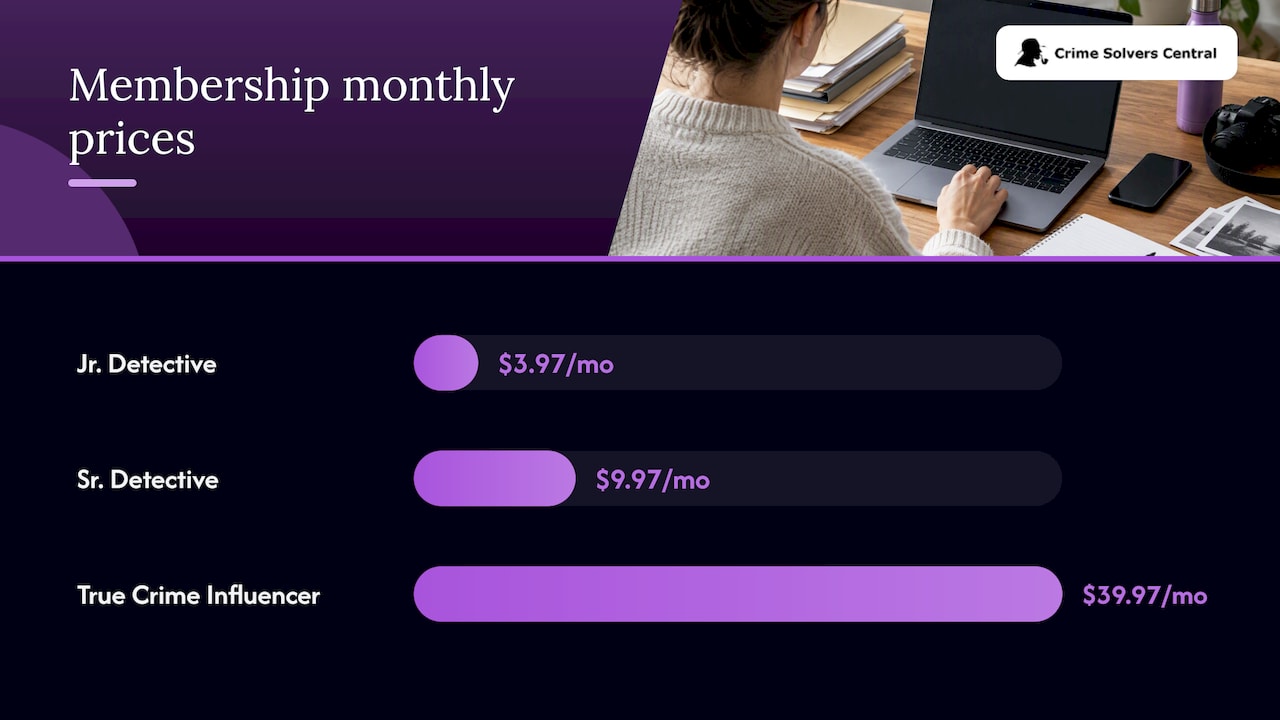
Official public searches through NamUs and your local coroner’s office remain the right first step, every time. Once you’ve done that groundwork, our membership plans give you access to deeper case files, forums, and community tools if you want more support while a case stays open. Plans start at $3.97 per month for Jr. Detective, $9.97 per month for Sr. Detective, or $39.97 per month for True Crime Influencer, each with an annual option listed on our pricing page. Getting started just means registering an account and searching our catalog alongside the official databases you’ve already checked. If you’re also navigating a family member’s incarceration while managing a case, resources like The Bail Network’s guide to official inmate locator tools cover a related piece of the public records landscape.
FAQ
Can you give me a list of unidentified people?
NamUs publishes a searchable public list of unidentified persons cases, filterable by state, physical description, and date found, through the National Institute of Justice’s program. You won’t find a simple downloadable master list, since cases are added individually as local agencies submit and verify them.
How long are unclaimed bodies kept?
Retention timelines vary by county and state, and no single national standard governs how long remains are held before burial or cremation. Contacting the specific medical examiner’s office handling a case is the only reliable way to learn its local retention policy.
Is there a free database for unclaimed bodies in a specific state?
NamUs is free to search nationwide and includes records from participating counties in every state, though coverage depends on local reporting. For state-specific gaps, a direct call to that state’s medical examiner or coroner association fills in records that haven’t been entered online.
How can I find unclaimed bodies in a specific state?
Start with a NamUs search filtered to that state, then follow up directly with county medical examiner or coroner offices, since reporting to the national database is often voluntary. NBC News reporting found that some counties rarely submit certain unclaimed cases, so local outreach fills real gaps.
Sources
- National Missing and Unidentified Persons System | National Institute of Justice
- NBC News reporting on NamUs coverage and coroners’ reporting