

Unidentified Persons Database: U.S. Families Must Search Beyond NamUs
If you’re searching for a missing loved one or trying to help identify an unknown decedent, start with NamUs, the national clearinghouse for missing, unidentified, and unclaimed person cases. Run a targeted search there first, then contact the investigating law enforcement agency directly if you’re a family member. Our own case catalog and community tools can add deeper case files and volunteer support once you’ve covered those official steps.
TL;DR:
- State and county medical examiner sites may list cases before NamUs does, and voluntary reporting leaves gaps across both national and local systems.
- Filter by location and date, then compare physical traits and distinctive marks; restricted fields or missing photos do not mean investigators lack further details.
- Family members cannot collect or submit DNA directly for CODIS; authorized personnel must take reference samples and connect them to the missing person investigation.
- Verified law enforcement or medical examiner staff generally submit NamUs records; CODIS compares DNA profiles, while FBI services route unmatched fingerprints for further research.
Table of Contents
- What are the major public databases and who runs them?
- How do you search and browse unidentified-person records?
- How do submissions and family DNA samples actually work?
- How do forensic matching tools lead to an identification?
- How can volunteers and family advocates help responsibly?
- Crime Solvers Central: how our database and community tools complement official resources
- How to get started with Crime Solvers Central
- FAQ
- Sources
What are the major public databases and who runs them?
NamUs is the starting point for most searches because it’s funded and administered by the National Institute of Justice and built specifically as a centralized, searchable home for three case types: missing persons, unidentified decedents, and unclaimed persons. Public users can browse case summaries and photos, while verified professional users (medical examiners, coroners, law enforcement) access additional details and forensic tools.
Beyond NamUs, many state medical examiner and local Office of the Chief Medical Examiner websites publish their own unidentified case listings, often with jurisdiction-specific details not yet uploaded to the national system.
- NamUs covers missing, unidentified, and unclaimed cases in one searchable system.
- State and county medical examiner pages sometimes list cases before they reach NamUs.
- Entry into any of these systems is largely voluntary, so coverage gaps exist.
Because reporting isn’t mandatory everywhere, a case you’re looking for might sit in a local system without yet appearing nationally. Checking both levels matters.
How do you search and browse unidentified-person records?
Searching effectively means thinking like an investigator: start broad, then narrow using the details that are least likely to change. Here’s a practical sequence:
- Enter the geographic area and approximate date range where the person was last seen or found.
- Add physical descriptors: estimated age, height, weight, sex, and race or ethnicity as recorded.
- Search for unique identifiers like tattoos, scars, dental work, or surgical implants, which narrow results fast.
- Note clothing or personal items found with the decedent, since these are often published even when other fields are restricted.
- Use available filters or Boolean search tools to combine criteria instead of scrolling case by case.
Case records often show a status (active, resolved, or under review) along with fields marked restricted, meaning that information is held back from public view for investigative reasons. A missing photo or sparse description doesn’t mean a case lacks data; it usually means sensitive details are limited to verified professional users.
Pro Tip: Save or screenshot any case that looks like a possible match, then bring it directly to the investigating agency rather than drawing conclusions from the public listing alone.
Our step-by-step walkthrough of NamUs search fields breaks this process down further for families preparing a search.
How do submissions and family DNA samples actually work?
Not everyone can submit a case the same way. Public users can report tips or request information, but entering a formal case record is generally reserved for professional users, such as law enforcement or medical examiner staff, who are verified through a Regional System Administrator before anything goes live. That verification step exists to keep published data accurate and tied to a real investigation.
Family reference DNA works differently. Samples must be collected by authorized personnel, not family members themselves, and are uploaded into CODIS’ Relatives of Missing Persons index, where they’re searched against the Unidentified Human index. Family members cannot independently collect or submit their own DNA samples for CODIS comparison, a safeguard that protects chain of custody and search eligibility.
Before approaching NamUs or local law enforcement, gather:
- A detailed physical description, including height, weight, and distinguishing marks.
- Dental and medical records, if available.
- Photographs from multiple years, not just one.
- Any prior missing person reports or case numbers already on file.
Having this ready speeds up both the NamUs intake conversation and any DNA reference sample request an agency may make.
How do forensic matching tools lead to an identification?
Three systems work in sequence, and understanding each helps explain why identification can take time. CODIS (the Combined DNA Index System) holds several relevant indices: the Unidentified Human index, the Missing Person index, and the Relatives index, and searches run automatically as new profiles are added, flagging potential matches for investigators to confirm.
Fingerprints follow a separate but related path. The FBI’s Deceased Person Identification services route unmatched prints for additional biometric and biographic research across NCIC and NamUs, which can surface a match even when an initial fingerprint search comes back empty.
- CODIS compares DNA profiles across its unidentified, missing person, and relatives indices.
- FBI DPI services forward unmatched fingerprints for further research through NCIC and NamUs.
- Investigative genealogy, which pairs DNA analysis with traditional genealogy research, has helped resolve long-dormant cold cases when used through authorized law enforcement channels.
These tools complement each other rather than compete, and a case that stalls in one system sometimes moves forward through another.
How can volunteers and family advocates help responsibly?
The most useful thing you can do as a volunteer or family member is pass information to the people who can act on it. Find the contact information listed directly on the case record and report tips to that investigating agency rather than to social media first.
- Report tips directly to the agency or medical examiner listed on the case page.
- Share case details to build public awareness, using accurate information only.
- Use community tools like a flyer builder or discussion forum to organize volunteer outreach.
- Avoid collecting DNA, handling remains, or posting another family’s private information without consent.
Pro Tip: A well-made flyer with accurate case details often reaches more potential witnesses than a vague social post, so take the extra few minutes to get the facts right.
Crime Solvers Central: how our database and community tools complement official resources
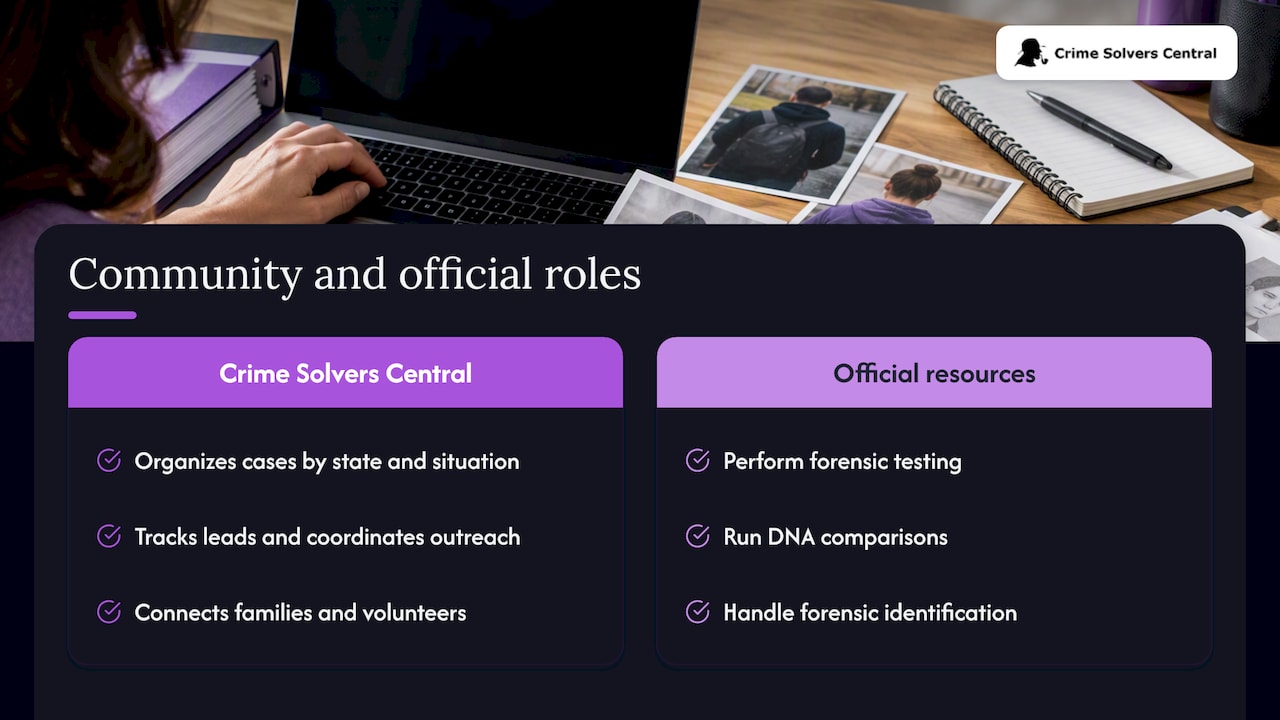
We built our national case catalog to sit alongside NamUs and local law enforcement, not replace them. Our database organizes cases by state and situation, so families and volunteers can browse missing persons, unsolved homicides, and unidentified remains cases in one place, then dig into full case files and community tools once they’re ready to act.
We don’t perform forensic testing or run DNA comparisons ourselves. What we offer is organized access to case information and tools that help families and volunteers stay engaged between official updates: tracking leads, coordinating outreach, and connecting with others working the same case. Think of us as the place to organize your search and your community, while NamUs and law enforcement remain the authorities handling forensic identification.
How to get started with Crime Solvers Central
Getting started takes a few minutes. Create a free account to browse our cold case database by state, then compare membership tiers on our pricing page, which range from Jr. Detective at $3.97 per month to Sr. Detective and True Crime Influencer tiers for those who want full case access and community features.
Membership unlocks complete case files, forum discussions, and volunteer coordination tools. Alongside that, keep your case registered with NamUs and your local investigating agency. That’s the path that preserves access to CODIS and fingerprint-based identification resources.
FAQ
What information is in the NamUs database?
NamUs holds case records for missing persons, unidentified decedents, and unclaimed persons, including physical descriptors, circumstances, and in many cases dental or DNA information. As of mid-2026, NamUs published over 15,000 active unidentified decedent cases within a system that houses tens of thousands of missing, unidentified, and unclaimed person records overall.
How many people go missing in New York City every year?
We don’t have a sourced figure specific to New York City to cite here. For current counts in any city or state, NamUs and local law enforcement agencies are the most reliable places to check.
What rights do families of missing people have?
Families can request updates from the investigating agency, provide reference information such as dental records or photographs, and, through authorized personnel, contribute DNA reference samples to CODIS’s Relatives of Missing Persons index. Family members themselves cannot collect or submit DNA samples directly; that step requires authorized criminal justice personnel to preserve chain of custody.
What are the top 5 states for missing persons?
We don’t have a sourced ranking of states to share here. NamUs allows you to filter case searches by state, which is the most accurate way to see current numbers for any specific location.
How do investigators match fingerprints to unidentified remains?
When a fingerprint doesn’t immediately match an existing record, the FBI’s Deceased Person Identification services forward that print for further biometric and biographic research across NCIC and NamUs. This additional research step has helped identify decedents who would otherwise have remained unknown.
Sources
For official procedures and forms, start with NamUs and the FBI’s DPI services sheet. For a deeper family-facing walkthrough, see our guide to identifying unidentified remains and our missing persons database overview.
When official systems move slowly, it’s easy to feel like nothing is happening. But every detail entered into NamUs, every DNA reference sample properly collected, and every fingerprint forwarded for further research is a step that stays in motion long after the initial search. The families who make progress aren’t the ones who search the loudest. They’re the ones who pair patience with the right channel for each piece of information, and who understand that community effort and official forensic work aren’t competing paths. They’re the same path, walked together.
— Crime