

10 Unsolved Missing Persons Cases and Where Families Can Search
An unsolved missing persons case is any disappearance where a person hasn’t been located, identified, or confirmed dead, sometimes for decades. This guide profiles notable unsolved disappearances, explains why so many stay cold, and points to real tools like NamUs and Crime Solvers Central’s extensive database of cases so families and investigators know where to actually look.
TL;DR:
- Many unresolved cases involve cases with degraded evidence or those classified early as runaway or voluntary departures, leading to lower investigative priority.
- Jurisdictional fragmentation often hampers case resolution, especially when disappearances cross county, state, or federal lines, reducing information sharing.
- Modern forensic techniques like DNA reanalysis and AI-driven pattern recognition are reopening old cases and increasing the chances of identifying remains or linking cases.
- Community tools like Crime Solvers Central provide critical support for case organization, search coordination, and sustained publicity, often prompting new leads.
- Public involvement through strategic media campaigns and proper reporting protocols can significantly enhance the likelihood of case breakthroughs.
Table of Contents
- Notable Unsolved Missing Persons Cases Worth Knowing
- Why Do So Many Missing Persons Cases Stay Unsolved?
- National Databases and Resources for Missing Persons Cases
- What Can Families and the Public Do to Help a Case?
- How Forensic Science Is Reopening Cold Missing Persons Cases
- The Toll Unsolved Cases Take on Families
- Patterns Investigators See Across Unsolved Disappearances
- Does Media Coverage Actually Help Solve Missing Persons Cases?
- Why Jurisdictional Boundaries Complicate Missing Persons Investigations
- How AI and Data Tools Are Changing Missing Persons Investigations
- Publisher Perspective: How Crime Solvers Central Supports Case Searches
- Get Full Access to Cold Case Files by State
- Sources
- FAQ
Notable Unsolved Missing Persons Cases Worth Knowing
Some disappearances stay in public memory because they defy easy explanation. Others matter because they reveal patterns law enforcement still struggles with. The list below spans decades and circumstances, from vanishings on hiking trails to disappearances from private homes.
- D.B. Cooper (1971) — A skyjacker parachuted from a Boeing 727 over the Pacific Northwest with $200,000 in ransom money and was never found. The FBI closed active investigation in 2016; identity remains unconfirmed.
- Amy Bradley (1998) — Vanished from a Royal Caribbean cruise ship at age 23. Alleged sightings have surfaced for years; case remains open.
- Asha Degree (2000) — A nine-year-old girl disappeared from her North Carolina home overnight. Items linked to her were found along a roadside; no resolution to date.
- Brandon Swanson (2008) — A 19-year-old vanished after a phone call from a rural Minnesota roadside; last words indicated he was walking toward lights he thought were a farmhouse.
- Maura Murray (2004) — Disappeared after a car crash in rural New Hampshire; no confirmed sighting since.
- Lauria Bible and Ashley Freeman (1999) — Two Oklahoma teenagers vanished after a house fire; case remains unresolved with unidentified remains questions still open.
- The Springfield Three (1992) — Three women disappeared from a Missouri home overnight with no forced entry; case remains a suspected foul play investigation.
- Kenneth Fusco (2019) — Vanished from a jogging trail; classified as a suspicious disappearance pending further evidence.
- Bergen County Jane and John Does — Multiple unidentified remains cases tied to missing-person files remain unmatched despite forensic testing.
- Amber Fellows (1990) — A teenager missing from Massachusetts for over three decades; case remains listed as unresolved.
Each case underscores a different obstacle: overwhelmed rural jurisdictions, ambiguous evidence, or the sheer geography separating a disappearance from a discovery.
Why Do So Many Missing Persons Cases Stay Unsolved?
Cold cases don’t stay cold by accident. NIJ research on cold-case investigations identifies evidence availability and the presence of new witnesses as the strongest predictors of whether a case ever gets resolved. When physical evidence degrades, gets lost in storage, or was never collected properly at the scene, the odds of resolution drop sharply.
Several structural factors compound the problem:
- Jurisdictional fragmentation — a person vanishes in one county, is last seen in another, and no single department owns the full picture.
- Case age — witnesses relocate, memories fade, and physical evidence chains break down over years.
- Classification bias — cases initially logged as “runaway” or “voluntary departure” often receive far less resource allocation than those flagged for suspected foul play, even when circumstances later suggest otherwise.
- Staffing gaps — most departments lack a dedicated cold-case unit, meaning old files compete with active caseloads for detective time.
NIJ’s cold-case unit guidance defines a cold case as one unsolved for at least three years, but notes these files often become solvable again once new evidence, a new witness, or modern testing enters the picture.
National Databases and Resources for Missing Persons Cases
A handful of federal systems exist specifically to break jurisdictional silos. Knowing which one does what saves families and investigators real time.
- NamUs (National Missing and Unidentified Persons System) — a free, centralized repository offering forensic services including fingerprint analysis, forensic odontology, anthropology, and DNA testing. Families, medical examiners, and the public can all enter or search records.
- FBI ViCAP (Violent Criminal Apprehension Program) — an investigative repository built for law enforcement to search for patterns across jurisdictions, particularly in cases with suspected foul play. Access is largely limited to law enforcement, not the general public.
- National Park Service cold-case listings — the NPS maintains rosters of unresolved disappearances that occurred on federal land, often coordinating with the FBI given the jurisdictional overlap in parks.
- Bureau of Indian Affairs Missing and Murdered Unit (MMU) — a specialized federal unit addressing the disproportionate rate of unresolved disappearances among Indigenous people, working across tribal, state, and federal lines.
None of these tools guarantee resolution. They exist to centralize information that used to sit in disconnected filing cabinets.
What Can Families and the Public Do to Help a Case?
Grief and urgency push people toward action, but the wrong action can hurt a case. Here’s a sequence that actually helps investigators instead of complicating their work.
- Report and re-report through the right channel. File with local police first, then submit the case directly to NamUs if it isn’t already listed.
- Request a formal case review. Families often get more traction petitioning a police chief or county prosecutor directly rather than repeatedly calling an overloaded assigned detective, since formal requests get documented and can trigger a fresh look.
- Document new information precisely. Note who found it, when, where, and how, before contacting law enforcement.
- Preserve, don’t touch. Photograph potential evidence from a distance; handling it can break the chain of custody needed for forensic testing.
- Use media strategically. Local news segments, anniversary coverage, and social media pushes can prompt new witnesses to come forward, but coordinate timing with investigators rather than flooding tip lines independently.
Pro Tip: When you submit a tip, include a timestamp, location, and your contact information in writing, not just a phone call. Investigators prioritize documented leads they can verify over secondhand accounts they have to chase down.
How Forensic Science Is Reopening Cold Missing Persons Cases
DNA testing has changed more in the last decade than in the previous three combined. Mitochondrial DNA techniques now let labs extract usable profiles from bone fragments or hair shafts that older testing couldn’t touch, which means evidence collected in the 1990s can sometimes be retested with results impossible to get at the time.
- Old evidence becomes valuable again once matched against expanded reference databases.
- Automatic matching between missing-person records and unidentified remains has improved as NamUs and similar systems grow more interoperable.
- NIJ’s applied research on regional task forces shows that consolidating cases lets investigators spot cross-jurisdiction patterns a single department would likely miss.
Reopening a file doesn’t always end in an arrest. Sometimes the outcome is simpler and still meaningful: a set of unidentified remains finally gets a name, and a family gets an answer instead of a question mark. Genealogical resources like the DNA testing options available after death can also help resolve family relationship questions tied to unidentified decedents.
The Toll Unsolved Cases Take on Families
Ambiguous loss is its own category of grief. Families of long-term missing persons describe living in a suspended state, unable to mourn fully because there’s no confirmation, and unable to hope fully because years have passed without contact. That in-between state has a name in psychology: ambiguous loss, and it tends to last far longer than grief tied to a confirmed death.
The financial and logistical burden compounds the emotional one. Families often spend years fielding tips, funding private investigators, or traveling to follow leads that go nowhere. Siblings and children of the missing frequently report anniversaries and holidays becoming harder rather than easier over time, since each one passes without resolution.
Social isolation follows a predictable pattern too. Friends and extended family, uncertain how to offer support for an open-ended tragedy, often drift away after the first year or two, leaving immediate family members to carry the case largely alone. Support groups built specifically around missing persons, rather than general grief support, tend to help more because they understand the specific ache of not knowing.
Law enforcement engagement matters here as much as forensics. Families who receive regular updates, even when there’s no new information, report better long-term coping than those who feel cases have gone silent. That’s part of why formal case-review requests matter beyond their investigative value: they signal to a family that someone is still paying attention.
Patterns Investigators See Across Unsolved Disappearances
Certain circumstances recur often enough across unsolved cases that they’ve become recognizable categories to investigators. Disappearances from rural or geographically isolated areas, like Brandon Swanson’s roadside vanishing, show up disproportionately in cold-case files, largely because sparse populations mean fewer potential witnesses and slower initial response times.
Cases involving adults initially classified as voluntary departures form another recurring pattern. Because these files often get deprioritized early, evidence collection lags behind cases flagged immediately as suspicious, and by the time classification gets revisited, the trail has usually gone cold. Age at disappearance also correlates with case trajectory: children and teenagers tend to generate faster initial response, while adults, particularly those with any history of transience or mental health struggles, often see slower institutional urgency.
Certain locations recur too. Waterways, dense forest, and remote trailheads appear again and again in unresolved case files, partly because they complicate search logistics and partly because remains in these environments degrade faster, limiting what forensic testing can later recover. Indigenous communities show a strikingly disproportionate rate of unresolved disappearances relative to population, a pattern serious enough that the federal government created the Bureau of Indian Affairs Missing and Murdered Unit specifically to address it.
None of these patterns explain every case. But recognizing them helps families and advocates understand why a specific case may be moving slowly, and where advocacy pressure tends to be most effective.
Does Media Coverage Actually Help Solve Missing Persons Cases?
Media attention is one of the few levers ordinary people can pull without a badge or a lab. Persistent coverage, including anniversary segments, true-crime podcast episodes, and organized town halls, can prompt new witnesses to come forward years after a disappearance, according to cold-case practitioners who’ve watched dormant tip lines light up after a single well-placed story.
That said, coverage is uneven by design. High-profile cases involving young, photogenic, or otherwise “newsworthy” victims tend to receive outsized attention, while cases involving adults, people of color, or those with complicated personal histories often get a fraction of the airtime, regardless of how solvable the case might be. This disparity has become its own subject of criticism within true-crime communities and among family advocates.
Awareness campaigns work best when they’re specific rather than diffuse. A vague “have you seen this person” post rarely moves the needle. A campaign that includes precise dates, last-known locations, distinguishing details, and a direct tip line tends to generate leads investigators can actually use. Reward offers, when publicized clearly, have prompted new information in several long-dormant cases documented in NPS cold-case files, though rewards alone rarely substitute for sustained coverage.
Families who engage media strategically, rather than sporadically, generally see better long-term results. That means coordinating timing with investigators so a media push doesn’t flood a tip line with unmanageable volume right when a real lead needs following up.
Why Jurisdictional Boundaries Complicate Missing Persons Investigations
A person can go missing in one county, be spotted crossing into another state, and have remains eventually surface on federal land, three separate jurisdictions with three separate reporting systems and no automatic obligation to share information. That fragmentation is one of the most persistent, least discussed reasons cases stay cold.
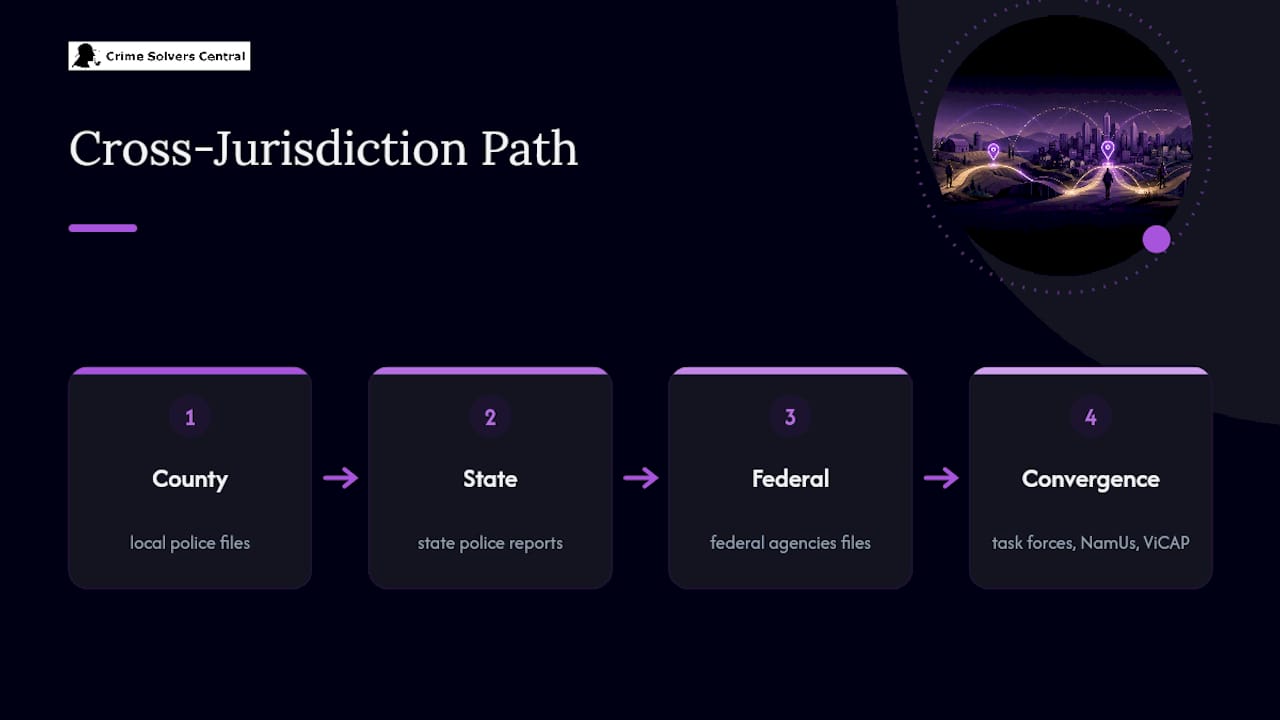
Local police departments, county sheriffs, state police, and federal agencies each maintain their own case files and often their own databases, and historically these systems didn’t talk to each other well. A rural sheriff’s office with a handful of detectives may lack the staffing or the systems access to cross-reference a case against national databases at all, let alone maintain it as an active priority for years.
Multiagency task forces have become the standard fix, and NIJ’s applied research on cold-case units backs the approach: consolidating cases regionally lets investigators spot patterns across jurisdictions that isolated departments would likely never connect. The Bureau of Indian Affairs MMU exists precisely because tribal, state, and federal jurisdiction over Indigenous missing-person cases created gaps no single agency could close alone.
Even with task forces, coordination takes deliberate effort. Databases like NamUs and ViCAP exist specifically to route around jurisdictional walls, but they only work when individual departments actually enter and maintain their records consistently, which remains inconsistent across the country.
How AI and Data Tools Are Changing Missing Persons Investigations
Forensics gets most of the attention, but data analysis has quietly become just as important to reopening cold cases. Automated matching systems now cross-reference missing-person records against unidentified remains databases continuously, flagging potential matches that a human investigator manually comparing files might take years to notice, or might never notice at all.
Facial recognition and age-progression software help generate updated images of long-missing children and adults, giving media campaigns fresher visuals to work with instead of decades-old photographs that no longer resemble how a person might look today. Geographic pattern analysis, meanwhile, helps investigators spot clusters of disappearances along specific highway corridors or in specific regions, informing where task forces focus resources.
None of this replaces investigative fieldwork. Software can surface a possible match or a pattern worth investigating, but a human detective still has to verify it, follow up with witnesses, and build a case that holds up. The realistic value of these tools is speed: cutting down the time it takes to notice a connection that used to require someone manually cross-referencing thousands of paper files by hand.
Publisher Perspective: How Crime Solvers Central Supports Case Searches
Crime Solvers Central maintains a database of more than 264,913 cases, categorized by state and case type, built specifically to complement resources like NamUs rather than duplicate them. Membership unlocks deeper case files, digital evidence boards, a flyer builder, and forum access where families and volunteers coordinate search efforts.
Organized community engagement, tip forums, fundraising for search efforts, and volunteer coordination, tends to keep public attention on a case longer than a single news cycle ever could. That sustained pressure is often what pushes an overloaded department to revisit a file.
— Crime
Get Full Access to Cold Case Files by State
Crime Solvers Central exists for the moment after you’ve filed the police report and checked NamUs, when you need the deeper case file, the forum where other researchers are comparing notes, and the tools to actually organize a search. Membership unlocks full case details, digital evidence boards, a flyer builder, and volunteer coordination features that official databases weren’t built to offer.
This isn’t a replacement for NamUs, ViCAP, or your local department. It’s a working companion to those tools, built for the families, advocates, and researchers doing the day-to-day legwork between official updates. If you’re trying to raise visibility on a specific case or dig into patterns across a state, start with the cold case database by state and see what’s already documented before you build from scratch.
Sources
- Home | NamUs
- Cold-Case Investigations: An Analysis of Current Practices and Factors Associated with Successful Outcomes
- ViCAP Missing Persons
- Cold cases - National Park Service
FAQ
What Are Some of the Most Well-Known Unsolved Disappearances?
Cases like D.B. Cooper, Amy Bradley, Asha Degree, the Springfield Three, and Maura Murray remain among the most discussed unsolved disappearances, each illustrating a different investigative obstacle from ambiguous evidence to jurisdictional gaps.
Has Anyone Ever Been Found Alive After Being Missing for Decades?
Yes, though it’s uncommon. Long-term missing person cases have occasionally ended with the person found alive years or decades later, which is part of why databases like NamUs keep long-cold files active rather than closing them permanently.
What Is Considered the Most Famous Missing Persons Case in the United States?
D.B. Cooper’s 1971 skyjacking and disappearance is widely considered the most famous unsolved case in the country, largely because it involves a genuine mystery with physical evidence, ransom money, and no confirmed resolution to this day.
How Can I Report a Tip on an Unsolved Missing Persons Case?
Contact local law enforcement first, then submit the information directly through NamUs, which routes tips to the appropriate investigating agency. Crime Solvers Central’s database by state also lets you review existing case details before submitting new information.
Why Do Some Missing Persons Cases Never Get Solved?
Most stay unsolved due to a combination of degraded or missing physical evidence, fading witness memory, and jurisdictional fragmentation between the agencies involved, exactly the factors NIJ’s cold-case research identifies as the strongest predictors of case outcome.