

What Is an Open Case Database? A 2026 Guide

An open case database is a publicly accessible repository of criminal or civil case information, designed to support transparency and give families, advocates, and the public access to cold case and investigative data. These systems sit at the center of modern justice advocacy, and understanding how they work can mean the difference between a case staying cold and a family finding answers. Crimesolverscentral maintains a national catalog of over 264,913 cases organized by state, making it one of the most accessible platforms of this kind in the United States. The gap between what law enforcement holds internally and what the public can actually reach is wide. Knowing where open case databases fit in that gap is the first step toward using them well.
What is an open case database and what does it contain?
An open case database is defined as a structured, publicly searchable collection of records related to criminal investigations, court proceedings, or missing persons cases. The term “open” signals that access is not restricted to law enforcement or legal professionals. Anyone, including family members, journalists, and community advocates, can search these systems without a badge or a law license.
The data inside these databases varies by platform. Most include docket sheets, case file summaries, press releases, public court records, and basic identifying information about victims or defendants. Docket sheets are the most important document in court case searches, providing a chronological log of all filings and hearings. Reviewing a docket sheet first gives you a map of the entire case before you spend time or money pulling individual documents.

Cold cases make up a significant portion of what families search for in these systems. Utah’s approach is instructive: Utah Statute Code Section 53-10-115 (2018) requires all cold cases to be entered into a centralized Law Enforcement Cold Case Database accessible through public portals. That mandate shows what is possible when a state commits to transparency. Federal cases, state criminal matters, and local civil proceedings can all appear in open databases, though coverage depends entirely on the platform and jurisdiction.
Pro Tip: Start every search by identifying the jurisdiction where the case was filed. Case files link strictly to the court where they originated, so searching the wrong county or state system will return nothing.
The types of data you will typically find include:
- Docket sheets: Chronological records of all court filings and hearings
- Case file summaries: Condensed overviews of charges, parties, and outcomes
- Public records summaries: Aggregated information from press releases and law enforcement statements
- Victim and missing persons profiles: Names, physical descriptions, and last known locations
- Case status indicators: Whether a case is active, closed, or under review
How do open case databases differ from law enforcement systems?
Open case databases and official law enforcement databases serve different purposes and hold fundamentally different information. Law enforcement databases like NCIC hold real-time sensitive data including active warrants, missing persons flags, and stolen property records. That information is restricted to authorized agencies and is never publicly accessible.
Open case databases, by contrast, aggregate what is already public. They pull from court records, news archives, press releases, and government data portals. The distinction matters because public databases can lag behind real-time developments. A suspect may have been arrested last week, but an open database might still show the case as unsolved.
“Public-interest archives and nonprofit databases can increase awareness but must be verified against official law enforcement or court records for accuracy. Treating a nonprofit archive as a definitive source without cross-checking introduces serious risk of error, especially in active investigations.”
Verification is not optional. Nonprofit archives are useful for raising awareness and connecting families to information, but they require cross-referencing with official sources before any conclusions are drawn. The practical steps for verification look like this:
- Locate the case in the open database and note the case number and jurisdiction.
- Search the official court system for that jurisdiction to confirm the record exists.
- Cross-check victim or suspect details against NamUs or FBI records where applicable.
- Contact the relevant law enforcement agency directly if discrepancies appear.
Understanding why public databases aid law enforcement also helps clarify what these systems are built to do. They supplement official channels. They do not replace them.
What are examples of open case databases available in 2026?
Several platforms give the public meaningful access to case information, each with different scope, cost structures, and data sources.
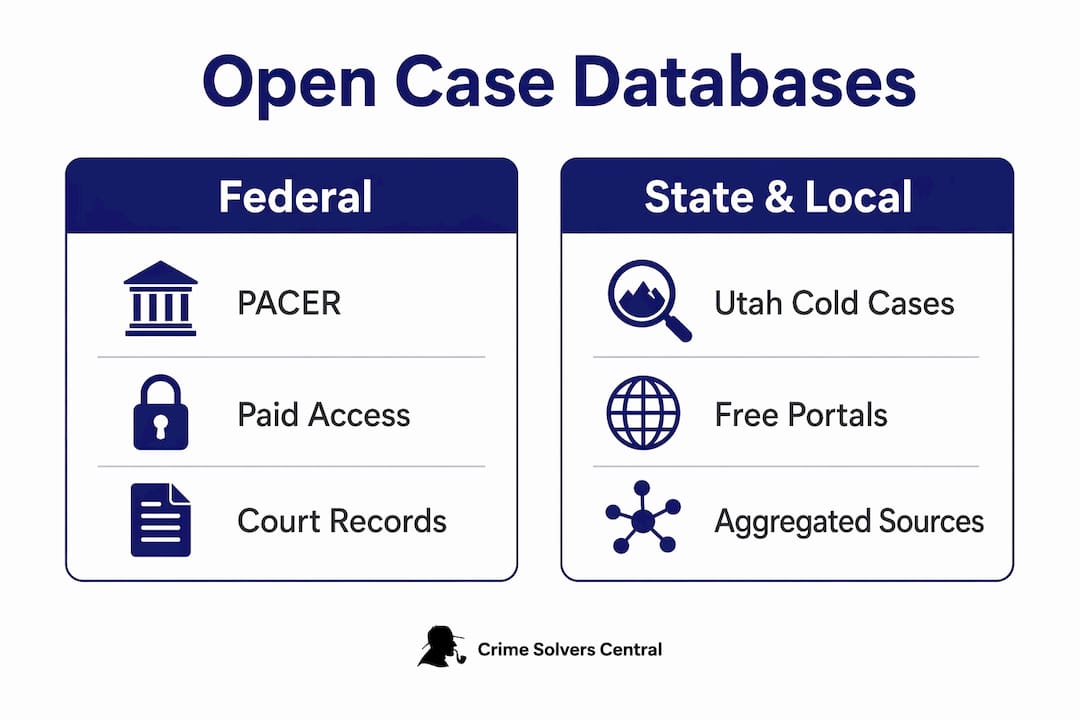
PACER (Public Access to Court Electronic Records) is the federal government’s primary system for accessing court documents. It charges $0.10 per page with a $3.00 cap per document, and users who accumulate less than $30 in charges per quarter receive a fee waiver. That pricing structure makes PACER affordable for targeted searches but expensive for broad, unfocused research.
Utah’s Law Enforcement Cold Case Database is a state-mandated system that gives families and advocates access to cold case records through public portals. It is one of the few examples in the United States where state law directly requires cold case transparency.
CaseLinker curates publicly available records from 56 sources and holds information on over 7,426 cases as of early 2026. That breadth makes it a strong starting point for advocates trying to locate cases that span multiple agencies or jurisdictions.
Maryland Judiciary Case Search is a free state-level portal that allows searches by name, case number, or filing date across Maryland’s court system. Many states offer similar portals, though quality and coverage vary significantly.
| Platform | Access type | Cost | Primary use |
|---|---|---|---|
| PACER | Federal court records | $0.10/page | Federal criminal and civil cases |
| Utah Cold Case Database | State cold cases | Free | Cold case research by families |
| CaseLinker | Multi-agency aggregator | Free | Cross-agency cold case searches |
| Maryland Judiciary Case Search | State court records | Free | State-level case lookups |
Pro Tip: Use CaseLinker or a state judicial portal before turning to PACER. Free resources often surface the case number and jurisdiction you need, which then lets you pull only the specific PACER documents that matter.
Crimesolverscentral takes a different approach by organizing over 264,913 cases by state and situation, giving families a single entry point rather than requiring them to navigate dozens of separate portals. That structure is especially valuable for advocates working across state lines.
What challenges come with using open case databases?
Open case databases are powerful, but they come with real limitations that every researcher needs to understand before relying on them.
No single, unified national criminal case database exists for public use. Families and advocates must navigate a patchwork of federal, state, and county systems. That fragmentation means a case involving events in three states may require searching three entirely separate platforms, each with its own interface and data standards.
The core challenges include:
- Jurisdictional fragmentation: Each court system operates independently, so investigators often conduct a “jurisdictional hunt” by searching county-level portals one by one.
- Sealed cases: Some cases or dockets are sealed by court order and will not appear in any public search, regardless of platform.
- Data currency: Open databases update on different schedules. A case resolved six months ago may still appear as open in a public portal.
- Fee accumulation: PACER costs add up quickly if you pull documents without first reviewing the docket sheet to identify exactly what you need.
- Incomplete records: Not all jurisdictions digitize older case files, so cold cases from the 1980s or 1990s may have no online presence at all.
These barriers are real, but they are not insurmountable. Understanding them upfront prevents wasted time and misplaced conclusions.
How to use open case databases effectively for cold case research
Effective use of open case databases follows a clear sequence. Starting with the right resources in the right order saves time and reduces cost.
- Begin with free platforms. Search Crimesolverscentral, CaseLinker, and your state’s judicial portal before opening a PACER account. Free resources frequently surface the case number and jurisdiction you need.
- Identify the jurisdiction. Case files link strictly to the jurisdiction where the case was filed. Confirming this before searching prevents dead ends.
- Pull the docket sheet first. On PACER, the docket sheet costs a fraction of the full case file and tells you exactly which documents are worth downloading.
- Cross-check with official sources. Verify findings against NamUs, FBI records, or the relevant law enforcement agency. Public records support cold cases best when paired with official confirmation.
- Submit tips through official channels. If your research surfaces new information, submit it directly through the law enforcement agency’s tip portal or through a platform like Crimesolverscentral that connects community members with active investigations.
Pro Tip: Keep a running log of every database you search, the date you searched it, and what you found. Cold case research often spans months, and a clear record prevents duplicating effort and helps you spot when a database has been updated.
Understanding how to leverage national database cold cases also means knowing when to ask for help. Advocates who connect with local cold case organizations or legal aid groups often gain access to resources and contacts that are not publicly listed.
Key Takeaways
Open case databases give families and advocates direct access to case information that was previously difficult to locate, but effective use requires knowing each platform’s scope, cost, and limitations.
| Point | Details |
|---|---|
| Open case database definition | A publicly searchable repository of criminal or civil case records, distinct from restricted law enforcement systems. |
| Verification is non-negotiable | Always cross-check open database findings with official sources like NamUs, FBI records, or court systems. |
| No national public database exists | Researchers must search multiple federal, state, and county portals to build a complete picture of any case. |
| Start with free resources | Use CaseLinker, state portals, and Crimesolverscentral before accessing fee-based systems like PACER. |
| Docket sheets save money | Reviewing a docket sheet first on PACER identifies which documents are worth the cost of downloading. |
Why open case databases matter more than most people realize
I have spent years watching families hit the same walls. They find a name in a news article, search for the case online, and land on a platform that either charges them immediately or returns nothing because the case is in a county system they did not know existed. The frustration is real, and it is not a reflection of their effort. It is a reflection of how fragmented public case access still is in this country.
What I have found is that the families who make the most progress treat open case databases as a starting point, not a destination. They use platforms like Crimesolverscentral to locate a case, then follow the thread into official court systems, law enforcement contacts, and nonprofit networks. The database gives them the language they need, including case numbers, jurisdictions, and victim details, to ask the right questions of the right people.
The technology is improving. Platforms that aggregate records from dozens of sources, the way CaseLinker pulls from 56 agencies, represent a real shift toward accessibility. But the human element still matters. A database entry does not grieve. It does not advocate. The families and community members who use these tools with persistence and precision are the ones who move cases forward.
My honest advice: do not let jurisdictional complexity stop you. Cold case audits yield new leads precisely because someone was willing to search one more portal, make one more call, or submit one more tip. The information is often out there. The work is in finding it.
— Crime
Crimesolverscentral: a centralized resource for cold case research
Crimesolverscentral organizes over 264,913 missing persons and unsolved homicide cases into a state-by-state cold case database that families and advocates can search without navigating dozens of separate portals. Each case is categorized by state and situation, giving you a clear entry point regardless of where the case originated. The platform also supports community participation through membership, fundraising, and health and safety initiatives, so your involvement can go beyond searching. For families who have spent years hitting dead ends across fragmented systems, Crimesolverscentral offers a single, organized starting point built specifically for people seeking justice and closure.
FAQ
What is the open case database definition?
An open case database is a publicly accessible repository of criminal, civil, or missing persons case records, designed to support transparency and give families and advocates access to investigative information without requiring law enforcement credentials.
How do open case databases differ from NCIC?
NCIC holds real-time sensitive data including active warrants and restricted law enforcement records, while open case databases aggregate publicly available records such as court filings, press releases, and public case summaries.
Is there a free national open case database in the United States?
No single free national public case database exists. Researchers must search multiple platforms including state judicial portals, CaseLinker, and Crimesolverscentral to build a complete picture across jurisdictions.
How much does PACER cost for case searches?
PACER charges $0.10 per page with a $3.00 cap per document, and users who accumulate less than $30 in charges per quarter receive a fee waiver automatically.
How can families use open case databases to support cold case investigations?
Families should start with free platforms to identify case numbers and jurisdictions, then cross-check findings against official sources like NamUs or FBI records, and submit any new information through official law enforcement tip channels.