

Why Unidentified Persons Cases Matter for Justice
Every year, around 600,000 missing person reports are filed in the United States. Yet behind that number sits a quieter, less-discussed crisis: an estimated 14,000 sets of unidentified human remains nationwide, with roughly 4,400 currently logged in national databases. Understanding why unidentified persons cases matter goes far beyond statistics. These are real people with families, histories, and names that deserve to be spoken again. For families waiting on answers, for advocates pushing for reform, and for communities that deserve safety, these cases are not cold files. They are open wounds.
Table of Contents
- Key takeaways
- Why unidentified persons cases matter: the basics
- The human and legal cost of unnamed victims
- Technology that is changing how cases get solved
- Systemic challenges that keep cases unresolved
- How you can support identification efforts
- My perspective on what gets overlooked
- Explore cases and get involved with Crimesolverscentral
- FAQ
Key takeaways
| Point | Details |
|---|---|
| Scale of the crisis | An estimated 14,000 unidentified remains exist nationwide, far exceeding public awareness. |
| Justice depends on identity | Naming a victim is often the single step that unlocks a full homicide investigation. |
| Technology is changing outcomes | Forensic genetic genealogy has solved cases nearly 40 years old that were previously considered closed. |
| Systemic bias exists | High-profile cases receive more resources, leaving marginalized victims without equal attention. |
| Community action matters | Reporting promptly, joining DNA databases, and supporting advocacy groups directly improve case outcomes. |
Why unidentified persons cases matter: the basics
The formal term used by law enforcement and forensic professionals is “unidentified decedent” or “unidentified remains.” These are cases where a body or skeletal remains have been found but cannot be linked to a known missing person or given a confirmed identity. The phrase “unidentified persons cases” is widely used by advocates and families, and both terms describe the same heartbreaking reality.
Missing persons cases and unidentified remains cases are two sides of the same coin, yet they are often tracked in separate systems. A family reporting a missing loved one may not know that unidentified remains matching that person’s description exist in a database across the country. This disconnect is one of the most preventable tragedies in the entire system.
A few things most people get wrong about these cases:
- There is no 24-hour waiting period. This is one of the most damaging myths in missing persons reporting. Immediate reporting is not only allowed but strongly advised. The first 48 hours are the most critical window for investigators.
- Not all missing persons become unidentified remains. Many are found alive. But for those who are not, the gap between “missing” and “identified” can stretch for decades.
- Unidentified does not mean unknown. Many of these individuals were reported missing. The failure is in connecting the two records.
Pro Tip: If you are helping a family report a missing person, bring any available dental records, medical records, or DNA samples to law enforcement immediately. These can be cross-referenced against existing unidentified remains databases without delay.
The human and legal cost of unnamed victims
The emotional toll on families who do not know whether their loved one is alive or dead is profound. Psychologists describe this as “ambiguous loss,” a form of grief with no defined endpoint. There is no funeral, no legal closure, and often no answers. Families are suspended in a state of waiting that can last years or entire lifetimes.
“Identifying victims is often the bottleneck to progressing cold cases into active homicide investigations, enabling justice and closure.” — INTERPOL’s ‘Identify Me’ campaign
That quote captures something investigators know well but the public rarely hears. When a victim has no name, prosecutors cannot build a case. Witnesses cannot be located. Motive cannot be established. The entire machinery of justice stalls at the first step. Unsolved violent crimes leave offenders free to harm others, which means the impact of unidentified cases extends well beyond the individual victim.
There is also a documented disparity in how these cases are handled. Many unidentified individuals receive far less media attention and fewer investigative resources than high-profile victims. Race, socioeconomic status, and geography all influence which cases get pursued and which sit untouched for decades. This is not a flaw in one department. It is a pattern embedded in how the system allocates attention.
The significance of nameless individuals is not just personal. It is structural. When communities cannot trust that every victim will receive equal effort, confidence in the justice system erodes. That erosion has consequences that ripple outward.
Technology that is changing how cases get solved
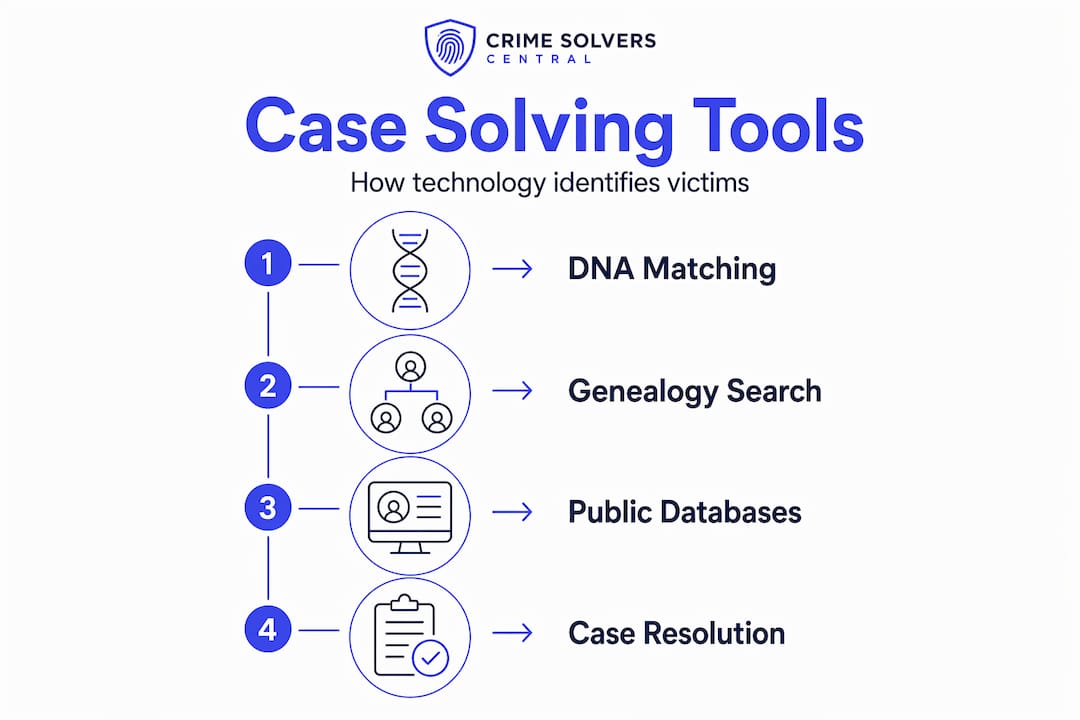
The last decade has produced genuinely transformative tools for investigators working unidentified remains cases. The most significant is forensic genetic genealogy, which uses DNA profiles from unidentified remains and compares them against voluntary public databases to find living relatives who can help establish identity.
| Method | How it works | Notable strength |
|---|---|---|
| Forensic genetic genealogy | Matches DNA from remains to relatives in public databases | Solves cases decades old with no other leads |
| Traditional DNA databases | Compares profiles in law enforcement systems like CODIS | Fast when a direct match exists |
| AI-assisted pattern analysis | Identifies links across jurisdictions and case files | Surfaces connections invisible to manual review |
| INTERPOL data sharing | Cross-border victim identification using shared records | Resolves cases involving international movement |
Since 2018, around 75 cold cases in Colorado alone have been solved using investigative genetic genealogy, including a 1986 homicide victim identified nearly 40 years after the crime. That is not an outlier. It is a preview of what becomes possible when the right tools meet the right data.
The critical factor is public participation. Family members opting into public DNA databases like GEDmatch or FamilyTreeDNA create the reference points investigators need. Without those voluntary submissions, even the best forensic tools hit a wall. AI and international data sharing are multiplying success rates further by linking cases across borders that previously had no connection.
Pro Tip: If you have a missing family member, consider uploading your own DNA to a public genealogy database and marking it as available for law enforcement matching. This single step has directly led to identifications in cases that had no other leads.
Systemic challenges that keep cases unresolved
Progress in technology does not automatically translate into progress on cases. Several structural obstacles continue to slow outcomes, and understanding them matters if you want to advocate effectively.
- Volume versus resources. Thousands of unidentified remains cases compete for the attention of forensic labs that are already backlogged. Many cases simply wait in line.
- Fragmented databases. Law enforcement agencies at the local, state, and federal level do not always share records in real time. A missing person report filed in one state may never be cross-referenced against unidentified remains found in another.
- Equity gaps in case prioritization. Systemic inequities affect which cases receive attention. Victims from marginalized communities, including Indigenous, Black, and low-income individuals, are statistically underrepresented in media coverage and investigative resources.
- Privacy and ethical tensions. Using public DNA databases raises legitimate questions about consent, data security, and the potential for misuse. These concerns must be addressed through clear policy, not ignored.
- Policy gaps. Many jurisdictions lack standardized protocols for entering unidentified remains into national databases, creating preventable blind spots.
Better resource allocation and cooperation between agencies can improve clearance rates on violent crimes, including those involving unidentified victims. The tools exist. What often lags behind is the political and institutional will to use them consistently.
How you can support identification efforts
The importance of unidentified persons work is not limited to law enforcement. Ordinary people have a real role to play, and the actions below have documented impact.
- Report missing persons immediately. Do not wait. Contact law enforcement as soon as someone is missing and bring any identifying records you have.
- Submit DNA voluntarily. If you have a missing family member, upload your DNA to a public genealogy database and flag it for law enforcement use.
- Support advocacy organizations. Groups that track cold cases, raise awareness, and push for policy reform fill gaps that government agencies cannot always address.
- Engage with public databases. Platforms that catalog unidentified remains cases allow community members to review cases and potentially recognize individuals.
- Advocate for equitable attention. Push for media coverage and investigative resources to be distributed without bias. Every victim deserves the same effort.
Public awareness and advocacy directly support the work of identifying unidentified individuals and resolving cold cases. The gap between what technology can do and what actually gets done is often filled by people who refuse to let cases be forgotten.
My perspective on what gets overlooked
I’ve spent years watching how these cases are discussed publicly, and the pattern that troubles me most is not the lack of technology or even the lack of funding. It’s the lack of urgency for the cases that don’t generate headlines.
When a case does get national attention, resources appear. Investigators get support. Families get answers. But for every high-profile case, there are hundreds of others where a family is sitting in silence, not knowing whether their loved one is in a database somewhere waiting to be matched. That silence is not inevitable. It’s a choice the system keeps making.
What I’ve found genuinely hopeful is that forensic genetic genealogy has changed the calculus. Cases that were considered permanently cold are being solved. A victim identified after nearly four decades is no longer a miracle. It’s a method. The technology works when it’s applied and funded.
What I’d push back on is the idea that this is purely a law enforcement problem. Every person who uploads their DNA to a public database, every advocate who keeps a case visible, every journalist who covers a victim who would otherwise be forgotten. These actions have direct, measurable effects on whether someone’s name gets restored to them.
Every unidentified person was someone’s child, sibling, or parent. Treating their identification as optional is not a resource problem. It’s a values problem. And it’s one we can fix.
— Crime
Explore cases and get involved with Crimesolverscentral
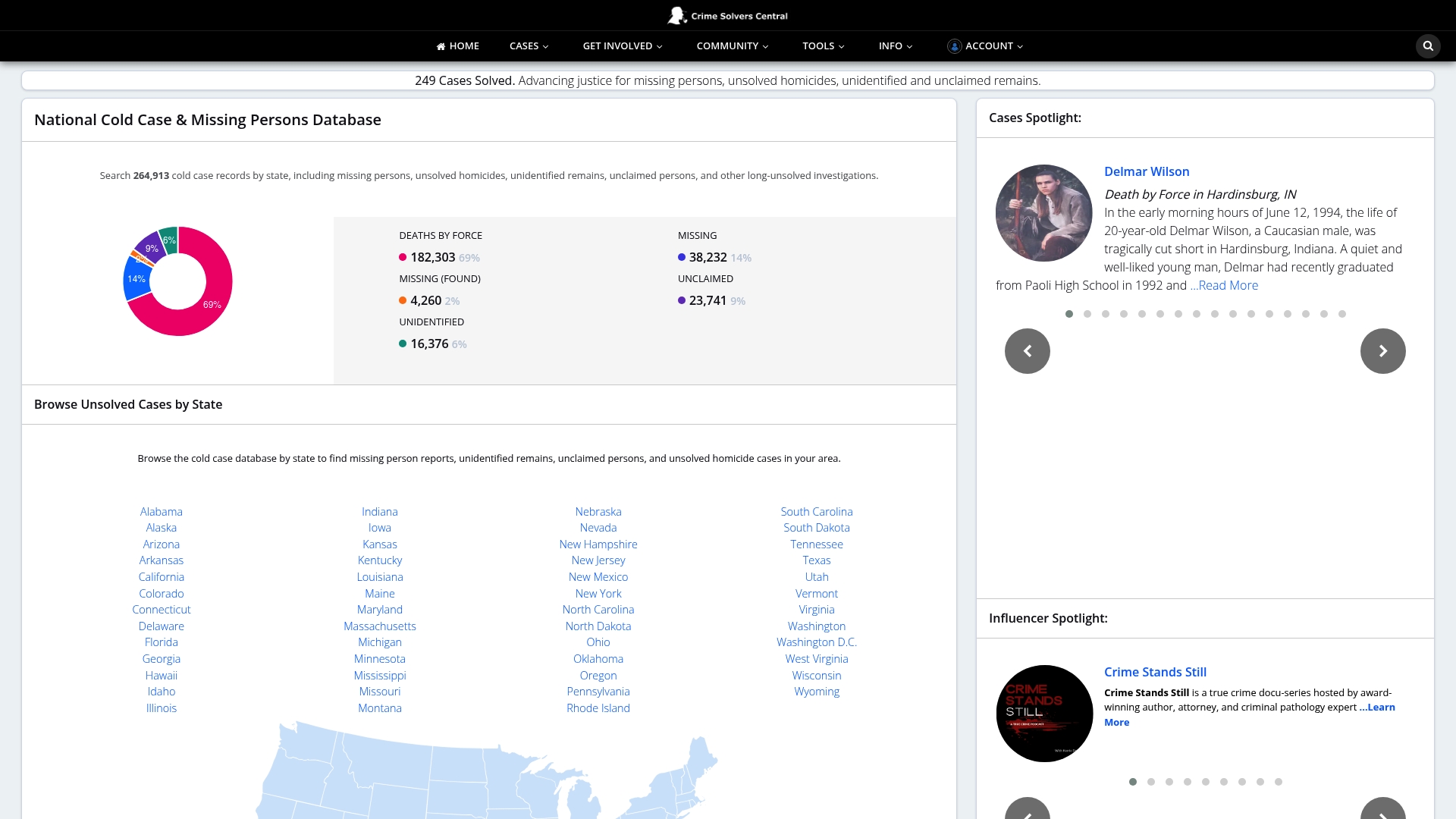
If reading this has made you want to do more than understand the issue, Crimesolverscentral gives you a direct way to act. The platform hosts a national database of over 264,913 cold cases, organized by state and case type, so families, advocates, and concerned citizens can search, track, and stay informed. Whether you are looking for a specific case, trying to understand the scope of unresolved homicides in your region, or looking for ways to contribute to identification efforts, the cold case database is built for exactly that purpose. Public awareness and advocacy are documented drivers of case resolution. Use the tools available.
FAQ
What does “unidentified remains” mean legally?
Unidentified remains refer to human remains found by law enforcement that cannot be matched to a known missing person or confirmed identity. These cases remain open until a positive identification is made through DNA, dental records, or other forensic methods.
How many unidentified persons cases exist in the U.S.?
Estimates place the total at around 14,000 unidentified sets of remains nationwide, with approximately 4,400 currently entered into national databases. The gap between those two numbers reflects how many cases have not yet been formally logged.
Can genetic genealogy really solve old cases?
Yes. Forensic genetic genealogy has resolved cases that were cold for nearly 40 years. It works by matching DNA from unidentified remains to living relatives who have voluntarily submitted their DNA to public genealogy databases.
Why do some missing persons cases get more attention than others?
Research consistently shows that race, socioeconomic status, and media interest shape which cases receive investigative resources and public coverage. This disparity means many victims from marginalized communities remain unidentified longer than others.
What is the most important thing someone can do to help?
Report missing persons immediately without waiting, and if you have a missing family member, submit your own DNA to a public genealogy database flagged for law enforcement use. These two steps have directly contributed to identifications in previously unsolvable cases.