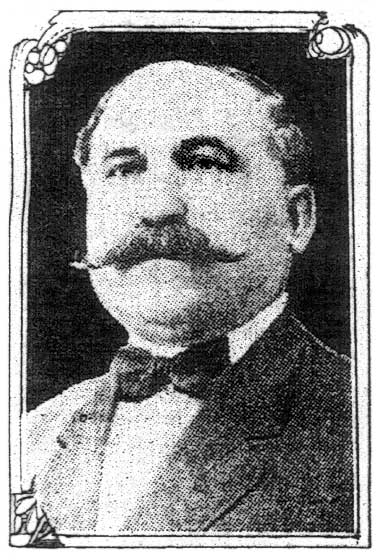
Benjamin Nathan was a man of considerable standing in 19th-century New York City. A successful investor and philanthropist, the 56-year-old male had served as the vice president of the New York Stock Exchange and was a founder of what would become Mount Sinai Hospital. He was also the president of Congregation Shearith Israel, the oldest Jewish congregation in the United States. A husband and father of nine children, he and his family divided their time between a country estate in Morristown, New Jersey, and an elegant four-story brownstone at 12 West 23rd Street in Manhattan, a fashionable neighborhood just steps from the esteemed Fifth Avenue Hotel.
The summer of 1870 was oppressively hot, and the Nathan family was staying in New Jersey to escape the city heat. On July 28, Benjamin made a last-minute decision to stay overnight at the Manhattan townhouse, which was undergoing renovations. He was joined by two of his sons, Frederick, 26, and Washington, 22.
That evening, the brothers went out separately. Frederick returned around 11:15 p.m. and spoke briefly with his father before going to bed. A severe thunderstorm rolled through the city, and Washington returned later, between midnight and 1:00 a.m. He later told police he saw his father sleeping as he passed his room.
The next morning, July 29, 1870, was the anniversary of Benjamin's mother's death, and the sons had planned to accompany their father to the synagogue. Around 6:00 a.m., Washington went to wake his father and made a horrific discovery. Benjamin Nathan was lying dead on the floor in a pool of blood, his head brutally battered. Blood was spattered on the walls and furniture. Washington screamed for his brother, who ran downstairs. Seeing the carnage, Frederick cradled his father's head before the two young men, still in their nightshirts, ran onto the front stoop and frantically summoned a police officer. An investigation determined Nathan had been struck at least fifteen times with a blunt and sharp object. His safe had been opened and rifled through; a gold watch, cash, and three diamond studs were missing.
The investigation, led by Police Chief John Jordan and Chief Detective James J. Kelso, was immediately confounded. Four other people had been in the house that night—Frederick, Washington, a housekeeper, and her son—yet all claimed they heard nothing, despite the violent struggle that had clearly taken place. Neighbors, however, reported hearing bangs and crashes from the Nathan home around 2:00 a.m. Near the front door, investigators found the murder weapon: an 18-inch iron carpenter's "dog," a tool shaped like a large staple, covered in blood and hair. Police questioned the workmen renovating the house, but none claimed the tool.
There were no signs of a forced entry. A patrolman who walked the beat on 23rd Street testified that he had checked the front door at 1:30 a.m. and 4:30 a.m. and found it locked both times. The mystery deepened, becoming one of New York's most famous "locked-room" murders. Public and press speculation quickly focused on Benjamin's son, Washington. Known for his profligate lifestyle of drinking, gambling, and spending, Washington had a contentious relationship with his father. His alibi for the night of the murder included visits to multiple hotel bars, a concert, and nearly three hours at a brothel. Despite the intense scrutiny and a coroner's inquest, no indictment was ever brought against him or anyone else.
The murder of such a prominent citizen caused a sensation. The New York Stock Exchange flew its flag at half-mast. The Mayor of New York and Nathan's widow offered a substantial reward of $30,000 for the killer's arrest and conviction, with the Stock Exchange adding another $10,000. Some theories suggested that Nathan's powerful brother-in-law, Judge Albert Cardozo, a man connected to the infamous Boss Tweed, may have impeded the investigation to prevent family secrets from becoming public.
More than 150 years have passed, and the brutal killing of Benjamin Nathan remains one of New York City's most enduring and mysterious unsolved homicides. No one was ever charged, and the stolen items were never recovered. As of early 2026, the case is officially cold, a dark chapter in the city's Gilded Age history that continues to fascinate historians and true-crime followers alike.