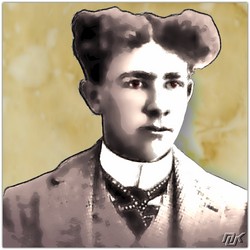
Eugene Butler: The Midnight Rider of Niagara
Overview
In the quiet farming community of Niagara, North Dakota, Eugene Butler was known as a wealthy, eccentric, and deeply troubled recluse. For years, his bizarre behavior culminated in strange, terrifying nighttime rituals that earned him the moniker "The Midnight Rider." But the true depths of his madness remained a secret, buried beneath the floorboards of his isolated farmhouse. Butler died in a state mental hospital in 1913, his dark secrets seemingly taken to the grave.
Two years later, in the summer of 1915, that secret was unearthed. Workmen hired to renovate the old Butler property made a horrifying discovery: a hidden crawlspace containing the skeletal remains of six individuals. An investigation revealed that all six had been bludgeoned to death, their skulls crushed by a sharp, heavy instrument. The victims were never identified, but authorities came to believe they were itinerant farmhands Butler had hired over the years. Because the killer was already dead, no one was ever charged, and the case of the six unknown men remains one of North Dakota's oldest and most disturbing murder mysteries.
Early Life and Background
Eugene Butler was born around 1849 in Royalton, New York, one of three sons of Ephraim and Rebecca Butler. In the early 1880s, drawn by the promise of land, he migrated west to the Dakota Territory. He settled near the newly founded town of Niagara in Grand Forks County, a community established by fellow New Yorkers. There, he acquired a substantial 480-acre farm and, through hard work and shrewd land acquisition, became one of the wealthiest farmers in the region. His property was valued at between $40,000 and $50,000, a fortune equivalent to over a million dollars today.
Despite his financial success, Butler lived a life of profound isolation. He never married and had no children, managing his large farm almost entirely by himself. He was rarely seen by his neighbors, venturing into the nearby town of Larimore only when business required it. His sole interactions were typically with the transient laborers he hired during the busy summer months to help with the farm work. Neighbors who had limited contact with him initially found him odd but harmless. Over time, however, his eccentricity curdled into a severe and frightening paranoia that would ultimately define his legacy.
Descent into Madness
By the turn of the 20th century, Eugene Butler's mental state had deteriorated dramatically. He was plagued by intense paranoia and vivid hallucinations. He frequently spoke of "invisible people" whom he believed were constantly chasing him or attempting to break into his house to steal his money. This fear was not entirely baseless in his mind; it was later discovered he kept a large sum of cash, around $6,000, hidden in his home.
His delusions took on specific forms. He developed a phobia of cameras, convinced that having his photograph taken would steal his soul. He also harbored the bizarre belief that all the local widows and single women were desperately in love with him and plotting to marry him, a notion that reportedly angered him.
Around 1906, his private torment spilled into public view in a terrifying spectacle. Butler began a nightly ritual of riding his horse at full gallop through the dark countryside, screaming wildly into the night. This alarming behavior, which terrified the sleeping residents of Niagara, earned him the nickname "The Midnight Rider." His actions were no longer seen as mere eccentricity but as a public nuisance and a sign of a man who had lost his grip on reality. Eventually, the community had enough, and authorities were forced to intervene. In 1906, Eugene Butler was declared insane and committed to the North Dakota State Hospital for the Insane in Jamestown, about 120 miles from his farm.
Life and Death in the Asylum
At the state hospital, Butler remained under the watch of superintendent Dr. W. M. Hotchkiss. His paranoia and delusions persisted. He often asked nurses and attendants if they could hear people talking about him and remained haunted by the feeling that someone was after him. Some later speculated that this constant fear was not just a symptom of his illness but perhaps a manifestation of guilt over the bodies buried back at his farm.
Despite his profound mental illness, hospital staff did not consider Butler to be violent. Dr. A. W. Guest described him as a man of small stature who was "very gallant." He enjoyed the hospital dances and even developed a deep, though unrequited, infatuation with one of the nurses. Eugene Butler would spend the last seven years of his life within the institution's walls. He died of what were reported as natural causes on October 22, 1913. His body was claimed by relatives and shipped back to New York for burial.
Discovery of the Murders
After Butler's death, his farm and estate were sold. On June 25, 1915, the new owner, Leo Verbulehn, hired workmen to begin renovations on the old farmhouse, which included digging a new cellar. As Verbulehn was digging under the house, he uncovered a cleverly concealed trapdoor in the floor. Prying it open, he peered into a dark, earthen crawlspace. There, to his horror, he found human skeletons.
The Grand Forks County Sheriff's Department was immediately summoned. A full excavation of the area beneath the house revealed a ghastly scene. In total, the remains of six individuals were unearthed from the shallow graves. One body had been placed in the crawlspace through the trapdoor. The other five were found buried together in a separate area, likely interred by removing stones from the foundation wall to access the space from outside.
The cause of death was brutally clear for all six victims: their skulls had been crushed by powerful blows from a sharp object, such as an axe or a spade. The legs of at least two of the victims had been broken, a detail that suggests the killer broke them to make the bodies fit into the cramped, shallow burial site. Investigators found no clothing, buttons, or personal effects with the remains, leading them to conclude that Butler had likely burned the victims' belongings to prevent any chance of identification.
The Victims
To this day, the identities of Eugene Butler's six victims remain unknown. The advanced state of decomposition made it impossible for investigators in 1915 to determine a precise timeline for the murders, though they are estimated to have occurred between 1900 and 1906, the period when Butler's madness was escalating, before his commitment to the asylum.
Initial theories reported in the press varied wildly. One early report suggested the victims were a family—a man, a woman, and three children—killed at one time, with the sixth victim, a male, killed later. Another theory proposed they were Butler's former housekeepers, whom he had complained were costing him too much money. However, as the investigation progressed, authorities concluded that all six skeletons belonged to males. One was determined to be a teenager, estimated to be between 15 and 18 years old.
The most enduring theory is that the victims were itinerant laborers or vagrants. Butler was known to hire such men for seasonal work, and they often traveled alone with few family or social ties. Their disappearances would have easily gone unnoticed and unreported, explaining why no one in the Niagara area had ever filed a missing person report that could be connected to the remains.
In July 1915, a potential lead emerged. A wealthy Minnesota farmer named Leo Urbanski contacted authorities, believing one of the victims might be his brother, John Urbanski (who also used the name John Miller). John had disappeared near Niagara around 1902 while working as a farmhand for a local bachelor. The last letter his family received from him was postmarked from Larimore, the very town where Eugene Butler conducted all his business. Without any personal effects or modern forensic methods, however, the lead could never be confirmed.
- Six Unknown Males — killed between approximately 1900 and 1906 near Niagara, North Dakota. Believed to have been transient farmhands, they were murdered by blunt force trauma to the head and buried in a crawlspace beneath Eugene Butler's farmhouse. Their identities have never been discovered.
Investigation and Aftermath
The discovery of the "murder farm" caused a sensation across North Dakota and the nation. News of the gruesome find drew crowds of more than 150 curious onlookers to the property. In a shocking failure of crime scene preservation, many of these spectators trampled the area and stole bones and fragments from the skeletons as macabre souvenirs. This contamination, coupled with the fact that the original police and case files have been lost or destroyed over the intervening century, has made any modern investigation nearly impossible.
The motive for the killings remains a matter of speculation. The prevailing theory among investigators at the time was that Butler's extreme paranoia was the driving force. Known to be obsessively protective of the cash he kept in his house, he may have murdered the hired hands in a delusional belief that they were plotting to rob him.
Because Eugene Butler was already dead, no charges were ever filed, and the case was never officially closed or solved. The farmhouse where the murders took place was torn down shortly after the discovery, erasing the physical location of the crimes. The collected remains of the six unknown victims were eventually buried together in a local cemetery.
In 2016, more than a century after the discovery, the Grand Forks County Sheriff's Department made a public appeal for information. They specifically asked for the return of any of the bones that had been stolen as souvenirs in 1915, hoping that modern DNA technology could finally give the victims their names back. To date, none have been returned, and the identities of the six men buried beneath the North Dakota prairie remain a silent testament to the dark secrets of the Midnight Rider.