Joseph Kallinger: The Shoemaker Killer
Overview
Joseph Kallinger was a Philadelphia shoemaker who, over a seven-month period in 1974 and 1975, committed a series of burglaries, sexual assaults, and three murders across Pennsylvania, New Jersey, and Maryland. What made his crimes particularly disturbing was the involvement of his adolescent son, Michael, as his accomplice. Kallinger claimed to be acting on divine orders, part of a long history of severe mental illness that was intertwined with a childhood of horrific abuse. His crime spree culminated in a hostage situation in Leonia, New Jersey, that ended in murder and led to his capture. Convicted in both Pennsylvania and New Jersey, he was sentenced to life in prison, where he remained a violent and troubled individual until his death.
Early Life and Background
Joseph Lee Brenner III was born on December 11, 1935, in Philadelphia, Pennsylvania. His father abandoned the family, and his mother, unable to care for him, placed him in foster care shortly after his birth. In October 1939, he was adopted by Stephen and Anna Kallinger, a couple who subjected him to a childhood of unimaginable cruelty. The abuse was both physical and psychological, including severe beatings that led to a hernia at age six, being forced to kneel on jagged rocks, being locked in closets, and being burned with irons. At nine, he was sexually assaulted by a group of older boys.
As a teenager, Kallinger showed signs of rebellion and mental distress. He married his first wife, Hilda Bergman, at 17 and had two children, but the marriage ended due to his domestic violence. He remarried in 1958 and had five more children. Throughout this time, he was in and out of mental institutions for issues including amnesia and attempted suicide. He also began setting fires to his own properties. In 1972, he was arrested for child abuse after three of his children reported his violent punishments, which included branding his daughter with a hot iron. He was diagnosed with paranoid schizophrenia, but after his children recanted their statements, he was released on probation with a mandate for psychiatric treatment that he apparently never received.
The Murders
By mid-1974, Kallinger was reportedly experiencing constant hallucinations, including conversations with a disembodied head he called "Charlie" and receiving orders from God to kill. He enlisted his 13-year-old son, Michael, to join him on what he termed a "divine mission."
The first murder occurred on July 7, 1974. Kallinger and Michael lured 9-year-old Jose Collazo into an abandoned building in Philadelphia. There, the boy was tortured and killed. The murder went unsolved at the time, as there was no obvious link between Kallinger and the victim.
The second victim was Kallinger's own son, 14-year-old Joseph Jr. Kallinger had taken out a large life insurance policy on his sons. On July 28, 1974, after previous failed attempts to kill him, Kallinger and Michael took Joseph Jr. to a demolition site. They chained him to a ladder and lowered him into a flooded basement, where he drowned. Kallinger reported his son as a runaway, and when the body was found weeks later, the cause of death was initially undetermined. The insurance company, suspecting foul play, refused to pay out the claim.
Between the murders, Kallinger and his son Michael embarked on a violent spree of home invasions. Posing as salesmen, they gained entry into homes in Pennsylvania, New Jersey, and Maryland. They would then rob, assault, and sexually abuse the families inside. They terrorized four women during a bridge game in Susquehanna Township, Pennsylvania, and assaulted a woman in Lindenwold, New Jersey.
The final murder took place on January 8, 1975, in Leonia, New Jersey. Kallinger and Michael forced their way into the home of the Romaine family, taking three people hostage. As more friends and family members arrived, they too were bound and terrorized. The eighth person to enter the house was 21-year-old Maria Fasching, a nurse who was visiting a friend. When she resisted Kallinger's orders, he stabbed her repeatedly in the neck and back, killing her. During the chaos, one of the hostages managed to escape and alert the police, but the Kallingers fled before they arrived.
The Victims
- Jose Collazo, 9 — On July 7, 1974, in Philadelphia, he was lured to his death by Kallinger and his son. He was a young neighborhood boy whose life was brutally cut short.
- Joseph Kallinger Jr., 14 — On July 28, 1974, in Philadelphia, he was murdered by his own father and brother. He had previously tried to run away from his father's abuse.
- Maria Fasching, 21 — On January 8, 1975, in Leonia, New Jersey, she was a compassionate nurse visiting a friend when she walked into a hostage situation. She was killed when she bravely refused to comply with her attacker's demands.
Investigation and Capture
The murder of Maria Fasching in the quiet suburb of Leonia sparked an intensive investigation. Police quickly connected the crime to a string of similar home invasions in the tri-state area, all involving a man and a young boy. The key piece of evidence came from the Leonia crime scene: a bloodstained shirt left behind by the killer. A laundry mark on the shirt was traced to Joseph Kallinger. This, combined with eyewitness descriptions of the perpetrators, led police to the Kallinger home in Philadelphia.
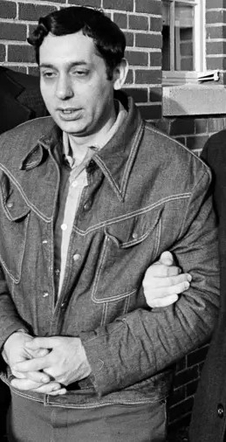
On January 17, 1975, police arrested Joseph Kallinger and his sons Michael and James. James was soon released after it was determined that Michael was the accomplice. Fingerprints found at one of the robbery scenes also matched Kallinger's, which were on file from his 1972 child abuse arrest.
Trial and Sentence
Joseph Kallinger faced trials in two states. In Pennsylvania, he was tried for robbery and other felonies related to the home invasions. His first trial in June 1975 ended in a hung jury. At his retrial in September 1975, he claimed insanity, testifying that God communicated with him and that he was the son of God. The jury deliberated for less than an hour before finding him guilty on all counts. He was sentenced to 30 to 80 years in prison.
In September 1976, Kallinger stood trial in Hackensack, New Jersey, for the murder of Maria Fasching and the Leonia hostage-taking. He again pleaded not guilty by reason of insanity, and his courtroom behavior was erratic, with observers noting he would moan, babble, and jerk his head continually. Prosecutors argued he was faking his symptoms, and psychiatric evaluations concluded he was competent to stand trial and knew right from wrong. On October 14, 1976, the jury found him guilty of murder, kidnapping, and other charges. He was sentenced to life in prison, to be served consecutively with his Pennsylvania sentence.
It was not until years later, after the 1983 publication of the book "The Shoemaker," which was written with his cooperation, that Kallinger was charged with the murders of Jose Collazo and Joseph Jr. He was subsequently convicted and given two more life sentences.
His son, Michael Kallinger, was judged to have been under his father's control. He was sentenced to a reformatory and was released upon turning 21, after which he changed his name and disappeared from public view.
Aftermath and Legacy
Joseph Kallinger remained a danger even while incarcerated. He made several suicide attempts, including setting himself on fire. He also assaulted fellow inmates, at one point slashing another convict's throat, though the victim survived. Due to his violent behavior and mental instability, he was transferred to the Farview State Hospital for the criminally insane. In televised interviews from prison, he expressed a continuing desire to kill everyone on Earth and then himself so he could "become God."
Kallinger's case was detailed in the 1983 bestselling book "The Shoemaker: The Anatomy of a Psychotic" by Flora Rheta Schreiber, the author of "Sybil." The book explored his abusive childhood and delved into the psychological torment that seemingly drove his horrific crimes.
Joseph Kallinger died of heart failure on March 26, 1996, at the State Correctional Institution at Cresson in Pennsylvania. He was 60 years old and had spent the last eleven years of his life on suicide watch. His case remains a chilling study in the cyclical nature of abuse and the complex interplay of trauma and severe mental illness in the making of a serial killer.