Unknown: The Harbor City Serial Killer
Overview
In the first half of 1993, a palpable sense of fear descended upon the working-class neighborhood of Harbor City in Los Angeles. A lone gunman, methodical and brazen, began a series of drive-by shootings that appeared both random and chillingly specific. Over four months, this unidentified assailant targeted four Black men within a tiny, three-block radius. Three of his victims were killed; one miraculously survived to provide the only detailed description of the man who hunted in the shadows.
The killer, described consistently as a white man with reddish hair driving a Jeep, employed a simple, terrifying tactic: he would pull up to his target, beckon him over as if to ask a question, and then open fire with a handgun. The attacks were swift, occurring under the cover of night, and left behind no clues other than shell casings and a community paralyzed by fear. The Los Angeles Police Department launched an intensive investigation, releasing a composite sketch and pleading with the public for information, but the gunman seemed to vanish as quickly as he had appeared. The motive was never established, though the racial component was undeniable. Decades later, the Harbor City serial shootings remain an unsolved and deeply unsettling chapter in Los Angeles's history of violent crime, a cold case that left three families without justice and a neighborhood with scars that have never fully healed.
A Neighborhood on Edge
Harbor City in the early 1990s was a community grappling with many of the same issues plaguing other parts of Los Angeles. Situated in the South Bay region, it was a neighborhood of contrasts, with residential streets existing alongside industrial zones. While not as infamous for gang violence as areas like South-Central, it was by no means immune to crime. Residents were accustomed to the sounds of sirens and the presence of police, but the events of 1993 introduced a new and more insidious kind of terror.
The violence that year was not the familiar, if tragic, result of gang rivalries or drug deals gone wrong. This was different. The attacks were predatory, carried out by an outsider who seemed to select his victims based on their race. This injected a profound sense of vulnerability into the community, particularly for Black men. The killer’s hunting ground was a small, unassuming cluster of streets just south of the Harbor Freeway, an area of modest homes and apartment buildings. It was a place where people knew their neighbors, where children played in the street, and where, for a time, a man in a Jeep became a real-life bogeyman.
The Murders
The killer’s campaign began on the last night of January 1993. On Sunday, January 31, at around 9:00 p.m., Howard L. Campbell, a 32-year-old man, was standing on the sidewalk in front of an apartment building at 1087 West 252nd Street. A Jeep pulled up to the curb. The driver, a white man, called out to Campbell, motioning for him to come closer. As Campbell approached the vehicle, the driver raised a handgun and fired, killing him on the spot before speeding away into the night. The sudden, brutal act shocked residents, but it was initially viewed as another tragic, isolated incident in a city with a high murder rate.
Two weeks later, the killer returned. On Valentine's Day, February 14, at approximately 8:00 p.m., Michael Kevin Meador, 35, was standing in the very same spot where Howard Campbell had been murdered: 1087 West 252nd Street. In a chillingly audacious repeat of the first crime, the man in the Jeep pulled over, summoned his victim, and shot him dead. This second murder at the exact same address transformed the initial shock into widespread alarm. It was now clear to both residents and police that this was not random violence. A pattern was emerging, and a predator was stalking their streets.
The gunman lay dormant for two months, allowing a tense quiet to settle over the neighborhood. But on the evening of Thursday, April 15, he struck again. At around 10:00 p.m., Joseph Alexander Maxwell, 26, was walking near the corner of 254th and McCoy Avenue, just two blocks from the site of the first two killings. The now-familiar Jeep appeared. Maxwell was called over to the vehicle and, like the others, was shot and killed as he approached. Three men were now dead, all Black, all killed in the same manner within the same small geographic area. The police officially had a serial killer on their hands.
The final attack occurred just over a month later and provided investigators with their only living witness. On Saturday, May 22, a 38-year-old man, whose name was withheld by police to protect him, was walking in the 1100 block of West 253rd Street, squarely within the killer's hunting ground. The man in the Jeep pulled alongside him and called him over. But as the victim neared the vehicle, something made him hesitate. The driver opened fire, hitting the man three times. Despite his severe injuries, the man survived. He was able to give detectives their first and only firsthand account of the attacker.
The Victims
The four men targeted by the Harbor City shooter were not connected to one another, sharing only their race and the tragic misfortune of crossing paths with a killer.
- Howard L. Campbell, 32 — The first victim, killed on January 31, 1993. He was a resident of the area, and his murder marked the beginning of the four-month reign of terror.
- Michael Kevin Meador, 35 — Murdered on February 14, 1993. His death at the exact location of the first killing confirmed the fears of a serial predator and sent a wave of panic through the community.
- Joseph Alexander Maxwell, 26 — The third and final fatality, killed on April 15, 1993. He was shot just a short walk from where the other two men had lost their lives.
The fourth man, a 38-year-old who survived the May 22 attack, became the key to the investigation. His courage in speaking with police provided the only hope of identifying the gunman.
Investigation
The investigation was led by the Los Angeles Police Department's South Bureau Homicide Division. Detectives quickly linked the shootings based on the consistent modus operandi, the tight geographic clustering of the crimes, the victimology, and the descriptions of the suspect and his vehicle.
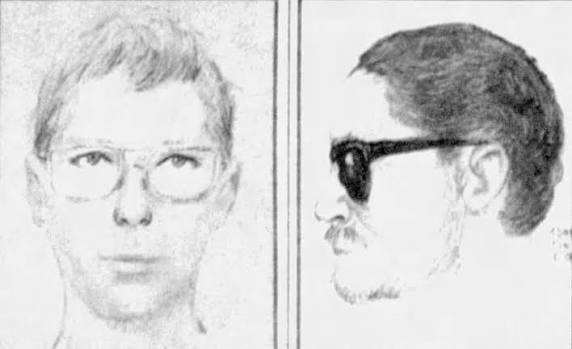
The surviving victim and other witnesses who had seen the vehicle in the area around the time of the shootings provided a remarkably consistent description. The gunman was a white male, estimated to be between 25 and 35 years old, with a fair complexion and distinctive red or reddish-blond hair, sometimes described as collar-length. He was said to have a medium build. His vehicle was identified as a Jeep, possibly a Wrangler or CJ model. Descriptions of its color varied slightly, with witnesses calling it red, maroon, or burgundy, and some noting it had a white or tan soft top.
From this information, an LAPD artist created a composite sketch of the suspect. The drawing, showing a man with sharp features and a full head of hair, was widely circulated to the media and plastered on flyers throughout the South Bay. Police established a 24-hour tip line, hoping the sketch or the description of the Jeep would generate a lead.
Detectives struggled to identify a motive. Robbery was immediately ruled out, as the killer never took anything from his victims. The attacks didn't appear to be related to gangs or narcotics. The most glaring and unavoidable pattern was the race of the victims. All four men targeted were Black. This led police to strongly consider a racial motivation. "It may be a guy who just hates Black people," LAPD Lt. Sergio Robledo told the press in late May 1993. However, without a confession or some form of communication from the killer, detectives were hesitant to officially classify the crimes as hate crimes, leaving the motive as officially undetermined.
The investigation was intense. Police patrols were heavily increased in Harbor City, with both marked and unmarked cars flooding the small neighborhood. Officers were under orders to stop any Jeep matching the description. The community was on high alert. Residents, particularly Black men, were warned not to approach any vehicle whose occupants tried to get their attention. The fear was so acute that one local man told a reporter he had started carrying a gun for protection. "The guys he killed may or may not have been angels," the resident said, "but it looks like he picked them off for no reason and that scares me."
Despite the public appeals, the composite sketch, and the heightened police presence, the investigation stalled. No credible leads emerged. The tip line received calls, but none led to a viable suspect. The gunman and his Jeep seemed to have vanished completely after the fourth attack. There were no more similar shootings in Harbor City or anywhere else in Los Angeles. The trail went cold, and the case, filled with terrifying certainty about the what, where, and how, was left with a permanent and frustrating void where the who and why should have been.
Aftermath and Legacy
The abrupt end to the shooting spree in May 1993 left the Harbor City community in a state of uneasy relief. The immediate terror subsided, but the questions and the fear lingered. The killer was never caught, meaning he was, and may still be, living freely. For the families of Howard Campbell, Michael Meador, and Joseph Maxwell, there was no closure and no justice. Their loved ones were murdered for no discernible reason by a phantom who was never held accountable.
The case of the Harbor City serial shooter serves as a chilling reminder of the vulnerability of a community to a determined, predatory individual. The killer's ability to operate with such brazen confidence—returning to the exact same location for his second murder—and then to simply stop and disappear, is one of the most disturbing aspects of the case. It suggests a level of self-control and criminal cunning that makes him particularly dangerous.
Over the years, the case has faded from public memory, eclipsed by other high-profile crimes in Los Angeles. It remains officially open but inactive within the LAPD's cold case files. Without new evidence, such as a DNA link, a deathbed confession, or a witness finally coming forward, the identity of the man with the red hair and the Jeep is likely to remain a mystery forever. The shootings are a dark footnote in the city's history, a brief but brutal series of crimes that exposed how quickly a sense of safety can be shattered, and how a killer can emerge from the darkness and retreat back into it, leaving only sorrow and unanswered questions in his wake.