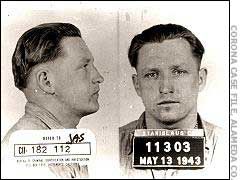
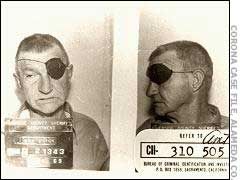
Clarence Hocking, a 53-year-old man, was one of the victims in the series of killings that became known as the Juan Corona murders in Sutter County, California. Although August 22, 1971, has been associated with Hocking in some records, the surviving court record does not support that as his date of death. In People v. Corona, Hocking's murder was charged as having occurred sometime between February 26 and May 12, 1971.
His remains were subsequently discovered on May 27, during the intensive search of orchards and river-bottom land near Yuba City that ultimately uncovered 25 murdered men.
Hocking's death was part of a disturbing pattern investigators were finding repeatedly in shallow graves around orchards along the Feather River. The victims were largely itinerant or seasonal laborers, men who could be offered short-term agricultural work and whose movements were often difficult for relatives or authorities to track. The bodies showed strikingly similar injuries. With only one exception, the victims suffered hacking or chopping wounds to the head, some apparently made with a heavy machete-like weapon. Stab wounds to the upper left chest were another recurring feature, often penetrating the heart, lung, or major blood vessels. The men were also buried in remarkably similar positions, generally on their backs, with clothing pulled over their heads and their arms positioned above or across their bodies.
The evidence connecting Hocking specifically to Juan Vallejo Corona included a significant forensic discovery at Corona's home. Investigators found a post-hole digger in Corona's garage with dried mud and human hair embedded on its blade. Microscopic examination determined that the hair was not Corona's and that portions of it were similar to the head hair of several victims, including Hocking. Some of the hair had an actively growing follicle, indicating that it had been forcibly removed rather than simply shed. Hocking was among the victims named in the murder charges eventually brought against Corona.
The investigation had begun after a landowner noticed a freshly dug, grave-sized hole in a peach orchard in May 1971. When the area was excavated, authorities found the body of Kenneth Whitacre. More graves soon appeared, and what initially seemed to be an isolated homicide rapidly became one of the largest murder investigations in California history. Investigators found bodies on properties where Corona had access through his work as a farm-labor contractor. Corona recruited and supervised itinerant agricultural workers and was known to transport men to orchard jobs, giving him direct access both to potential victims and the isolated areas where the bodies were buried.
As the search expanded, investigators accumulated a large amount of circumstantial and physical evidence. Receipts bearing Corona's name were recovered in connection with the grave sites. Witnesses described seeing his vehicles near areas where bodies were later discovered, and some victims were last seen leaving with him after accepting offers of employment. Searches of Corona's residence, vehicles, garage and work facilities uncovered knives, a bolo-style knife, a pistol, a shovel, bloodstained clothing and extensive human blood evidence. Blood representing multiple blood groups was detected in his vehicles and on various objects. Investigators also recovered a green ledger containing names and dates, including the names of several men who became identified victims, although Hocking was not among the specific victim names listed in the portions of the ledger described by the appellate court.
Corona was arrested at his Yuba City home on May 26, 1971, while investigators were still uncovering bodies. Hocking's remains were among those reportedly found the following day. By June 4, authorities had recovered 25 bodies, four of which could not initially be identified. The scale and consistency of the killings led investigators and prosecutors to conclude that the victims had been murdered by the same perpetrator or perpetrators.
A Sutter County grand jury ultimately returned a 25-count murder indictment against Corona. Hocking's killing was specifically charged as Count XIII. Prosecutors constructed their case largely through the accumulation of physical and circumstantial evidence rather than an eyewitness account of Hocking's murder. The similar injuries and burial methods, Corona's control of or access to the orchard areas, evidence recovered from his vehicles and property, his contacts with several of the victims, and the forensic material found on items including the post-hole digger combined to form the case against him.
Corona went to trial in 1972. The prosecution presented more than 100 witnesses and an extensive body of forensic, documentary and eyewitness evidence. Corona did not testify, and his defense attorney called no witnesses on his behalf. After several days of deliberation, the jury found him guilty of first-degree murder on all 25 counts in January 1973, including the murder of Clarence Hocking. Corona was sentenced to life imprisonment.
The case did not end with that conviction. In 1978, a California appellate court overturned the judgment and granted Corona a new trial, concluding that serious problems with his original representation had deprived him of effective assistance of counsel. Among the issues was his attorney's agreement to obtain literary and dramatic rights to Corona's life story, creating a conflict of interest, together with the attorney's failure to adequately investigate or present potentially available defenses. The reversal did not amount to a finding that Corona was innocent; it required that the prosecution prove the murders again in a new trial.
Corona's second trial took place in Alameda County in 1982. This time his attorneys actively presented an alternative-suspect theory, arguing that Corona's half-brother, Natividad Corona, may have been responsible for the killings. Natividad had previously been accused of a violent machete-like attack on another man and had subsequently gone to Mexico, where he died before the retrial. The defense argued that similarities between the brothers could explain some witness identifications. Prosecutors countered with the extensive physical and circumstantial evidence tying Juan Corona himself to the victims and burial areas. The jury rejected the alternative-suspect theory and again convicted Juan Corona of all 25 murders, including Hocking's.
Following the second conviction, Corona received 25 concurrent life sentences. He repeatedly sought parole but was denied at eight hearings between 1984 and 2016. For much of his imprisonment he either maintained his innocence or said he could not remember the murders. He remained incarcerated for the rest of his life and died of natural causes in an outside hospital while in the custody of California State Prison, Corcoran, on March 4, 2019.
No separate accomplice was convicted in Clarence Hocking's killing. The only person convicted of his murder was Juan Vallejo Corona, and that finding survived the complete retrial of the case. Hocking's death therefore became one count in a prosecution involving 25 men whose disappearances might individually have attracted little attention but whose shallow orchard graves ultimately exposed a sustained series of killings in Sutter County during the spring of 1971.